|
Burial of Sacrificial Objects with the Dead
Burying valuable objects with the dead has been a practice
in China for several thousand years. In addition to gold, silver
and other valuables, burial objects include daily necessities, arts
and crafts, the four treasures of study (writing brush, ink stick,
ink slab and paper), books and paintings, tools of production and
scientific and technological devices, and these have turned many
tombs into priceless underground treasure houses, telling the
vogues of the times. Clothes, hats and ornaments, silk and linen
fabric, bronzes, jades, porcelains and pottery, lacquer-ware and
wood and gold and silver objects were often made for special burial
purposes, thus reflecting fairly well the craftsmanship, life
styles and customs, artistic styles and scientific and
technological levels of the times. As historical evidence,
unearthed cultural relics are more reliable in depicting conditions
of the times, as well as being better preserved than objects handed
down from generation to generation.
Sealed off from air and sunlight and changes of climate,
temperature and humidity for hundreds of years, objects of burial
show little disintegration, remaining almost as they were when they
were placed in the tomb. They are of inestimable historic and
cultural value, especially those from imperial tombs, as the
richest and most precious of all, because they are collections of
the enormous wealth created by the ancient laboring people and
crafted by the wisdom and skills of veteran workers and talented
smithies of the time.
??
Burial of objects, with the dead in imperial tombs, went through
a process of development similar to that of tomb construction.
1) The primitive burial. Early primitives paid little attention
to burial of the dead and even less attention to inclusion of
burial objects. Subsistence societies of the time had few objects
to bury with the dead. Burial of certain survivors and of funeral
objects with the dead were natural development following emergence
of the conscious act of burying the dead.
In burying the bodies of their deceased, it was natural to
include things which had been used by the deceased. Such inclusions
may have had two purposes: first, a tribute to the memory of the
dead, an act of affection; secondly, the acts were the products of
concepts of the soul.
It was thought that when people died they would live in the
nether world in much the same manner as they had lived in this
worldly world and thus would need their working tools, daily
necessities and beloved playthings. In the hope that the dead might
live a more convenient and comfortable life, survivors supplied
them with these amenities as part of a tomb burial.
??
Excavations suggest that burial of sacrificial objects with the
dead started from formation of the primitive clan system. In the
lower levels of the site where the Upper Cave Man lived about 18
thousand years ago, a young woman, a middle-aged woman and an old
man were found buried with cultivating and household tools and
ornaments including flints for lighting fire, stone-made tools and
animal teeth, with holes, used as ornaments.
??
As the clan commune developed into the matrilineal and
patrilineal society, productivity developed and the number and
quality of funeral objects also increased. Burial objects in a tomb
from that time typically include a set of three to five pieces of
pottery for cooking, mixing, water hauling and storing food or
drinking water; a small number of implements; a few ornaments of
bones--hairpins and beads, jade pendants and pottery rings, and
some weapons. Burial objects predated coffins, since no burial
structure was evident by this time.
??
The unearthed sacrificial objects of that period were articles
for daily use though quite limited in number. The kinds, quantity
and quality of funeral objects buried with the dead of one clan are
similar to those found in graves of members of other clans. Since
durable implements such as stone knives were used frequently, they
were seldom buried. From the funeral objects we can judge the
social state and general prosperity of the primitive clan commune
according to the numbers and types of objects found in their
graves.
??
In line with the development of the patrilineal clan commune,
surplus products appeared and divisions into extremes of rich and
poor occurred, measured by the differing ranges of items being
used. The funeral objects reflect differences through the
quantities of implements and exquisite ornaments that symbolized
the individual's ability to accumulate property in his
lifetime.
??
In the neolithic culture tombs at Qingliangang, Yingyangyin to
the north of Nanjing, Jiangsu Province, 70 percent of funeral
objects unearthed were household implements and other precious
articles. One of the tombs contained 12 stoneware items, four
pieces of used pottery, 11 jade and agate ornament pieces, and more
than 20 stone tools.
??
Among the tombs of the Dawenkou Culture site, Tai'an, Shandong
Province, those with rich burial items usually contained 30 to 40
objects, and the richest one had as many as 180. They include
exquisitely painted, black and white potteries, well fashioned
stone and bone tools and intricate ornaments. In some of the tombs,
combs and ivory pots with complex carved designs were found. In
contrast, in tombs of the same period at some other places, only a
few, and even in some cases, no burial objects were found. The
disparity in burial objects reflects divisions into two extremities
of the rich and poor: the slave society was in its embryonic
state.
??
2) Burying the living with the dead and offering sacrifice of
the living. After emergence of classes in the history of human
society, exploited and oppressed people lived a miserable life for
several thousand years. Tragedy appeared continuously and the most
tragic occurred in the slave society. In the slave society slaves
were sold, given as gifts or even slaughtered like animals. The
historic tragedy of slavery is typified in the burying and offering
of live slaves as sacrifices to their dead owners.
??
In a large tomb of the Shang Dynasty (c.16th-1lth centuries BC)
at the Northwest Ridge of Houjia Village, Anyang, Henan Province,
for example, a slave holding a dagger-axe was buried with a dog at
the center of the pit's bottom and eight other slaves, each with a
dog and holding dagger-axes, were distributed to the four corners
of the pit. Once this had been done, the inner and outer coffins of
the slave owner were laid down. Then, at the top of the outer
coffin, weapons and guards of honor were placed. The passages
around the chamber were filled with slave bones. Judging from the
excavation, it appears that a group of slaves were first buried in
a coffin chamber filled with tightly packed earth, leaving an
opening at the southern end.
??
Ten to twenty more slaves with their hands tied behind their
backs were led in a row into the passage, forced to stand in rows
west and east of the coffin chamber and to kneel facing the chamber
where their heads were cut off. These bodies were covered with
earth which was also packed tightly. Their heads were then buried
in outer rows as the bodies had been buried. In this tomb,
altogether 59 bodies without heads in eight rows and 73 heads in 27
groups were discovered. As skeletons and skulls, other bones were
found in scattered and broken conditions it is difficult to
determine how many sacrificial bodies are in the tomb. Most of the
slaves buried in the tomb were youngsters, even small children. In
the Yin Ruins, Anyang, this kind of tragic scene was found in every
imperial tomb; some were buried alive, some were killed before
entombment.
??
Generally speaking, big imperial tombs contain 300 to 400
slaves. In one of the big tombs, Wuguan Village, for example, 41
male and female slaves were buried along the sides of the funeral
chamber, in addition to 52 heads being placed all around. To the
south of the tomb, four rows of burial pits each contains 10
headless skeletons. Altogether there are 152 identifiable
individual bodies.
Besides burial of live slaves with their deceased masters, slave
owners killed many slaves when they offered sacrifices to their
ancestors or gods. For instance one oracle bone inscription records
a ceremony for offering sacrifices. It states that "30 male and 30
female salves are used as sacrifices."
In the tomb grounds of the Yin Ruins at Wuguan Village, nearly
2,000 skeletons were found in 184 pits in 1976, each pit containing
8 to 10 remains. Hundreds of slaves were then cooped up and
victimized as beasts of burden when burial or sacrificial
ceremonies were held.
??
These tragic practices lasted over a thousand years in China and
declined gradually until they ended in the feudal society. During
the Spring and Autumn (770 BC-476 BC) and the Warring States (475
BC-221 BC) periods writers recorded the tragedies.
??
On Control of Burial Ceremony by Mo Tzu states that
"slaves killed as offerings by a king number several hundred; by a
general, gentry or a man of rank, several to a few dozen."
??
3) Funeral objects. Funeral objects are first recorded in the
Rites of the Zhou Dynasty, they are divided mainly into two
categories: Figurines and everyday useful articles or items.
Figurines are made in various shapes, such as figures of human
being, birds and beasts, used articles, houses and weapons.
Everyday, practical items encompasses a wide variety.
??
In the 3,000 years from the later period of the slave society
through the feudal society a set of complicated rites for tomb
burial accumulated and the protocol for funeral objects used in
tomb burials is so varied that comprehensive listings are
difficult.
??
To understand fully the use of funeral objects, one must have a
brief introduction to the origin and development of the figurines
which became very important.
??
Figurines were at first made of wood or other materials in the
shape of human figures to replace the sacrifice of live slaves.
Replacement of live objects by figurines then extended to domestic
animals, birds and beasts, and various articles and wares. The use
of figurines in place of live slaves and animals in burial and
sacrificial ceremonies developed gradually over a long period. In
the beginning, perhaps the later years of the slave society, slave
owners, recognizing that mass slaughter of slaves, oxen and horses
was a waste of resources, started using figurines in their place.
In the Yin Ruins, Anyang, male and female figurines, their hands
fastened with fetters and handcuffs and made of a dark, bluish gray
clay, were found. However, the replacement by figurines did not
develop rapidly. Live burial of slaves and animals continued even
into the time of Confucius (551 BC-479 BC). He hated live sacrifice
but could not accept the replacements, saying "the one who creates
burial figurines will have followers, for the figurines are
remainders of the use of human sacrifices." He also said, "Those
who make figurines are not benevolent.''
??
Many and varied types of materials were used and processed to
make figurines, including fire clay, wood or stone, gold, silver,
bronze and lead. Moreover, many were woven with straw or paper.
During the Spring and Autumn and the Warring States periods most of
the figurines were carved of wood. They had silk clothing, hair
ornaments or hats, and some of them had designs painted on their
bodies. At Jincun Village, Luoyang, Henan Province, metal figurines
have even been found from this period.
??
The terracotta figures unearthed in recent years from the three
pits 1.5 kilometers from the east gate of the outer wall of Emperor
Qin Shi Huang's mausoleum in Lintong, Shaanxi Province, is a major
archaeological discovery. Various life-size warriors, horses and
chariots, exquisitely crafted, are placed in battle array, totally
as many as 10,000 pieces. If these warriors and horses had been
replaced by real, living sacrifices, what a tragedy that would have
been! In contrast to these were more than 200 horses found buffed
alive in a pit in Linzi, Shandong Province.
??
Figurines made in the Han Dynasty are not so big as the
terracotta figures but many and different varieties are fashioned
such as riding and shooting, dancing and acrobatic figurines. In
addition to figurines of humans there are pottery figurines of
houses, towers, wells and kitchens as well as figurines of pigs,
oxen, sheep, dogs, roosters and ducks.
??
"The chief craftsman in the East Garden is responsible for
making articles and wares used in tombs" is recorded in the
"Picture of Officials," History of the Han Dynasty, showing
that the manufacture of figurines and other funeral objects had
become a specialized trade. Three-color glazed figurine making in
the Tang Dynasty reached a summit in the molding art. Most of the
female figurines from that time have full figures, reflecting
appreciation of beauty which prevailed in the flourishing period of
the Tang Dynasty. Many other figurines bear such features as sunken
eyes and high noses, giving the effect of images of central Asians
and Europeans.
??
Besides the figurines mentioned above there have been quite a
number of three-color glazed camels loaded with goods discovered,
reflecting the development of transportation between east and west
in the Tang Dynasty.
??
Patterns and styles of figurines at different times reflect
different social customs and life habits. For instance, this is as
found in a poem of Bai Juyi (772-846), a great poet in the Tang
Dynasty, who wrote in the line "Two eyebrows painted to resemble a
flat '八' (eight) character," which did exist on female figurines of
that time. In Northern and Southern Dynasties (420-589), aesthetic
standards favored the thin, pretty and handsome, reflected in
unearthed figurines.
??
After the Tang Dynasty, funeral objects were replaced by paper
figures for burning, and stone-carved guards of honor appeared.
These were not buffed in tombs but were put at the sides of spirit
paths to the tombs. Funeral objects placed in the tombs shifted to
pearls and jades and functional articles and wares.
??
Of course, the change was not complete. In the tombs of the Ming
Dynasty, pottery figurines of humans and horses were found but they
were fewer than before.
??
Articles of daily use and other wares for funeral objects
appeared after emergence of tomb burial in the primitive society
and the quantity become greater and things used became much more
valuable, splendid and precious as social productivity
developed.
??
Funeral objects found from the Shang and Zhou dynasties mainly
consist of wine vessels, cooking vessels, food containers,
sacrificial vessels and utensils, weapons, tools, and ornaments.
Sacrificial vessels in the Zhou Dynasty were used to indicate the
wealth and social status of the nobility, especially the number of
ding (tripod) and qui food vessels were determined by
the social status. Bronzewares developed to an unprecedented high
level and many bronzewares were made in excellent patterns and rich
decorative designs, used as burial objects and splendid records of
the bronze culture.
China was also known as a country with well-developed silk
weaving. After the Spring and Autumn (770BC-476 BC) and the Warring
States (475BC-221 BC) periods silks fabrics were frequently used as
burial objects. For instance many silk fabrics, embroidered silk
and clothing embroideries unearthed from a Western Han tomb at
Mawangdui, Changsha, are excellently done and in bright colors.
??
Among them is a long gauze gown of light color weighing less
than 50 grams. In Jiangling, Hubei Province, a large quantity of
silk embroidered fabric, bed sheets, quilt and clothes were
unearthed in exquisite design, form and color, dating back to the
Warring States Period. This shows that silk embroidery then had
already reached a high artistic level in China.
??
A large number of lacquer wares were excavated from the tombs of
the Warring States Period and the Western Han Dynasty (206 BC-AD
24), which had formed the main part of burial objects at that time,
marking great achievements in lacquer ware making in ancient times.
Lacquer wares excavated from the tombs of the Warring States Period
at Changguan, Xinyang, Henan Province and those a Western Han tomb
at Mawangdui, Changsha, Hunan Province, are all exquisitely done,
large in size and great in number. Conditions underground are so
suitable for preservation of these wares that they looked as though
they were new when they were dug out.
??
China was regarded as a center for porcelain ware. Its ancient
porcelain wares rank first in the world. Although pottery and
porcelain cannot corrode, they break easily, so few pottery and
porcelain ware pieces have been handed down through generations.
However, a large number of precious pottery and porcelain ware
pieces were well preserved in the ancient tombs, including painted
pottery of the primitive society, big mouth proto-porcelain jars of
the Shang Dynasty, painted pottery of the Han Dynasty, celadons of
the Western (265-316) and the Eastern Jin (317-420) and the
Northern and Southern Dynasties, tri-colored glued pottery of the
Tang Dynasty and the exquisite porcelain wares of the Song, Yuan,
Ming and Qing dynasties. Especially important are the pottery and
porcelain wares of the early periods in history, and nearly all
tombs have produced examples.
??
In addition, of course, the ancient tombs preserved other
burial objects, such as gold, silver, jade stones, pearls, cultural
relics and antiques, inscription tables, stele engravings, bamboo
slips, paintings and calligraphy.
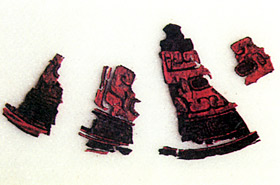
Lacquer fragments excavated from the Yin ruins in
Heber
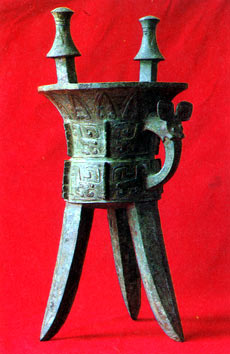
Bronze jia (wine vessel ) of the Yin
Dynasty
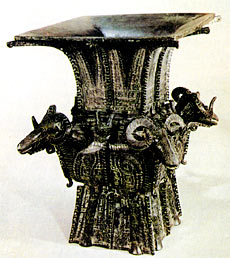
Four-sheep zun of the Shang Dynasty
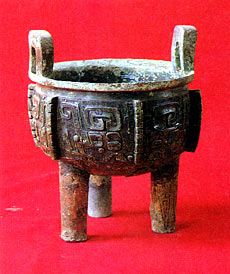
Round ding (three-legged tripod) of the
Zhou Dynasty
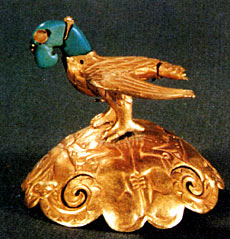
Cold ornaments of the Huns dating from the Warring
States period excavated in Inner Mongolia
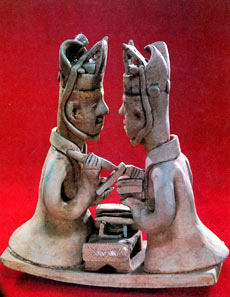
Two-scribe figurine of the Warring States
period
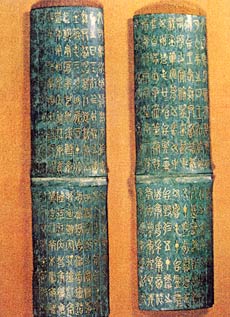
Bamboo tablets representing the power of
Lord?excavated in Hubei
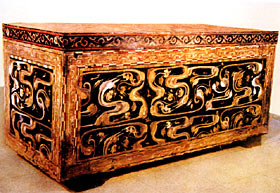
Lacquer coffin of the Western Han excavated at
Mawangdui, Changsha
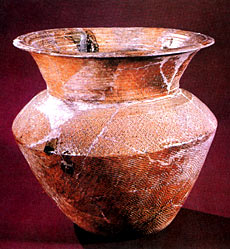
Porcelain jar of the Shang Dynasty
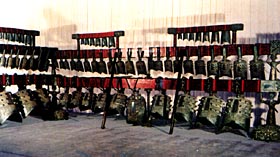
A chime of bells dating from the Sui of the Spring
and Autumn period unearthed at Suizhou, Hubei
|