There are thirteen imperial tombs of the Ming Dynasty scattered
over an area of forty square kilometers in Changping?District
to the northwest of Beijing. Construction of the necropolis spanned
more than two hundred years, almost throughout the entire Ming
Dynasty: The first tomb was built in 1409, and the last one in
1644. There is the magnificent Yanshan Mountain, running from west
to east, encircling the Ming tombs on three sides. The thirteen
Ming Dynasty imperial tombs are Changling of Emperor Cheng Zu (Zhu
Di), Xianling of Emperor Ren Zong (Zhu Gaozhi), Jingling of Emperor
Xuan Zong (Zhu Zhanji), Yuling of Emperor Ying Zong (Zhu Qizhen),
Maoling of Emperor Xian Zong (Zhu Jianshen), Tailing of Emperor
Xiao Zong (Zhu Youtang), Kangling of Emperor Wu Zong (Zhu Houzhao),
Yongling of Emperor Shi Zong (Zhu Houzong), Zhaoling of Emperor Mu
Zong (Zhu Zaihou), Dingling of Emperor Shen Zong (Zhu Yijun),
Qingling of Emperor Guang Zong (Zhu Changluo), Deling of Emperor Xi
Zong (Zhu Youjiao) and Siling of Emperor Si Zong (Zhu Youjian).
?? ?
Origin of the Ming Tombs?The Ming Dynasty was
founded by Zhu Yuanzhang, who made Nanjing his capital, under the
reign title of Hong Wu. He was on the throne for thirty-one years
and was buried in Xiaoling in Nanjing after his death. The second
emperor was Zhu Yunwen, Zhu Yuanzhang's grandson, whose reign title
was Jian Wen during the four years he was on the throne. Zhu
Yunwen's uncle, Zhu Di, the Prince of Yan, who was in Beijing at
that time, sent troops southward to seize the throne for himself.
After a war of several years, Zhu 135 finally occupied the Ming
capital of Nanjing and became emperor. As Zhu Di occupied Nanjing,
the palace was ablaze and Emperor Jian Wen (Zhu Yunwen) disappeared
without a trace. Some say he burned himself, others say he became a
monk. Still, no one knows.
???
After Emperor Cheng Zu (Zhu Di) ascended to the throne in
Nanjing, he changed his reign title to Yong Le. Staying in Beijing
for many years, he had taught Emperor Zhu Di the strategic,
military importance of what is now China's capital dh7. In the 4th
year of the Yong Le reign (1406), one million laborers were sent to
begin building projects in Beijing. In the 5th year of the Yongle
reign, Empress Xu died. Since Emperor Zhu Di did not plan to build
a mausoleum in Nanjing, he sent Zhao Yu, a high official, Liao
Junqing, a diviner, and other people north to choose auspicious
sites for imperial burial grounds.
???
In the 7th year of the Yong Le reign (1409), the burial
grounds were selected. Emperor Zhu Di, in visiting the place
himself, found a vast area with good soil and ringed by hills. Zhu
Di, gratified that his diviners found the signs for this location
agreeable, ordered forty square kilometers in this area dedicated
to the necropolis. Thus construction of the Changling Mausoleum
began.
????
The area chosen as an auspicious site for the imperial
burial grounds was not only beautiful of scenery, but also in an
excellent position from a military perspective as the mountains
provided a natural defense for the area, as well as for the
capital. Changling, built by Emperor Zhu Di at the foot of Tianshou
Mountain in the northern part of present Changping County, was the
first imperial tomb in this area.
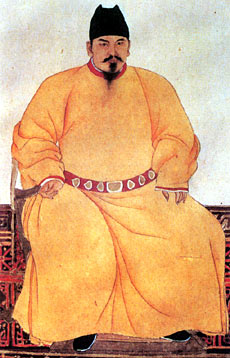
Portrait of Ming Emperor Cheng Zu who was buried
at Changling
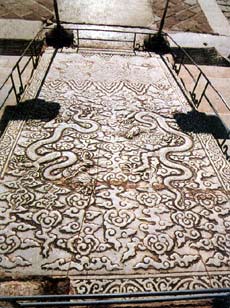
The Hall of Prominent Favor at Changling
Stone ramp caved with dragons sporting in clouds in
bas-relief at the center of the staircase leading to the Hall of
Prominent Favor at Changling
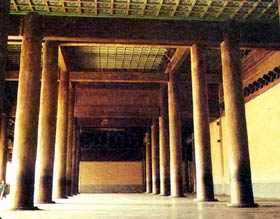
Inside the Hall of Prominent Favor at
Changling
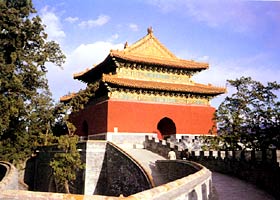
Soul Tower at Changling
???
The last tomb (Siling) was built during the reign of Chong Zhen
(the last emperor of Ming). Thirteen of sixteen Ming emperors were
buffed there, except for Emperor Jing Tai, who was buffed in the
western suburb of Beijing. Therefore, the huge complex is known in
Chinese as Thirteen Ming Tombs.
???
Generally speaking, the scale and grandeur of imperial
mausoleums depend on seniority in imperial families. The scale of
the ancestral mausoleums must be larger than for descendants. The
Thirteen Ming Tombs, however, did not follow that rule. Some
imperial tombs for descendants are larger than those of their
ancestors. After Zhu Yuanzhang, the first emperor of Ming, died, he
was buried in Xiaoling in Nanjing. His son, Emperor Zhu Di, the
emperor who consolidated the reign of Ming, was buried in Changling
in Beijing.
???
The tombs of Emperor Zhu Yuanzhang and Emperor Zhu Di were both
built on a grand scale. Later some imperial tombs of descendants
also reached that scale, as a tomb built during an emperor's
lifetime generally was on the grand scale since tomb construction
was supervised by the emperor. Thus, all the buildings of living
emperors' mausoleums were likely to be tall and magnificent. In
most cases, a mausoleum built by descendants was smaller in scale,
with the buildings roughly built.
???
Emperor Ren Zong, the first son of Emperor Zhu Di, was on the
throne for only one year followed by Emperor Xuan Zong, the first
grandson of Zhu Di, who reigned for ten years. In history, of
course, this period was called the reigns of Emperor Ren Zong and
Emperor Xuan Zong.
???
In fact, however, the two emperors did not make great
contributions to the Ming Dynasty. They mostly enjoyed the fruits
of the work of their predecessors. But they did follow Emperor Zhu
Di and knew how difficult it was to win and keep the throne.
Besides, they knew something about their society, so after they
ascended to the throne, they used manpower and material resources
sparingly and did other beneficial things for the people. The tombs
of the two emperors were comparatively small. Emperor Ren Zong said
in his testament, "I did not make great contributions to Ming and I
can not bear to lay heavy burdens on the people. After my death,
my
mausoleum should be roughly built."
???
After Emperor Ren Zong died, Emperor Xuan Zong, acting on his
father's testament, decided the scale of Xianling. Emperor Xuan
Zong built his own Jingling mausoleum during his lifetime, but the
scale of Jingling was smaller than that of Xianling. The book
Changping's Mountains and Rivers says, "Xianling was
constructed on a small scale; Jingling was even smaller than
Xianling." From the foundation remains of the Soul Tower and high,
castle-like walls, the scale of the two mausoleums can still be
seen. They were both most simply built.
???
After the reign of Emperor Xuan Zong, all succeeding emperors
were raised in the palace in Beijing. They seldom left their
palaces, therefore they knew nothing about how difficult it was to
establish and exercise power. They led dissipated lives, did not
care much about affairs of state, and were accustomed to the
flatteries of officials, though they often refused to listen to
sincere advice offered. They lived in luxury and spent money like
water.
???
According to burial rules and customs during the early Ming, an
imperial mausoleum was for the emperor and the empress. But, after
Emperor Ying Zong died, he and his two consorts were buried in
Yuling. Later, after Emperor Xian Zong died, he and his three
consorts were buried in Maoling. The burial rules and customs had
been broken. This suggests the decadent politics of the middle Ming
and illustrates that emperors led dissipated lives.
??
After Kangling of Emperor Wu Zong, there were Yongling of
Emperor Shi Zong, Zhaoling of Emperor Mu Zong, Dingling of Emperor
Shen Zong, Deling of Emperor Xi Zong and Siling of Emperor Shi
Zong. During this period, politics were more decadent and life in
the palace was more luxurious. Some mausoleums built during this
period were very magnificent. The representative ones are Yongling
and Dingling. Zhaoling and Deling were built after the emperors
died, so the scale of their mausoleums was small. The two
mausoleums, Qingling and Siling, were built for others, but Emperor
Guang Zong and Emperor Si Zong were later buried there.
??
Layout of the Thirteen Ming Tombs?The Thirteen Ming
Tombs in Beijing and Xiaoling Mausoleum in Nanjing have similar
layouts and construction. The spirit path stretches seven
kilometers from south to north across the center of the site to
symbolize the dignity of the emperors.
??
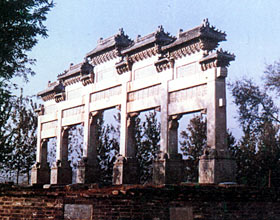
In front of the mausoleum gate is huge marble archway,
built in the 19th year of the Jia Jing reign (1540). The marble
archway, though built some 450 years ago, is still in excellent
condition. It is twenty-nine meters wide, supported by six marble
pillars and has five arches. The massive pedestals are decorated
with relief carvings of dragons and clouds, and on top of each
pedestal squats a stone animal. The archway was built with massive
white marble, and the vivid and exquisite archway carving was
rarely seen during the Ming and Qing dynasties.
Portrait of Ming Emperor Jia Jing
Stone memorial archway at the Ming Tombs
???
One kilometer from the archway is the main Great Palace Gate,
which faces south and has three passage ways, vermilion walls and a
yellow glazed-tile roof. There are tablets on each side of the gate
to enjoin "officials and others dismount here." Prohibitions
relating to the protection of Ming imperial tombs were many and
varied, including a whipping for anyone found collecting wood or
breaking off twigs in the tombs area, execution for anyone found
removing stones or soil, and a hundred lashes with a stick for
anyone entering without official permission. Anyone entering the
area, whether official or citizen, outsider or guard, was required
to dismount a hundred paces before the gate on pain of punishment
for disrespect.
???
Great Palace Gate stands between two hills, Mangshan (Python
Hill) on the east and Huyudan (Tiger Gorge Hill) to the west. All
the emperors were superstitious and were especially keen on
practicing geomancy when they chose burial grounds. Python meant
dragon and Tiger Gorge referred to white tigers. There is an old
saying, "A dragon on the left and a white tiger on the right." The
two hills (a dragon and a tiger) were like two guards beside the
mausoleum gate, making it dear that the location of the Great
Palace Gate was carefully determined. A wall built along the
mountains surrounding the tombs was forty kilometers long. Along it
were ten gateways (Zhongshan, Dongshan, Laojuntang, Xianzhuang,
Hulling, Zhuishi, Yanzi, Desheng, Xishan and Zhazi), each with a
fortress guarded by imperial troops. Most of the wall and buildings
have collapsed but remains can still be seen here and there, giving
some idea of the splendid architecture.
???
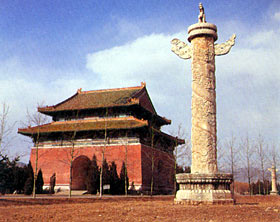
Some distance inside the gate is the tablet pavilion with
a double eave roof and white stone ornamental pillars at each of
the four corners. The four stone ornamental pillars, decorated with
relief carvings, are similar in size and design to those in front
of Tian'anmen Gate tower in Beijing.
Stele pavilion and ornamental pillar
???
Inside the pavilion is a tall stele, about 6.5 meters high,
built for Emperor Cheng Zu. The front of the tablet bears a
3,000-word inscription in the hand of Emperor Ren Zong. The tablet
was named 'Tablet of the Divine Merit and Sage Virtue of Changling
of the Great Ming." On the reverse is inscribed a poem by Emperor
Qian Long of the Qing Dynasty. Inscriptions on two sides of the
tablet talk of renovation of the Ming tombs by emperors Qian Long
and Jia Qing of the Qing Dynasty. The stele rests on the back of a
huge stone tortoise.
?? ?
A fairy tale says, "The dragon had nine sons, one of them was a
tortoise, each having its own interest and special skill. Known for
its powerful physique for carrying a heavy load and its longevity,
the tortoise was regarded highly by people. In slave societies,
slave owners used tortoise shells to practice divination because
tortoise lived a long life and therefore must know many things.
Slave owners would bum tortoise shells and find good or ill luck
according to cracks in the charred shells, inscribing results of
the divination on the tortoise shells." This was the wisdom of
three thousand years ago.
?? ?
According to the book Rites of the Zhou Dynasty (1027
B.C.-256), there were, at that time, guiren, officials
specially assigned to care of tortoises. During memorial
ceremonies, they would tend six tortoises. In the Han Dynasty,
handles of gold seals used by dukes were carved into tortoise
shapes.
??
After Wu Zetian took the throne, she ordered that fish shaped
bags used by officials should be changed into tortoise shaped bags.
In feudal society, the scarlet bird, the xuanwu
(tortoise), the bule dragon and the white tiger were four
divinities. Xuanwu was the embodiment of the tortoise.
?? ?
In the Forbidden City (the former palace of Ming and Qing
dynasties), in front of Taihedian (Hall of Great Harmony), two
bronze tortoises gilded with gold are still in excellent condition.
Thus, it can be seen that the tortoise was highly respected by
ancient people. It was then logical for the stele to rest on the
back of a stone tortoise in the mausoleum because all emperors
called themselves dragons and sons of the Heaven. The tortoise was
one of the sons of the dragon, so it was reasonable to have a son
do something for his father.
???
Tall steles in the mausoleums were usually a dozen meters high.
No ancient Chinese books tell how the stele was lifted to the
tortoise's back, but a Japanese book records a legend about the
stele and the tortoise. It says that as Emperor Cheng Zu was
building a stele for his father Zhu Yuanzhang's mausoleum, workers
found it difficult to put the stele on the back of the huge stone
tortoise.
???
Those in charge of construction worried very much, but one
night, Emperor Cheng Zu had a dream. An immortal said to him: "If
you want to install the stele, the stone tortoise must not see the
stele and the stele must not see the stone tortoise." After he woke
up, he thought about what he had dreamt. Knowing the meaning of
what the immortal had told him, he went to the construction site
and told the workers to cover the stone tortoise with soil. They
then pulled the stele up along the earth slope. When the stele was
upright and in position they removed the soil.
???
It is only a legend, but it is reasonable that the steles in the
Thirteen Ming Tombs might have been erected by this method. It
demonstrates the great intelligence of the laboring people of
ancient times.
?? ?
Inscribed steles were erected in front of the tombs usually to
extol emperor's merits and virtues. But no inscriptions are on the
steles in the front of the Thirteen Ming Tombs. There are a variety
of different explanations. Some say the merits and virtues of the
emperors were too great, difficult for people to write down. The
book The Imperial Mausoleums records Emperor Zhu
Yuanzhang's words: "There are some flatteries in inscriptions
written by officials. They cannot be used to exhort later
generations." After the officials in the imperial academy heard
this, no one would write inscriptions for the mausoleum. From then
on, successors to the emperors shouldered the responsibility for
writing inscriptions. Why, then, did they not write any
inscriptions?
?? ?
According to the True Account of the Shi Zong Period,
construction of the steles and pavilions in Changling, Xianling,
Jingling, Yuling, Maoling, Tailing and Kangling began in the 15th
year of the Jia Jing reign of the Ming Dynasty, lasting six years.
Yan Song, a high-ranking official asked Emperor Shi Zong to write
inscriptions for steles of the seven mausoleums. But Emperor Shi
Zong was a man infatuated with wine and women, and not interested
in writing inscriptions for the steles. Thus, there are no
inscriptions on the steles in the seven mausoleums, setting a
precedent followed by all the successors.
?? ?
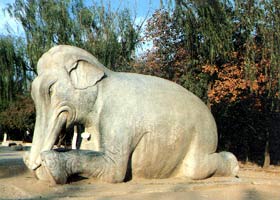
Beyond the stele pavilion is an 8,000-meter-long spirit path.
Along both sides of the path are stone animals and stone human
figures. The procession starts with four lions, four
xiezhai (mythical beasts with a single horn), four
elephants, four qilin and four horses. In each group one
pair is standing and the other kneeling. The human figures are four
military officials, four civil officials and four meritorious
officials. The stone figures are heroically shaped and graphically
carved. The big statues are each carved from a single piece of
white marble and are wonderful ancient art objects. All these stone
carvings were the works in the early Ming Dynasty built more
than five hundred and forty years ago.
Stone animal on the spirit path
Stone elephant on the spirit path
Stone official on the spirit path
Stone general on the spirit path
??
The practice of placing stone animals and human figures in front
of imperial tombs can be traced back at least to the Qin Dynasty
some two thousand years ago as each dynasty has followed the
custom, though varieties and numbers of stone animals and stone
figures differ by dynasty.
?? ?
In the Qing Dynasty, such stone animals as qilin,
pixie (exotic animal with horns), elephants and horses
were placed in front of the tombs. In the Tang Dynasty, lions,
horses, oxen, black birds and stone figures of civil officials and
warriors were favored. In the Northern Song Dynasty, stone animals
--elephants, horses, sheep, tigers, lions, black birds, and stone
figures of civil officials and military officials also were lined
in front of imperial tombs.
?? ?
The placing of stone animals and human figures in the Thirteen
Ming Tombs in Beijing almost followed the pattern of Xiaoling.
In ancient time, stone animals and human figures placed before
imperial tombs symbolized royal power and privilege in addition to
their decorative functions. Stone lions not only were placed before
imperial tombs, but also in front of yamen (a government
office in feudal China). Lions are ferocious animals roaring aloud.
Buddhist scripture says, "All animals will be in great panic at the
approaching of a roaring lion. Stone lions are placed before
imperial tombs in order to avoid evil influence."
??
Xiezhai were mythical, single-horned beasts which
attacked bad people. In ancient time, judges liked to wear hats
made in xiezhai shape, symbolizing an ability to
differentiate between evil and good. Camels and elephants were
important means of transport in desert areas and tropical zones and
qilin symbolized auspicious events.
?? ?
In ancient times, the qilin, phoenix, fish and dragon
were regarded as four important spirits. Horses in good temper were
good at running. Thus, in ancient time, horses were very important
for transportation in people's daily life. Qilin,
xiezhai, horses and lions symbolized royal power and
privilege.
??
The stone human figure was called Weng Zhong. It was said that
in Qin Dynasty, a military official named Ruan Wengzhong was a tall
man of great strength sent to guard Lintao (present Minxian County,
Gansu Province) where he rendered outstanding service against the
Xiongnu (Hun), an ancient ethnic group in China.
????
After he died, Emperor Qin Shi Huang built a bronze statue of
Ruan Wengzhong in commemoration. It was placed in Xianyang Palace
and from then on, bronze or stone statues of humans were called
Weng Zhong. The stone human figures of civil officials and
meritorious officials placed before the tombs symbolized real civil
and military officials guarding the tombs.
??
At the end of the sculpture avenue is the Lattice Gate, also
called the Dragon and Phoenix Gate, consisting of three parallel
small archways. Over the archways are stone carved sparks for
decoration.
?? ?
At the end of the spirit path is a Seven-Arch Stone Bridge,
followed by a zigzag path to Changling tomb. The spirit path built
in Changling times later became the pathway of the entire Ming
necropolis because it connected with other Ming tombs. This is one
of the characteristics of the Ming tombs.
???
Construction of the Thirteen Ming Tombs?The Thirteen
Ming Tombs were all built in the Ming necropolis. Every mausoleum
has architectural characteristics of its own though each was built
at the foot of a mountain.
?? ?
The layout of each mausoleum is different, but the thirteen
tombs still have nearly the same general arrangements. Each
mausoleum, called a "palace," is surrounded by vermilion walls.
Through each "palace" gate is the Gate of Prominent Favor leading
to the Hall of Prominent Favour where sacrifices were offered by
emperors, empresses and officials to the deceased emperors. Of all
the Ming tombs, only the Hall of Prominent Favor in Changling is
still in excellent condition. The hall was constructed throughout
of nanmu (a fine hard-wood). Each large supporting pillar
was made of a single trunk. The pillars are so large they take
three people to encircle hand in hand. This kind of large
nanmu is rarely seen in China.
?? ?
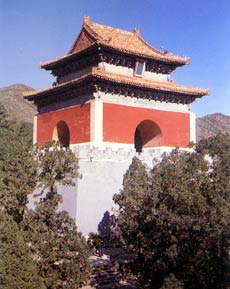
Behind the Hall of Prominent Favor is tomb mound within high
castle-like walls, created by piling yellow earth, where the
emperor and empress were buried. In front of the castle-like wails
stands a small building known as Minglou (Soul Tower), containing
at its center a stele inscribed with the posthumous title of the
emperor. In front of the Soul Tower is a set of five glazed pottery
altar pieces, consisting of two candlesticks, two beakers and an
incense burner.
???
Every mausoleum had special areas near the mausoleum called
jian, yuan and wei. Jian was
the residence area for officials and eunuchs who were in charge of
the offering of sacrifices to the deceased emperor. These areas
have become residential grounds for peasants. Yuan were
for the gardeners who supplied vegetables and fruits for offering
as sacrifices to the deceased emperor. Wei was for the
guards who defended the mausoleum.
??
All halls in the Ming tombs were built with nanmu. The
timber came from the mountains in Yuannan, Guizhou, Sichuan and
other provinces in southwest China. In the Ming Dynasty, special
groups were sent to the south to collect nanmu, called
imperial timber, for construction of imperial palaces and
mausoleums.
???
This kind of tree grew deep in the mountains where searchers had
to walk in groups among the dangerous, uninhabited mountain slopes
where wild beasts would attack and where diseases struck. These
parties braved wind and rain and suffered from cold and hunger and
many lumbermen died in these mountains in pursuit of
nanmu. "One thousand people went to the mountains, but
only five hundred came back" is a saying vividly describing the
fate of the lumbering expeditions.
???
The thinks were so big it was difficult to carry them on the
rugged mountain paths. The lumbermen had to await the rainy season
when torrents of water rushing down the mountain could wash the big
tree trunks down and into the open. Then the timber would be carded
to a river. It took five to six years to transport these logs to
Beijing. Even on the river, as lumbermen shepherded the timber,
they were often engulfed by terrifying waves. Again, many died
along the way and much timber was lost.
??
Bricks used in Ming Tombs were also special. Each brick weighted
about 25 kilograms with the word shou (longevity)
imprinted. Before the Jia Jing reign, the bricks were provided by
local kilns in Beijing. Later, most of the bricks were transported
from Linqing, Shandong. The Imperial Construction Office sent
specialists there to arrange manufacture of the bricks.
?? ?
One million bricks were required each year, each of good
quality, solid and smooth and emitting a clear tone when struck.
The names of brick manufacturers and officials put in charge were
printed on every brick for later check.
???
Large quantifies of stone were also used during construction of
the Thirteen Ming Tombs. Black stone and doucha stone were
used to pave the path and build foundations for walls, bridges and
wharves. The stones were from Beijing suburbs.
??
White marble is as white as snow and as fine and smooth as jade,
and is especially suitable for carving. The massive white marble
door of the underground palace in the Dingling was carved from a
single stone. This type of white marble came from Dashiwu, a
Beijing suburb. The figured stones are very solid. Different
patterns become visible as the stones are polished. The myriad
patterns are very beautiful. The floor of the rare hall of the
underground palace in the Dingling was paved with such patterned
stone.
??
The stone animals, stele, tortoise and corner columns were each
carved from single pieces of stone. At that time it was very
difficult to transport these big stones, not to mention all the
difficulties of quarrying. Between the quarries and the mausoleums
many wells were dug so that during severe winter weather coolies
had water to pour on the ground. Once the ground was frozen, a
special wooden frame (land boat) holding a big stone would be
pulled along the icy strip by one thousand people, moving the boat
a step at a time.
???
The book True Account of the Winter Palace, says, "In
order to build the Tablet of Divine Merit and Sage Virtue, twenty
thousand coolies from eight prefectures were sent to move the huge
white marble, which is 9.9 meters high, 3.3 meters wide and 1.6
meters thick. The huge marble took twenty-eight days to transport
to Beijing. It cost 5,500 kilograms of silver."
???
The Mysterious Underground Palace?In feudal
societies, imperial tombs were tightly sealed because emperors
feared grave robbers; such sealed tombs also made excavations
difficult for modern researchers. Therefore, there are many
mythological stories about the underground palace. To reveal the
secrets of the under-ground palace has been the research goal of
many archaeologists. Chinese archaeologists began excavation of the
underground palace in the Dingling in May, 1956. Because the
Dingling is so large they really did not know how to start the work
on such a huge project.
???
However, they discovered that several layers of outer wall
bricks had collapsed on the southeast side of the grave mound
within high, castle-like walls. The gate of the arched passage
could be seen from the broken wall. Later, some characters, such as
"gate of the passage," "stone passage" and "left passage" were
discovered on the inner side of the walls. These discoveries
provided important leads for excavation of the Dingling.
???
Based on these findings, the first step was to start from the
inner side of the wall. A ditch, 3.5 metres wide and twenty metres
long, was dug facing the gate of the arched passage. A brick
passage way was found, suggesting this passage might lead to the
underground palace. But the ditch was not long, so the whole
passage could not be seen clearly.
???
After further consultation among archaeologists, a zigzag
passage leading to the back side of Minglou (Soul Tower) was found.
Thus the archaeologists decided to dig another ditch, ten meters
wide and thirty meters long from the back side of the Soul Tower
standing before the mound. When they had dug 7.5 meters below
ground level, they found a small stone tablet with sixteen Chinese
characters, telling that the distance from the tablet was sixteen
zhang (nearly 53 meters) to the Jingang Wall and 3.5
zhang (11.5 meters) deep in the ground. This was the
unexpected research bonus. Some guessed the small tablet was the
key to opening the underground palace; others said it was a
guide.
Soul Tower at Dingling
??
The archaeologists, after further consideration of the small
tablet, concluded that the tablet was a guide to finding the palace
for the ancients.
??
Dingling was built in 1590. Emperor Shen Zong and the
empress were buried there in 1620. After it was built, the
underground palace was covered with deep soil. The people in charge
of the tomb construction and later burial of the imperials erected
the tablet as a sign for relocating the underground palace when
needed.
Portrait of Ming Emperor Shang Zong whose remains
were buried at Dingling
?? ?
Following guidance of the small tablet, a third ditch was
dug in the western side and a stone passage sloping down from east
to west was found, with a large wall at he end. Measurement from
the small tablet to the wall showed the same distance as was
inscribed on the tablet, leading to the conclusion that the Jingang
Wall of the underground palace had been found.
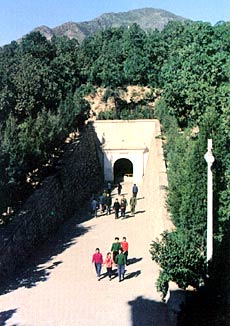
Entrance to Dingling underground palace
???
The Jingang Wall is 8.8 meters high with a roof of yellow
glazed tiles. Careful inspection of the wall disclosed the dim
shape of a door. Twenty-three layers of bricks across the front
wall sealed the door. The bricks were moved out, revealing a square
arched chamber, with an arched stone passage on its east side. In
the center of the west wall of the arched passage, are two white
marble doors, the entrance to the underground palace. The doors
were tightly closed, and could not be pushed open because of a
stone slab against the inside of the doors. To push the stone slab
away without breaking it, archaeologists inserted a lead wire
through the door crack to hook and hold the stone slab while the
doors were pushed open. A wooden slab through the door crack then
eased the stone from the door and, with great effort, the doors
were pushed open. The stone slab had eleven Chinese characters
inscribed: "The underground palace has seven doors." Each panel of
the entrance doors is 3.3 meters high, 1.8 wide and weighs four
tons. Nine lines of engraved knobs are on each huge door
panel.
 |
Dingling underground palace
???
The underground palace consists of five spacious halls: an
antechamber, central hall, rear hall and left and right annexes.
The vaulted halls are built of stone. A stone door stands between
the antechamber and central hall. At the end of the central hall is
the rear hall. On both sides of the central hall are tomb passages
and stone doors opening to the left and right annexes.
Interior of the Dingling underground palace
??
The underground palace occupies a total of 1,195 square meters.
The vaulted halls are built of stone, without a single beam or
column. To avoid damaging the marble floor, the surface from the
antechamber to the rear hall was covered with thick planks for the
hearse to roll on when it entered the underground palace, thick
planks that can still be seen today.
??
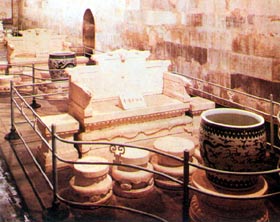
In the central hall are three white marble thrones, arranged
with one in front and the other two on each side and slightly
behind the first. In front of each throne is a set of five glazed
pottery altar-pieces (consisting of two pricket candlesticks, two
beakers and an incense burner), a blue-and-white porcelain jar of
oil, and an "everlasting lamp," a bronze bowl with a wick, floating
on its surface. The lamp was lit when the emperor was buried, but
once the tomb was closed, the flame soon died for want of
oxygen.
??
The two annexes are similar to the antechamber and central hall.
Each contains a white marble dais evidently intended for a coffin.
The rear hall, the largest of the five chambers is the main part of
the underground palace. At the center is a dais on which is placed
the coffin of Emperor Shen Zong (Zhu Yijun), with the coffins
containing the First Empress on his left and the Second Empress on
his right. Each coffin was surrounded by pieces of jade, porcelain
vases and twenty-six red lacquered wooden boxes filled with
precious funeral objects.
??
The archaeologists expected the remains would be enclosed in a
wax coveting, but when the coffin containing Emperor Shen Zong was
opened, only the unprotected skeleton was found, with the hair
still in good condition. The hair was tied in a bun in which there
were several gold hairpins, and some beard was still visible. The
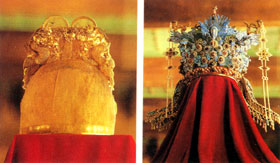
skeleton wore a gold crown, an imperial robe, a jade belt and
boots. The emperor was not tall, one leg was a bit shorter than the
other, and he was a hunch back.
??
Empress Xiao Rui, the First Empress was a native of Yuyao,
Zhejiang. She died in April, I620, at the age of fifty seven.
Emperor Shen Zong survived Empress Xiao Rui by three months.
Empress Xiao Jing, the Second Empress and mother of Emperor Guang
Zong, was native of Xuanhua, Hebei. At first she was a maid in the
palace, who served Emperor Shen Zong's mother. At the age of
seventeen, she won Emperor Shen Zong's favor and became his
concubine. After she gave birth to a son, she became
highest-ranking imperial concubine, and her son later was crown
prince. The emperor's favorite concubine, Zheng, was very jealous
of all this and hated Xiao Jing, seizing any opportunity to do her
harm. Empress Xiao Jing, who died at the age of forty seven, was
first buried in Dongjing, but in October, 1620, her coffin was
moved to Dingling to be buried in the underground palace.
??
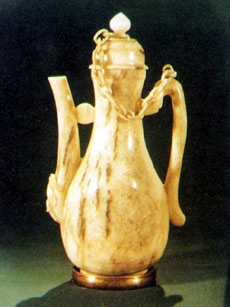
The Dingling tomb contained a very large number of
precious objects buffed with the emperor. About three thousand
burial objects have been excavated, including cloth woven in
beautiful patterns, clothes, small and exquisite gold jewelry, and
exquisite gold, jade and porcelain articles. All these are art
treasures contributing to an understanding of the technology of the
Ming Dynasty.
Gold crown and phoenix coronet unearthed from
Dingling
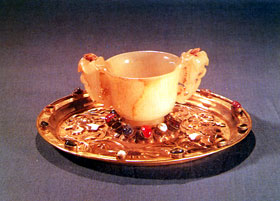
Gold and jade tea set unearthed from Dingling
Jade teapot with a gold holder