An ancient historic and cultural city in China, Nanjing had
served intermittently as the capital of nine dynasties, of which
the Six Dynasties were the earliest.
??
The Six Dynasties included the Eastern Wu and Eastern Jin during
the Three Kingdoms, and the Song, Qi, Liang and Chen during the
Southern Dynasty period. This period was a transitional stage of
unification from the Han to the Tang Dynasty lasting more than 300
years. It was also an important stage in the development of China's
ancient art, and served as a link between past and future.
??
It is over a history of more than 1,000 years that the
mausoleums of the SIX Dynasties, and stone carvings in front of
tombs have been preserved with historical characteristics, systems
and styles of their own. These relics are still a symbol
representing historical and cultural art at that time, and are
attractions for scholars from both home and abroad.
??
Recorded histories show 71 tombs of emperors, princes and
marquises through the Six Dynasties, 31 of which have been
discovered, all located around the area from Nanjing to Danyang in
Jiangsu Province. They include Emperor Liu Yu's Chuning tomb of the
Song Dynasty; Emperor Xiao Chengzhi's Yong'an tomb of Qi; Emperor
Xiao Daocheng's Tai'an tomb of Qi; Emperor Xiao Luan's Xing'an tomb
of Qi, Emperor Xiao Xun Zhi's Jian tomb of Liang; Emperor Xiao Ye's
Xiuling of Liang; Emperor Xiao Gang's Zhuangling of Liang; Emperor
Chen Baxian's Wan'anling of Chen, and Emperor Wen Di's Yongningling
of Chen, and the tombs of many princes and marquises of the Liang
Dynasty, such as Xiao Hong, Xiao Xiu, Xiao Hui, Xiao Jing, Xiao Ji
and Xiao Zhengxuan.
??
In addition, several unidentifiable tombs have been found with
damaged stone inscriptions and stone animals and pillars covered by
earth.
??
Stone inscriptions of these Southern Dynasties tombs scattered
in 31 locations can be divided into two categories -- tombs of
emperors and those of the nobility. Materials from emperors' tombs
have been found in 13 scattered locations. Stone inscriptions in
front of Liang Emperor Xiao Xunzhi's Jian tomb are well
preserved.
??
There are four kinds of stone objects in eight pieces: a pair of
stone beasts, a pair of pillars for the pathway leading to the
grave, a pair of stone tablets and a pair of square stone bases
lying between the stone beasts and the pillars on the path leading
to the grave. Since the structure on the base stones has
disappeared, the shape of the stone carvings it originally held
remains unknown.
??
Remaining stone inscriptions in front of most emperors' tombs
consist only of a pair of stone beasts, with only pieces of a few
surviving. Generally speaking, spirit path pillars and stone
tablets were placed in front of the tombs. However, these stone
carvings either disappeared or were damaged over the centuries.
??
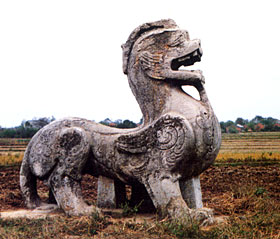
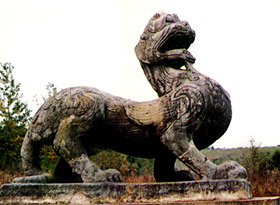
Stone beasts in front of these tombs are almost identical
though some have double horns and some a single horn. Usually,
those located to the left have double horns, while those on the
right are single horned. The single horned beasts were generally
called qilin (Chinese unicorn) and paired with a ferocious
mythical creature with two horns.
Stone unicorn
Stone unicorn
??
Tombs of the nobility are scattered in 18 locations. Inscribed
and carved stones in front of the tomb of Prince Xiao Xiu of Liang,
were well preserved, consisting of eight pieces, a pair of stone
lions, a pair of stone spirit path pillars and four stone tablets.
As for other tombs, most of their stone inscriptions have been
destroyed. Some have only stone lions, or stone pillars and
some
have inscribed stone pillars and stone lions, or even only stone
pillars.
???
Based on stone carvings found at 31 tombs, general rules for
placement of stone carvings usually covered six pieces, that is, an
emperor's tomb would have a pair of stone animals (the ferocious
creature and a Chinese unicorn), a pair of spirit path pillars and
a pair of stone tablets, while tombs of the nobility typically have
a pair of stone lions, a pair of stone pillars on the path leading
to a grave and a pair of stone tablets. Perhaps this placement was
the law for stone carvings at that time. However, some differences
are important. For example, the stone animals erected in front of
emperors' tombs and tombs of the nobility were quite different.
Usually, the ferocious creatures and the Chinese unicorn were
reserved for the emperor's tomb while stone lions were placed in
front of a nobility tomb. Legend has it that the ferocious animal
and the unicorn were spiritual animals whose appearance would
coincide with emergence of a man of high position. Therefore, such
animals could only be used in front of emperors' mausoleums,
indicating the absolute power and dignity of the emperors. The lion
is a beast of prey known as the king of animals. Placement of stone
lions in front of tombs of the nobility speak of the person's great
renown in life. All this was designed to distinguish the nobility
from the humble, a reflection of the feudal system of the time.
??
Among the three carved stone decorations (animals, pillars and
tablets), the animals ranked first, reflecting priority
characteristics of tombs in the Six Dynasties, and were of high
artistic value and quality.
???
Carved with unique skill and artistic exaggeration, the imposing
stone animals are usually large in size, and display a rich
imaginative faculty, quite different from the awkward carved stone
pieces of the Han Dynasty. Stone animals such as the unicorn and
its ferocious companion generally were carved separately from a
single large stone. On most of them, heads were raised with bodies
in repose; some crouched on their heels; some were lifting their
feet, as if to paw the ground, and some were obviously stationary
but straining to move forward. These were traditional forms for
stone beasts after the Eastern Hah Dynasty.
??
However, stone animals in the Six Dynasties were more vigorous
and powerful, exuding life and vitality.
??
The unicorns and ferocious beasts in front of the tomb of Liu
Yu, Emperor Wu Di of the Song Dynasty, are a good example to use
for an explanation. With huge stones carved in a rough-cast way,
the finished animals exhibit a simple and unsophisticated style,
connecting closely with the carving styles of the Han Dynasty.
??
Tombs in the Qi and Liang dynasties were a change from the old,
entrenched awkward style into one of fully developed, vivid shapes,
that leave a deep impression on viewers. Stone animals in front of
the tomb of Emperor Wendi (Chen Qian) appear full of vitality and
very cocky as if they are about to rise into the air in a great
jump. Obviously, these carved stones demonstrate fundamental
changes from the rougher carving practices of the Han Dynasty. This
indicates that the art of stone carving developed from a simple and
unsophisticated style toward a style of strength, vigor and
flexibility. These were important features of stone carvings during
the Southern Dynasties.
?? ?
Pillars on the spirit path to the tomb are tomb pillars unique
to the Six Dynasties. Carving features can be divided into three
pillar parts -- upper, middle and lower. The lower segment of the
pillar has a base of a facing pair of two-homed dragons with pearls
in their mouths, coiled in opposite directions around the pillar to
crossed tails; the middle part is the pillar body which generally
contains carvings of 24 bamboo slip patterns. A few pillars have 28
such patterns. The upper part of the pillar is a rectangular stone
block inscribed with carved characters. Also on the block are
carved dragon designs, rope patterns and robust men and other
relief sculptures. The top is a lotus-shaped round cover on which a
small stone animal similar to those in front of the tomb is placed.
All the elements blend into unity and the pillar is erected between
the huge stone animals and inscribed stone tablets, providing the
impression of height and endurance. Unfortunately, most of the
little stone animals and round covers of the stone pillars leading
to the tomb were damaged except for those of the nobility tombs of
Xiao Jing and Xiao Ji. These two tombs are sufficiently intact to
provide visitors with strong indications of how all the tombs
looked.
?? ?
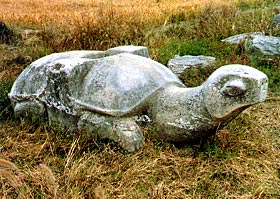
The shape of the inscribed tablets continued in the
patterns established during the Han Dynasty, i.e., an elongated
shape topped by a round head. The tablet's top is decorated in
coiled double dragon designs and the stone horizontal inscribed
block has a round hole while the bottom is a turtle-shaped
base.
Stone turtle
?? ?
There are eight pieces of relief sculpture patterns on the sides
of the stone tablets of Xiao Hong's tomb, featuring gods and
spirits, rare birds and animals. This type of decoration is seldom
seen in relief sculpture art.
?? ?
Special attention was paid to the placement symmetry of stone
objects for tombs of the Southern Dynasties. Not only each kind of
carved stones were to be arranged in a facing formation, but also
shapes of stone animals and even characters on the stone tablets of
the pillars on the path leading to the grave were to be arranged in
symmetry. Such emphasis on symmetric form is typical of carved
stone arrangements in Southern Dynasty tombs.
??
For burial, the Six Dynasties inherited clan burial customs of
the Han Dynasty. During the Song Dynasty in the Southern Dynasty,
individual occupation of mountain forests and river marshes was
affirmed by law. Owing to private ownership of land, burial through
clan practices had become common, and preferred, practice during
the Six Dynasties.
??
Emphasis was given to geomancy and the aura of the tomb
location; usually favoring a site with hills behind and a flat
plain in front. Tomb locations in the Six Dynasties to the south
were all placed on the low slope of a mountain, while the buildings
and other structures, such as carved stones, were all placed on
flat ground. This was the regulation of the time, which affected
directly the burial rules of the Tang, Song, Yuan and Ming
dynasties.
???
After selection of burial location, a rectangular tomb pit was
dug in the mountain slope. To build a tomb pit on the large scale
of the times required a deep cut into the hill, reflecting the
extensive work in building a tomb at that time.
???
A tomb chamber would be built soon after completion of the pit.
According to records and findings, all tombs of the Six Dynasties
were brick chambered, with two characteristics:
???
1) The tomb gates were stone and lintels were semicircular.
Generally, an emperor's tomb had two doors while those for princes
and marquises, one door. 2) A long drainage system was built for
each tomb. One channel started under the chamber inside the tomb,
to drain the structure. An outlet was built into the floor tiles to
drain water from inside the tomb. The drain was into low lying land
or a pond. Taking great care to build a durable, effective system,
long drainage conduit was lined with seven or eight layers of
brick, a feature seldom seen in other tombs in northern China. The
durable pipeline was to accommodate the humid climate of southern
China.
??
Emperors of the Six Dynasties repeatedly warned that grand
burials were strictly forbidden, especially the inclusion of gold
and silver as burial accessories.
???
However, not only were gold and silver articles found in some
damaged tombs of these times, but they are likely to have been very
ornate and costly. This suggests that so-called burial prohibitions
may have been misleading, and even deceitful.
??
The large tombs of the Six Dynasties usually had imposing
door-sealing walls across the broad front and a wind breaking earth
wall. Once the tomb was completed, a sacrifice hall was built and
stone carvings were placed in front of the tomb.
???
After Liberation in 1949, a number of painted brick tombs
containing relief depictions and patterned printing were excavated
in quick succession in Nanjing, Zhengjiang and Danyang. Discovery
of these tombs is an important archaeological achievement for
studying the Wei, Jin, Northern and Southern dynasties. Rich in
content and theme, portraits include gods, monstrous
elephants and blue dragons, white tigers, rosefinches, and
strange animals with bird or human bodies which would, according to
legend, protect the dead. Other portraits depict lions, warriors,
an immortal playing with a dragon, heavenly men and a panoramic
depiction of the pageantry of a royal excursion.
?? ?
In addition, there are paintings in which gods and spirits
reflecting Taoist consciousness are integrated with images
symbolizing Buddhism, such as lotus flowers and rosefinches,
monsters with animal heads and bird bodies with potted lotus and
double lotus patterns.
??
These brick paintings were made by piecing together colored
blocks or tiles, creating mosaic inlays in the tomb chamber.
???
Sometimes, one brick contained a single, small depiction while
larger-sized works were pieced together from dozens or even
hundreds of bricks. Because each tile was cast with a raised
surface appropriate to its place in the work, the art has the
appearance of relief sculptured patterns. Some of the patterns are
precise and minute, appearing to be bent wires and coiled threads,
presenting an extremely elegant appearance, while others are much
more bold in design, becoming a decorative pattern. These treasured
relics provide valuable material for studying the art and thinking,
as well as learning of the customs, of the Southern Dynasty
period.
?? ?
Calligraphy is an art special to China. Since ancient times,
calligraphy and painting have often been mentioned in the same
breath. After unification of characters in the Qin Dynasty (221-207
B.C.), xiaozhuan (small seal character) was changed to
zhengshu (regularized script) and again changed to
lishu (official scrip) in the Han Dynasty (206 B.C.-A.D.
220) for convenience in writing. At that time there appeared the
caoshu (cursive hand). During the Wei (220-265) and Jin
(265-420) dynasties, the character form once again evolved in
kaishu (regular script) and xingshu (running
hand). Many calligraphers appeared in the Qin Dynasty, and many
more during the Wei and Jin dynasties.
?? ?
Notable was Wang Xizhi (321-349), who was known as the "sage
master of calligraphy." Unfortunately, most original manuscripts
have been lost or neglected during the intervening centuries. Those
we see today are mostly carved inscriptions on memorial tablets in
tombs which have been preserved. Thus, carved stones and
inscriptions of tombs from the Southern Dynasty are valuable
materials for studying the art of calligraphy from ancient
times.