






China is a country with many religions, the most popular being Buddhism, Taoism, Islam and Christianity (both Catholicism and Protestantism). Currently, there are more than 100 million religious believers in China, with more than 100,000 sites for religious activities and 3,000-plus national and local religious organizations. Of about 300,000 religious clerics, 200,000 are Buddhist monks and nuns, 25,000 are Taoist monks and nuns, 40,000 are Islamic imams and akhunds (teachers), 4,000 are Catholic clerics and 20,000 are Protestant clerics.
Religious Policy
The Constitution of the People's Republic of China stipulates, "Citizens of the People's Republic of China enjoy freedom of religious belief. No state organ, public organization or individual may compel citizens to believe in, or not to believe in, any religion; nor may they discriminate against citizens who believe in, or do not believe in, any religion. The state protects normal religious activities." Meanwhile, the Constitution also provides, "No one may make use of religion to engage in activities that disrupt public order, impair the health of citizens or interfere with the educational system of the state." Also, "religious bodies and religious affairs are not subject to any foreign domination."
Other Chinese laws also provide stipulations on religious belief, including the Law on Regional Ethnic Autonomy, the General Principles of the Civil Law, the Education Law, the Labor Law, the Compulsory Education Law, the Electoral Law of the National People's Congress and Local People's Congresses, the Organic Law of the Villagers' Committees, and the Advertising Law. Relevant stipulations are: All citizens, regardless of their religious belief, have the right to vote and stand for election; the legal property of religious organizations is protected by law; education and religion are separate and citizens, regardless of their religious belief, have equal chance to receive education according to law; ethnic groups shall respect one another's language, customs and religious belief; citizens shall not be discriminated against in employment because of different religious beliefs; and advertisements and trademarks shall contain no content suggestive of ethnic or religious discrimination.
On March 1, 2005, the Regulations on Religious Affairs promulgated by the State Council went into effect. These regulations were formulated in the form of legal document for the purpose of ensuring the rights of religious groups and citizens who believe in religions to engage in religious activates, establish religious schools, publish religious books and periodicals, manage properties related to religions and conduct outbound religious exchanges. They showcase the Chinese Government's respect for and protection of its citizens' freedom of religious belief, and standardize administration of related departments in accordance of with the rule of law.
In China, all religions share equal status and harmony is maintained among and between religions; religious disputes are never heard of; citizens with and without religious belief respect and get along with one another. The situation is bestowed by the Chinese Government's policy of freedom of religious belief since the founding of the People's Republic in 1949, together with the spirit of compatibility and tolerance that are enshrined in traditional Chinese culture.
Religious Organizations
There are seven national religious organizations in China. They are the Buddhist Association of China, China Taoist Association, Islamic Association of China, Patriotic Association of the Catholic Church in China, Chinese Catholic Bishops College, the Three-Self Patriotic Movement Committee of the Protestant Churches of China and the China Christian Council. All the religious organizations elect leaders and leading bodies according to their own articles of association.
Religious Organizations in China
Name Founding Base Chairperson
Buddhist Association of China May 1953 Beijing Yi Cheng
(Honorary Chairman Paghalha Geleg Namgyai (Tibetan))
China Taoist Association April 1957 Beijing Ren Farong
Islamic Association of China May 1953 Beijing Chen Guangyuan (Hui)
Patriotic Association of the Catholic Church of China July 1957 Beijing Fu Tieshan (dead)
Chinese Catholic Bishops College 1980 Beijing Fu Tieshan (acting, dead)
The Three-Self* Patriotic Movement Committee of the Protestant Churches of China August 1954 Shanghai Ji Jianhong
(Honorary Chairman Ding Guangxun)
China Christian Council October 1980 Shanghai Cao Shengjie (female)
(Honorary Chairman Ding Guangxun)
*Three-Self: Self-administration, self-support and self-propagation
All the religious organizations independently organize religious activities, conduct religious services, run religious schools, and train young religious staff under the protection of the Constitution and the law. Currently, there are 74 religious schools in China, the most popular being the Chinese Institute of Buddhist Studies, the Institute of Islamic Theology, the Chinese Institute of Taoist Studies, the Jinling Union Theological Seminary in Nanjing and the Chinese Catholic Seminary. Chinese religious organizations maintain contacts and exchanges with other religious organizations in more than 70 countries and regions in the world. Religious personnel also play an extensive role in political affairs, with 17,000 of them being deputies to people's congresses and members of committees of the Chinese People's Political Consultative Conference at various levels.
On April 13-16, 2006, the First World Buddhist Forum was held in Hangzhou City and the Putuoshan Mountain in east China's Zhejiang Province. With the theme of "A Harmonious World Begins in the Mind," the forum attracted more than 1,000 participants, including Buddhist leaders, dignitaries and chiefs of major international Buddhist organizations, from 37 countries and regions.
A Chinese religious delegation headed by Chen Guangyuan, President of the Islamic Association of China, in which Ye Xiaowen, Director of the State Administration for Religious Affairs, served as consultant, attended the World Religion Conference in Moscow on July 3-5, 2006. On behalf of the Chinese religious delegation, Ma Yinglin, Vice Chairman of the Chinese Patriotic Catholic Association, Secretary General of the Bishops' Conference of the Catholic Church in China and Bishop of the Catholic Diocese of Kunming, delivered a speech entitled "Working Hard Toward a Harmonious World" at the meeting. Religious leaders from more than 49 countries and regions took part in the event.
On August 26-29, Religions for Peace convened its Eighth World Assembly in Kyoto, Japan. Chen Guangyuan, Vice Chairman of the China Religion and Peace Committee and President of the Islamic Association of China, headed the Chinese delegation consisting of representatives from Chinese religious circle to attend the meeting. Ding Guangxun, Chairman of the China Religion and Peace Committee and Honorary Chairman of the China Christian Council, was elected one of the honorary chairpersons of the World Assembly of Religions for Peace. Pagbalha Geleg Namgyae, Honorary Chairman of the China Religion and Peace Committee and Honorary Chairman Buddhist Association of China, was elected one of the chairpersons of the World Assembly of Religions for Peace.
On September 13, representatives from the Chinese religious circle participated in the Second Congress of the Leaders of World and Traditional Religions in Astana, the capital of Kazakhstan. A declaration issued by the meeting advocated that all religious groups around the world actively conduct dialogues among religions and cultures and oppose terrorism in all forms.
Buddhism
Buddhism was introduced from ancient India around the first century. After long development and evolution, it was divided into Han (Chinese) Buddhism, Tibetan Buddhism (popularly known as Lamaism) and Pali Buddhism (also known as Hinayana, or Lesser Vehicle). Han Buddhism is quite influential among Han people, but because there are no strict rituals and rules for becoming a Buddhist believer, it is hard to produce statistics on the number of believers. Tibetan Buddhism is basically the religion of ethnic minorities such as Tibetan, Mongolian, Yugur, Moinba and Tu, with a total of about 7.6 million believers. Pali Buddhism is basically the religion of such ethnic minorities as Dai, Blang, De'ang and Va, with the number of believers surpassing 1.5 million.
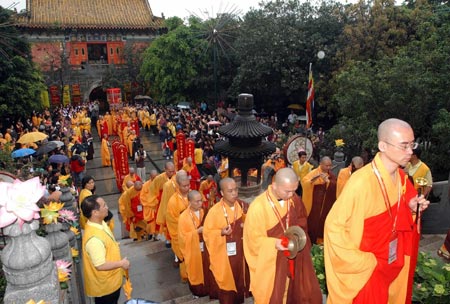 |
Buddhism has had growing Chinese believers since it was introduced from India into China around the first century.
Currently, there are more than 13,000 Buddhist temples with about 200,000 monks and nuns. Of them, Tibetan Buddhism has about 120,000 lamas and nuns, over 1,700 living Buddha and more than 3,000 monasteries. Pali Buddhism has nearly 10,000 monks, nuns and elders, and more than 1,600 temples. In areas inhabited by the Han people, 142 Buddhist temples are under state-level protection.
The three language families of Buddhism have altogether 19 colleges/schools at the primary, secondary and senior levels, including 14 in Han, four in Tibetan and one in Pali. There are Buddhist websites on the Internet, such as China Buddhism Online (www.fjnet) and China Buddhism Information Network (www.buddhism.com.cn).
Taoism
Taoism originated from China in the second century. Characterized by nature worship and ancestral worship, Taoism was historically divided into many sects, which gradually evolved into two major ones—Quanzhen Taoism (Way of Completeness and Truth) and Zhengyi Taoism (Way of Orthodox Unity). Primarily, Taoism is popular among the Han people. As there are no strict rituals and rules for becoming a Taoist, statistics on believers are not available. Currently, there are more than 1,500 Taoist temples in China.
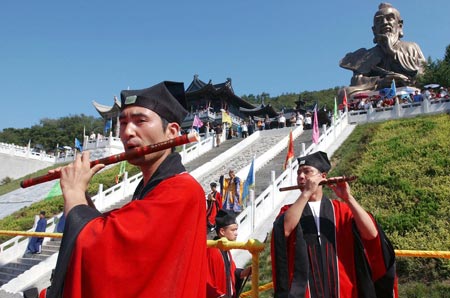 |
Taoism is the only indigenous religion of China, with a history of more than 1,800 years. Pictured is a Taoist ritual.
Islam
Islam was introduced from Arabia in the seventh century. There are two major sects—Sunni and Shiite—with Chinese followers primarily belonging to the former. The vast majority of the 10 ethnic minorities of Hui, Uygur, Tatar, Kirgiz, Kazak, Ozbek, Tajik, Dongxiang, Salar and Bonan, totaling more than 20 million people, are Muslims. Currently, there are more than 30,000 mosques in China.
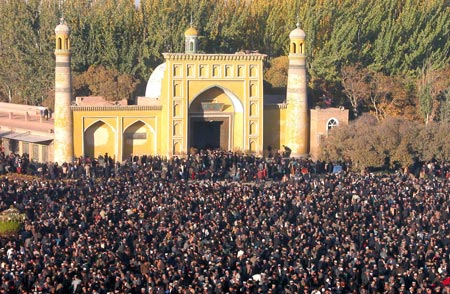 |
Muslims are celebrating the Fast-Breaking Festival in Kashi City in Xinjiang.
Catholicism
Catholicism began to enter into China in the seventh century, but did not get popular until after the First Opium War (1840-42). Currently, Chinese Catholics have 100 dioceses with close to 5 million followers. There are 5,000 churches open to the public throughout the country, together with 12 seminaries. Every year, about 50,000 people are baptized in Catholic churches. Since 1981, Chinese Catholic Church has trained and consecrated more than 1,500 priests. Of them, over 100 have been sent to seminaries in the United States, France, Britain, Belgium, Italy, Germany, the Philippines, the Republic of Korea and other countries, some of them obtaining a Master's or Doctor's degree before returning to China.
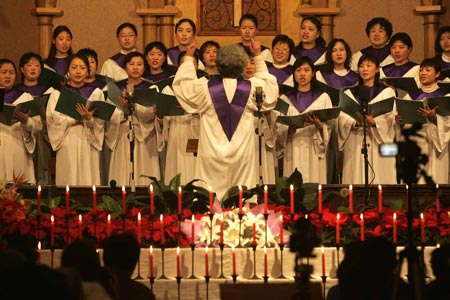 |
Pictured is Chinese Christians in Beijing attending a Christmas Eve candlelight carol service.
The Chinese Catholic Church has its own publishing organs, which have printed more than 3 million copies of The Bible and other kinds of religious works. Influential Catholic churches in the country are St. Mary of the Immaculate Conception Cathedral (Xuanwumen Church) in Beijing, the Church of St. Michael in Qingdao of Shandong Province, the Church of St. Joseph (Xikai Cathedral) in Tianjin, Hongjialou Church in Jinan of Shandong Province and Sheshan Church in Shanghai.
Protestantism
Protestantism was first introduced via Persia as early as 635. However, due to its failure to root itself in Chinese society and culture, it had never achieved significant development and almost disappeared several times. In the 19th century, Protestantism made significant advances into China from the West. In 1950, Chinese Protestants launched the three-self patriotic campaign, which consequently enabled them to be independent through self-administration, self-support and self-propagation. During the Cultural Revolution (1966-76), church activities were suspended. They resumed in 1979, followed by the founding of the China Christian Council in 1980.
Over the past two and a half decades, Protestantism has developed well in China under the leadership of the Three-Self Patriotic Movement Committee of the Protestant Churches of China and the China Christian Council. Approximately 50,000 churches are now open to the public, 70 percent of them being built in recent years. The number of Chinese Protestants has surpassed 16 million, with rural followers accounting for over 70 percent.
At present, there are 18 seminaries and Bible schools throughout the country, and nearly 5,000 graduates are serving in churches or seminaries all over China. The Three-Self Patriotic Movement Committee of the Protestant Churches of China and the China Christian Council have published and distributed approximately 30 million copies of The Bible, 14 million copies of The Psalms (new edition). They also have their own website Chinese Protestant Church (www.chineseprotestantchurch.org.).