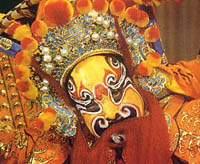
One quaint aspect of Peking Opera is the face paint worn by those in roles categorized as jing, a robust, strong-willed male character.
They paint their faces with thick and flamboyant greasepaint until their original looks are completely unrecognizable. It seems just as if they are wearing brilliantly colored, sometimes sinister-looking masks which are somehow greatly animated by their eyes and muscle movements.
In an article entitled Masks for gods, make-ups for ghosts: The earliest face painting in China that appeared in this year's ninth issue of Literature and Arts Studies, Zhou Huabin, a professor at the Beijing Broadcasting Institute and a noted scholar in the study of traditional opera, leads readers to tracing the history behind this interesting cultural phenomenon.
New origin
There is a widely accepted understanding in Chinese theatrical circles that face painting developed from the masks used in a musical dance called "Lanlingwang (Prince Lanling)" from the Tang Dynasty (AD 618-907).
In the article, however, Zhou suggests a quite different, but equally interesting tradition which might be the origin of jing's make-up.
As the article's title infers, the tradition has something to do with the different perceptions in ancient China regarding gods and ghosts.
Shentou guimian, or "masks for gods, make-ups for ghosts," is an old saying prevalent in the theatrical circles of the Song (960-1279) and Yuan (1271-1368) dynasties. It means to play a god you have to wear a mask, but to play a ghost you can just paint that likeness directly onto your face.
The custom reflected an even more ancient belief of Chinese people: The images of gods are sacred, and it would be a dangerous thing for mortals to mimic them. When ancient craftsmen created the images of gods on sculptures or masks, they would take great pains to execute their jobs well. Some even believed that as soon as the eyes of these sculptures and masks were carved open, the works would assume a certain supernatural power.
On the other hand, ghosts, which were believed to be the embodiments of disease, pestilence, poverty and evil, were generally regarded as hateful and despicable beings by Chinese people.
"As a result, to play the parts of ghosts was considered by ancient Chinese to demand no more effort than just smearing some powder and ink on the performers' faces," says Zhou in the article. "The main principle of the make-up was to make them look ugly."
Before the appearance of commercial theatrical performances in the Song Dynasty, Chinese people played gods and ghosts mostly in rites or activities held to celebrate festivals, remember ancestors, and, what was most often the case, exorcise demons. Masks or ugly make-up worn by the performers in these occasions were sometimes mentioned in historical materials.
In the ancient times of the Shang (c. 16th century-11th century BC) and Zhou (c. 11th century-256 BC) dynasties, people used to evoke a holy beast called Fangxiangshi to exorcise ghosts and drive away pestilence. In the ritual, the man who played Fangxiangshi would wear an extremely ugly mask.
"People believed that, in order to deter the ghosts, a ghost-dispeller must look even more monstrous and macabre than the ghosts themselves. That's why Fangxiangshi wore that famous ugly mask," explained Zhou in the article.
During the Tang Dynasty, the most famous exorcist in Chinese myth was Zhong Kui, whose features are also most notably characterized by extreme ugliness.
Legend has it that Zhong Kui killed himself with indignation in front of the imperial palace when he was unjustly deprived of first place in the civil service exams. Emperor Tangminghuang (AD 712-756 in rule), however, honored him with an imperial burial, and out of gratitude Zhong Kui vowed to free the world of ghosts and demons in his afterlife.
Since Zhong Kui's exorcising service was attached a certain official quality, he often made his appearance in paintings with a rank of subordinates attending him, just like a Chinese feudal official would do. Only in his case, these subordinates are ghosts. In some earlier paintings, these ghost attendants were most often characterized with bestial features.
According to Zhou, the earliest images that bear a close resemblance to the face painting associated with Peking Opera appeared in a painting now at the British Museum in London. The painting is called "Xingdao Tianwang Tu (The Grand Deity Preaches on Road)."
Made some time during the late Tang Dynasty and Five Dynasties (AD 907-960) periods, the painting depicts a grand military god riding on horseback and giving a sermon to peasants who worship him on the road. The god is followed by a retinue of 10 elves.
What is remarkable about the picture is that the faces of the elves are all dabbed with vermilion, and the lines of their features are drawn in a highly exaggerated way.
"The design of their facial make-up is quite similar to the type called the 'three-tile face' of Peking Opera's face painting," says Zhou in the article.
And unlike Zhong Kui's subordinate ghosts, who were often portrayed with strong animal qualities, the 10 elves more closely resemble the human attendants later appearing on stage during the Song and Yuan dynasties.
"The painting shows that in the Tang Dynasty there had already existed the convention of painting the faces of certain characters, such as the ghosts. And that convention might well be the precursor of the face painting used later in traditional opera," says Zhou.
The activities to exorcise demons or to celebrate festivals are mostly performances of postures and motions. They are closer to dance than to drama.
But with the growing numbers of professional actors and performances of commercial theatrical entertainment in the Song Dynasty, the roles of the gods and demons were introduced into drama to be played on stage.
Consequently, masks became a disadvantage for actors to do more profound renditions. And besides, people did not feel it so great a sin to imitate gods on stage as in a temple.
As a result, the "dead face" - as the old theatrical circle called masks - was gradually substituted by the "living face" in the form of face painting.
Opera faces
Unlike the simple effort of casually daubing on faces required in ancient times to play ghosts, the face painting in Peking Opera was painted in accordance with certain set norms and patterns.
In fact, the Chinese name for face painting is lianpu (patterns of faces).
Though those mysterious, intricate facial designs might seem quite baffling to a layman at first sight, a knowing audience can at once tell what kind of personalities they represent.
The colors employed on a jing actor's face, for one thing, are all of symbolic meanings.
For example, red represents royalty and courage, while black is the color for a bold and headstrong character. Blue says the man is shrewd and rebellious, while white symbolizes a treacherous personality. Gold and silver are only used for gods and spirits.
The overall composition of the face painting can also be classified into several patterns.
Chinese physiognomy believes that the shape and configuration of a person's face can betray something about their personality. The overall designs of the face painting in traditional opera are thus distinguished into several types, such as "three-tile face," "six-tenths face," "cross face," "slant face" and "butterfly face" among others, and all are painted in a greatly distorted and exaggerated way.
As for individual facial features, Chinese folk literature has long developed a system of stereotyped remarks to describe the appearances of different characters.
For example, a broad forehead and full chin are inevitably the signature look for the brave and upright protagonist. A full and straight nose, with large round eyes are often used for loyal and courageous vassals.
On the other hand, a crooked nose, a small and protruding mouth, hollow cheeks, or a flecked and beardless face are all deemed as signs for doubtful personalities.
What Peking Opera make-up does is emphasize these signs through outrageous exaggeration.
According to Zhou, for a long time Chinese opera performers used to paint their faces with great liberty for whimsical creation. Only by the late Qing Dynasty (1644-1911) had some widely-accepted norms appeared.
At that time, the imperial court specially established an agency called Shengpingshu (Shengping Agency) to take charge of the affairs of opera performances. Under the requirements of the agency, some imperial painters painted the portraits of the characters, in full make-up and costumes, of up to 200 operas. All these pictures were painted with exquisite strokes to show their full details. The portraits were called "Shengpingshu's patterns of stage make-up," and were widely accepted as authoritative patterns for face painting.
In the early 1900s, books and magazines of traditional opera flourished in China. Some professionals began to engage in collecting the designs of face painting and then sorting them into some regular patterns. From then on, the facial make-up of traditional opera gradually saw a trend of normalization.
(China Daily October 27, 2003)