In September, the
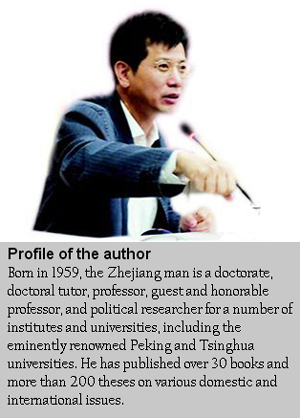
Beijing Daily published an in-depth article by Yu Keping, Deputy Director of the Central Compilation and Translation Bureau. By using academic expressions and convincing proofs, Yu has avidly studied and proved that the process of "reform and opening up" is a practice of continually emancipating the mind, a route for socialist democracy's constant development. Thanks to this emancipation, China can make huge progress in building Chinese-style socialist democracy, and establish its own political model.
The following are excerpts from the article:
Chinese President Hu Jintao, also the General Secretary of the Central Committee of the Communist Party of China (CPC), in a noteworthy speech to provincial and ministerial level officials at the Party School of the CPC Central Committee on June 25, said: "To develop the socialist democracy is the unswerving goal of the Party." So what are the significant achievements in socialist democracy construction, and what are Chinese political trends for the future?
20 years of reform in China has displayed enough proof that the transformation of thoughts and concepts has everything to do with social and political progress. In a certain sense, China's "reform and opening up" is a process whereby old and new ideas clash together, causing the new concepts to win and push forward societal advancement.
As to political theory, these new concepts listed below surpass traditional political concepts, and directly and deeply impact upon China's social and political life, thus strongly promoting Chinese democracy.
"Human-oriented". After 1949, the "human-oriented" concept was severely criticized as "Humanism" and "Anthropologismus" advocated by the Western capitalists. When Chinese people gave up on "Humanism" and "Anthropologismus", they also gave up on the "Human-oriented" concept. The "class struggle" concept started to penetrate every corner of society, including family, factory, and school. Many excellent traditional morals were abandoned; care, friendship, love and trust were lost. Even nostalgic people were perceived as bourgeois and criticized.
In the 1980s, when "reform and opening up" began, some theorists began to advocate the "Humanist value" and the "Human-oriented" concept despite intense political pressure. But things finally changed. In the mid-1990s, "Human-oriented" theory became a strong voice in Chinese thinkers' circle.
In the 21st century, the concept eventually joined the Party's mainstream ideology and became an important theoretical base for CPC's various reforming policies. In early 2007, Hu Jintao once again verified a fundamental Marxist viewpoint; to regard "every individual's free and full development" as the essential goal for human race's ideal society.
"Human rights" suffered a fate similar to "Human-oriented" theory, which led to ignorance for human rights and the shocking consequences – during the notorious Cultural Revolution, there were many violent acts trampling on citizens' human rights. After the mid-1980s, theorists began to call for human rights, actively study Marxist human rights concepts and introduce the West's human rights theories. As usual, they confronted barriers from traditional powers. Despite the difficulties, intellectuals decided to explore human rights theory because they couldn't let go of academic conscience and social responsibility.
At the end of the 20th century and early 21st century, the conception of human rights started to enter the political language system of CPC and Chinese government.
In late 2003, the CPC Central Committee suggested that "protecting citizens' human rights" should be included in the national Constitution. In March 2004, National People's Congress approved the motion, entering it as one of the articles in the Constitution.
"Rule of law". China has an over-2000-year history of "rule by man". One of the most painful lessons learned from the "cultural revolution" was that man should change the social system to "rule by law". After "reform and opening up", the Party and government began to stress the "legal system" and "rule by law". For a very long time, the law was as important as democracy.
In the 1980s, some theoreticians started to advocate the rule of law. The Party and the government paid great attention to this concept from the very beginning. In the mid-1980s, some Party's leaders indicated that even though the CPC is the only ruling Party, it must act inside a legal framework. No Party organization or leader should have any privileges beyond the law.
In the 1990s, the "rule of law" concept started to enter government documents and became a long-term goal for China's political development. At the 15th National Congress of the CPC in 1997, the political report definitely raises the goal of "establishing the socialist country under the rule of law". Soon this goal was written into the Constitution. The CPC's political goal became the national goal. The current government further put forward the requirement of "building up a government under the rule of law", detailing the goal and marking the government's determination to realize this goal.
"Private property". In China's traditional socialist model, public ownership was recognized as the fundamental characteristic of the socialism while the public ownership was simply equated with the state ownership and collective ownership. As a result, private property had not been encouraged for a long time, and even suffered from legal and policy bias.
As the socialist market economic system started to be promoted in China, more and more theoretical workers also started to fight for the legal status of private economy and private property. However, even after 10 years of "reform and opening up", the private economy and private property were still forbidden and/or sensitive theoretical areas for discussion.
Things started to substantially change in the 1990s; the private economy started to surface in the shell of "people-run economy" in theoretical circles, and deeply impacted the government's economic policies. In the late 1990s, the Party and the government began encouraging the "people-run economy" or private economy, as it came to be called. As the new century dawned, theorists started calling for the same status of the private economy and private property as the public economy and public property. This began to influence central decision makers, and eventually evolved into an important government policy.
A typical example: the CPC Central Committee proposed a motion to the National People's Congress in 2003, in order to amend the Constitution. The motion was to make "the nation protects citizens' private property" one of the articles in Constitution and it finally did in 2004.
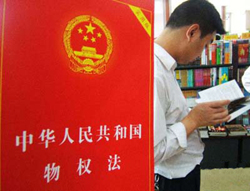
On March 16, the widely discussed Property Law was passed, which clearly states, "The state, collective and private properties are protected by law and must not be violated by any entity and/or individual." It means the country will invest the same effort into protection of citizen's private property as for public property.
"Political civilization." The CPC and the Chinese government put forward basic objectives towards both ethical and material progress in the 1980s. Main implications of material progress are concerned with economic development and main implications of ethical progress are concerned with cultural and educational development. At that time, some theoretical specialists discovered that the two basic objectives didn't include political democracy and therefore were not complete. At the end of 1980s and in the beginning of the 1990s, a few of them proposed that the socialist political civilization should also be included in the basic objectives.
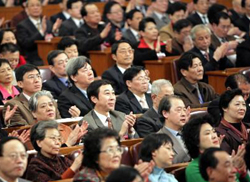 |
These political expressions started entering into the mainstream speaking of the central authorities at the end 1990s.The senior Party leader first mentioned the concept of the socialist political civilization in 2001. In 2002 at the 16th CPC national congress, the socialist political civilization was officially identified as the basic objective of the Party and government together with the material and ethical progress. As matter of fact, pursuing political civilization is equivalent to pursuing democracy and rule of law.
"Civil society". Civil society is actually the sum of civil organizations and civil relations, a civil public space independent of the nation and government. In a sense, it is concomitant with a market economy and an important foundation of democracy. However, "civil society" was once regarded as capitalist society in China. In some people's point of view, advocating "civil society" equals advocating "capitalist society", which is against governmental procedures. But after China adopted the socialist market economy, some scholars started to call for "Chinese-style civil society". Although this subject was actively discussed, it was also politically criticized.
After the "reform and opening up", more and more relatively independent NGOs (Non-government organizations) emerged. Under these circumstances, Chinese academic circles initiated discussions on the subject during the 1990s, resulting in the phenomena that more and more people began to admit and accept the fact that civil society does exist. In June 1998, China's Ministry of Civil Affairs officially changed the name of its department in charge of social organizations into the NGO Bureau, signifying that the government officially approved NGOs.
After the 16th Party congress, the central authorities started paying more attention to the functions of various social organizations including the NGOs, industry organizations and community organizations, and stress the reform and improvement of the country's social management system. This indicated that the Party and the government regarded civil society's existence and functions as a reference point when making important decisions.
"Globalization". In 1990s, not long after globalization became a hot issue in Western academic circles, some Chinese scholars started working on it as well. However, they were confronted with at least two sides of fierce objection and criticism. First, some scholars pointed out that the globalization was a trap set by western capitalist countries, attributing the term as indicating global capitalism. This was a serious political issue in China. Second, even though some scholars were agreeable to globalization study they still believed that there was only economic globalization but not general or political globalization.
Globalization has both advantages and disadvantages; certainly it indicates objective progress for world history and a general transitional progress for all of human history. At first it was believed to be the integration of economics, inevitably impacting human political and cultural life. To the beginning of 21st century, globalization has been transformed from a non-mainstream to mainstream word in the Chinese theoretical community. The concept has become part of a very important theoretical basis for setting up critical internal and external policies in the Chinese government. Actively involved in WTO, the Chinese government is in fact actively involved in globalization.
(To be continued...)
(China.org.cn, 17thcongress.org.cn October 20, 2007)