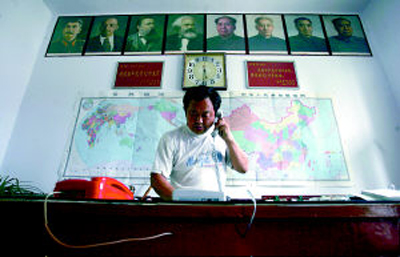
Wu Zhengen goes about his work as he always does. The deputy Party secretary of the fourth production team of Zhoujiazhuang Township in Jinzhou City, Hebei Province, is busy in his office, making phone calls to his team members to confirm their work assignments. Mounted on the wall behind his desk are a map of the world, a quartz clock flanked by two glass frames, and pictures of Communism's eight leading figures: Marx, Engles, Lenin, Stalin, Mao Zedong, Liu Shaoqi, Zhou Enlai and Zhu De.
Liang Jianzhong, head of the fourth production team, is not accustomed to the concept of "independent work". "All the work schedules and assignments are arranged by me," he said. At six o'clock every morning, Liang speaks through a loudspeaker, telling the members of his team who is to do what that day.
Here in Zhoujiazhuang, China's last people's commune, all the land and labor is owned by the township. Such obsolete terms as "work points or scores" and "grain rations", used during the planned economy era, are still very much a part of the village life in Zhoujiazhuang.
Other people's communes moved to the household contract responsibility system as early as 24 years ago, where production and management rights were transferred to farmers under long-term contracts. The farmers till the land and keep all profits earned from the sale of their crops, but pay an annual fee or tax to the government.
Figures for the 2005 fiscal year show that the per capita net income of Zhoujiazhuang villagers was 5,018 yuan (US$632), almost 52 percent higher than the national average of 3,255 yuan (US$412).
While the figures might be in favor of Zhoujiazhuang's collective economy, Lei Zongkui, Party secretary of the township, is fully cognizant of the challenges ahead. "We must do everything possible to boost people's incentive to work," Lei said, adding that he still supports the collective economy despite the inherent problems.
The binding "work point" system
On the afternoon of August 31, the women of the commune were picking cabbages in the vegetable field. Not far away, Zhang Shun and his co-workers from the fourth production team were chatting, tools in hand. They had to wait until the women finished their work before they could set about plowing the field.
Each person does exactly what he/she is assigned to do by the production team leaders. Zhang Shun said if a member of the commune did something not assigned to him/her, he/she wouldn't get the work point.
He said he had become quite used to this kind of management. "How can you pick assignments?" he said, incredulous. For each mu or 0.066 hectare of field he and his co-workers plough, Zhang Shun gets 0.24 work points. If the field is close to where he lives, he gets only 0.22.
All work assignments are convertible into points, which have different rates of cash value. Janitors, drivers, tractor maintenance workers as well as heads of the township and its production teams all get work points for their job, and are able to convert those points into cash at the end of the year.
The cash value of each agricultural work point in 2005 was 35.5 yuan (US$4.4). Zhang Shun got 340 work points for that whole year translating into a net income of 11,000 yuan (US$1,375).
Under this collective economy system, the head of a production team is in charge of everything. He/she plays a crucial role in the power structure. Every spring, it is his/her sole responsibility to draw up the work and assignment plan for the entire year. The commune then reviews all the plans of the different production teams, making changes where necessary, although the changes tend to be minor.
"It's all my responsibility to decide what to plant, and in which field," said Liang Jianzhong, head of the fourth production team. "We have commune representatives in our team; we also have production supervisors. But I appoint them all, and they are usually responsible workers."
Liang has been head of his production team for 22 years. There are 10 production teams managed by the Zhoujiazhuang Agricultural-Industrial-Commercial Cooperative. "These production team heads were all appointed 20 years ago. In recent years, we've only made a few transfers. These were people who we felt were incompetent," said Han Jianming, head of the cooperative.
Lei Jinhe - The man who ensured the Zhoujiazhuang's survival
The late Lei Jinhe played a pivotal role in ensuring the survival of the Zhoujiazhuang people's commune in spite of the adoption in 1982 of the agricultural household contract responsibility system across China's rural areas.
The collective economy is still practiced today in Zhoujiazhuang because the township achieved great economic success under Lei's leadership. It was Lei and his team who initiated the work point management scheme back in 1953.
As a result of Lei's initiative, Zhoujiazhuang recorded a 52 percent increase in productivity in 1954 from the year before. This made the government sit up and take notice.
In 1978, Lei, blessed with keen business acumen, sensed a mushrooming demand for cotton and ordered his commune to increase cotton acreage, so much so that by 1980, Zhoujiazhuang's cotton production was 4.8 times that of 1978.
By the end of 1979, the collective economy of Zhoujiazhuang had a favorable balance of 1.61 million yuan (US$203,669 million) in its account. Again, all government eyes were on this little township.
In 1982, the issue of the household contract responsibility system was discussed.
"Everybody knew we had a strong collective economy, so only a few families agreed to adopt the household contract responsibility system", recalled the 66-year-old Liu Jianzhong. He witnessed those meetings.
There was official pressure, however. The government of Hebei Province was determined to see the system adopted in Zhoujiazhuang. Nonetheless, it is possible that the decision of a central government leader to give the matter "more consideration" was what ultimately saved the commune.
What apparently transpired is that Lei Jinhe went to the then governor of Hebei Province and made this plea: "Just give us one year. If we cannot outperform other townships, we will adopt the household contract responsibility system.”
Lei passed away in 2001.
A prototype of the rural welfare system
A simple yet efficient welfare system has been in place in Zhoujiazhuang for more than 20 years. People in the commune enjoy benefits such as running water. Commune member Liang Minzhi said that education for his 10-year-old son is free. "The welfare the commune provides relieves us of a lot of burdens in life," Liang said. He also believed that the welfare system has made many commune members feel safe.
Free tap water has been provided to every family since 1981. The following year, the commune started handing out allowances to people over 65 years of age. The commune also decided to shoulder the responsibility of caring for widowed and senior folk who live alone.
Liang Minzhi finds life in the commune carefree to some extent, in spite of the mandatory work point system. "You just do the work the production team has arranged for you, and the commune will take care of everything else."
It would seem that farmers from other villages envy the lives that Zhoujiazhuang residents have. Forty-five-year-old Du Qiurong is from an adjacent village. His is a family of four. The family's annual income earned from farming is between 3,000 and 4,000 yuan (US$378-504). After deducting costs and incidental expenses, the family's net income is only slightly over 1,000 yuan (US$126). "That's little money compared with Zhoujiazhuang," Du said.
In addition to higher incomes, there are other perks that only the commune's members enjoy. In 1990, Liang Minzhi set about building his two-story house. All he had to purchase were the construction materials, and the cooperative's construction team built the house for him at no charge. For those who can't afford to buy construction materials, they can take an interest-free loan from a public accumulated fund managed by the cooperative. The cooperative sets aside 500,000 yuan (US$63,000) every year from the fund for this purpose.
"When I am old, I will be given 30 yuan (US$3.8) in living subsidies every month," Liang Minzhi said proudly, adding that he didn't think these benefits are available under the household contract responsibility system.
Industrial income - main source of rural welfare
The main source of the commune's welfare fund is its industrial income, which is ranked the highest in the city.
According to Lei Zongkui, the welfare system is supported by the nine collective enterprises in the township that employs about 4,000 people. Zhoujiazhuang's net agricultural income was only 21.21 million yuan (US$2.68 million) in 2005, "but the net income of our one valve factory reached 25.49 million yuan (US$3.22 million)."
Meng Hua, who works at the valve factory, said that profits are divide among all the staff at the end of the year according to number of work points earned.
After deducting production costs and contributions to the public accumulated fund, the cash value of one hour's work in the factory in 2005 was 2.6 yuan (33 US cents). Having clocked 4,300 hours of work, Meng received over 10,000 yuan (US$1,264) last year, which is also the average annual income of workers at the factory.
In agriculture, however, the 1,400 commune members who do this work earn a reduced yearly income of between 6,000 and 7,000 yuan (US$758-885).
To ensure fairness in assigning work, Lei said that each family has members working in the enterprises and in the fields.
A person assigned to a job that issues low work points would get a better following assignment, according to Feng Pingjun, head of the first production team. Last year, most people earned between 230 and 250 work points for the year. "In fact, we don't have people who are either very poor or very rich."
The commune's enterprises are labor-intensive, and products have little or very low added value. This is an issue that concerns Lei.
In 2005, the city government set a fixed tax quota of 9.496 million yuan (US$1.2 million) per year for Zhoujiazhuang for the 2005-2007 period. The village paid 14.47 million yuan (US$1.83 million) in taxes in 2005, and for 2006, the village has to date paid 16 million yuan (US$2.02 million). Total taxes payable for the year is expected to be 22.14 million yuan (US$2.8 million).
Free economy also allowed
Contrary to the practices of traditional collective economy, free enterprise is allowed in Zhoujiazhuang. Commune members who choose not to be involved in collective work assignments are obliged to make contributions to the public accumulated fund because they are also covered under the welfare system.
The amounts payable per year are: 1,500 yuan (US$190) for a male laborer, and 1,000 yuan (US$126) for a female laborer (women with children under 6 years of age are exempted); 750 yuan for a male laborer aged 56-64, and 500 yuan for a female laborer aged 41-55. Those above these age limits are exempted.
The deal in Zhoujiazhuang is that even if someone has chosen to work outside of the collective economy system, nothing precludes him/her from joining the system at a later time.
31-year-old Peng Qin is a taxi driver. He decided against the collective system upon graduating from high school because he values his freedom of choice. He added that the 1,500 yuan a year he pays to the accumulated fund is well worth that freedom.
Looking ahead
Lei Zongkui acknowledges that the collective economy has its limitations. For one, it is labor-intensive. In addition, it's proving more and more difficult to keep enthusiasm levels up, particularly in the factories.
He is not sure how much longer the commune will survive, but what he knows is that there is plenty of room for improvement.
In terms of keeping morale up, Lei and his team have introduced incentive schemes such as bonus payments for above-quota harvests on vineyards and fruit orchards.
As for the factories, Lei is considering setting up high-tech enterprises and introducing high value-added services in the near future.
"However," Lei said cautiously, "it's not so easy to get a breakthrough here. What we can do for now is to improve the quality of the valves we are producing."
Further, with more people being roped in to industrial production, Lei is thinking of upgrading agricultural tools and machines, and hiring workers from outside the commune to work in the fields.
(China.org.cn by Gu Feng and Xu Lin, October 8, 2006)