Full text of Premier Li's speech at China-Germany Forum
 0 Comment(s)
 Print
Print E-mail Xinhua, June 3, 2017


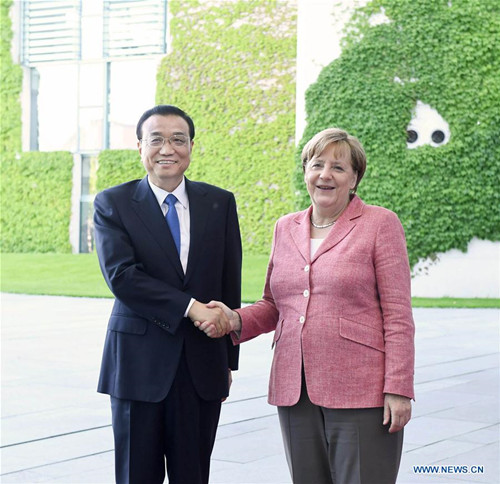 |
| Chinese Premier Li Keqiang (L) attends a welcome ceremony held by German Chancellor Angela Merkel before an annual meeting between the heads of the two countries' governments in Berlin, Germany, May 31, 2017. (Xinhua/Zhang Duo) |
The following is the full text of the speech given by Chinese Premier Li Keqiang at the China-Germany Forum: Shaping Innovation Together:
China and Germany: Building a Golden Partnership on Innovation
Speech by H.E. Li Keqiang
Premier of the State Council of the People's Republic of China
At the China-Germany Forum: Shaping Innovation Together
Berlin, 1 June 2017
Chancellor Merkel,
Ladies and Gentlemen,
Friends,
It is a great pleasure to meet you in the beautiful city of Berlin. Boasting a time-honored history, the dynamism of a modern metropolis and the reputation as the European capital of innovation, Berlin provides a fitting venue for the China-Germany Forum on innovation. I am sure our discussions here will trigger and foster new inspirations, new ideas and new business opportunities. On behalf of the Chinese government, I wish to congratulate you on the success of the forum and pay tribute to all those who have worked for friendship and cooperation between our countries.
During my visit to Germany three years ago, our two countries issued a joint program of action on cooperation, with the theme of shaping innovation together. It is so far the most substantial joint document and the master plan on mid- to long-term innovation cooperation between our two countries. We Chinese often say, three years is a natural cycle for making real progress. Over the past three years, with the concerted efforts of people from all sectors, China-Germany innovation cooperation has taken solid steps. The competent departments of our two countries respectively issued the China Strategy and Germany Strategy, which is the first of its kind for science and technology cooperation between major countries.
We jointly built the first "Industry 4.0" demonstration production line in Shenyang, a concrete result of cooperation between "Made in China 2025" and "Industry 4.0." Metro trains jointly developed by CRRC and Siemens are sold to the United States, Brazil and other countries, showing the dynamism of China-Germany cooperation in third countries. Our research institutes and companies have created the "2+2" cooperation model, building a bridge connecting research findings with market application. Sino-German industrial parks in Shenyang, Qingdao, Wuhu, Jieyang and Taicang, each with its distinctive features, have emerged as the front-runners of our innovation cooperation.
Strong partnership for innovation has provided a powerful engine for China-Germany practical cooperation. In recent years, despite sluggish global trade, trade between China and Germany has been stable overall. According to German statistics, our two-way trade reached 170 billion euros last year. For the first time, China has become Germany's largest trading partner, and Germany now accounts for 30 percent of total China-EU trade. The technological content and added value in our trade have been steadily increasing. About 80 percent of German exports to China are mechanical and electrical products and chemical products, and two thirds of German imports from China are mechanical and electrical products.
Investment cooperation between the two countries has moved from a one-way street onto a two-way lane. German companies still see China as a key destination for investment, with their investment in China growing by 74 percent in 2016. Investment by Chinese companies in Germany has been fast expanding, exceeding 10 billion U.S. dollars in accumulative terms. Our personnel exchange has increased. There are more than 45,000 Chinese students in Germany, and over 30,000 experts and 8,000 students from Germany in China. It is fair to say that China-Germany innovation cooperation has become an example of cooperation between a developing country and a developed country, playing a pivotal role in China-EU cooperation on innovation.
The global economic landscape has been undergoing deep readjustment. A new round of scientific and technological revolution and industrial transformation are in the making. This has presented unprecedented opportunities for innovation cooperation among countries. Germany excels in basic research, technology, invention and workmanship, and is well-known for being an innovation powerhouse. China, on its part, has a big market, abundant human resources, full-fledged industrial system and fast-growing Internet economy, which provide unique advantages in innovation. Such a strong complementarity in innovation resources has made our two countries natural partners. China is ready to enhance its golden partnership on innovation with Germany to multiply knowledge, added value and innovation efficiency through cooperation and boost our all-round cooperation with an upgraded innovation partnership.
We need to strengthen strategic guidance and steer our innovation cooperation along the right course. China-Germany innovation cooperation is not limited to science and technology, but also runs through cooperation in economic, social, cultural, ecological and security fields. We need to maintain close high-level exchanges, cement political mutual trust, and fully leverage the leading role of our inter-governmental consultation and other high-level dialogue mechanisms to ensure that our innovation cooperation continues to move in the right direction.
Next month, President Xi Jinping will visit Germany and attend the G20 Hamburg Summit. This will be an important opportunity to deepen our all-round strategic partnership and elevate innovation cooperation. We should speed up efforts to synergize our development strategies, namely, China's innovation-driven development strategy, "Made in China 2025" and "Internet plus" and Germany's "Industry 4.0" and High-Tech Strategy, and roll out more pilot projects. We should also enhance strategic coordination between China's Belt and Road Initiative and Germany's global development initiative, share major development opportunities and jointly tackle global challenges.
We need to follow a market-oriented approach and lay out a roadmap for innovation cooperation. Only when innovation is geared toward diverse market needs can it enjoy vast possibilities. China is ready to work with Germany to strengthen cooperation platforms in such areas as electric vehicles, clean water, future city and semiconductor illumination, and introduce new models for business development to better respond to ever higher consumer demands. In emerging sectors such as artificial intelligence, biotechnology, the Internet of Things and new-generation information technologies, we will encourage the "2+2" model for international cooperation and speed up the efforts of applied research, and the transfer and application of technologies to better serve the needs of industrial upgrading.
In areas where we each have our comparative strengths, such as automobile, rail transport, infrastructure and agriculture, we need to enhance cooperation in R&D, production and manufacturing, promote the harmonization and mutual recognition of standards and jointly explore third-party markets. Basic research is the foundation of applied research. China is ready to learn from Germany's experience in basic research and encourage greater cooperation among universities and research institutes of our two countries with a view to producing a number of research outcomes with visible impact in frontier areas.
We need to promote integrated innovation of large, medium-sized and small enterprises and reshape the "ecosystem" for innovation cooperation. We should not just focus on innovation cooperation among large companies but also endeavor to promote cooperation among SMEs and integrated innovation among companies of different sizes. China and Germany both have "flagship" companies that are the backbone of their industries, but also countless SMEs spread across all sectors. Germany has some 1,300 "hidden champion" companies, which account for almost half of the world's total. China also has hundreds of thousands of high-tech SMEs, and a booming nationwide campaign of entrepreneurship and innovation.
Companies of different sizes each have their unique advantages for innovation. While big companies are strong in technology, capital and scaled production, the strengths of SMEs come from their innovative ideas, flexible business operation and sensitivity to the market. In the past, innovation cooperation was mostly conducted between big companies, and SMEs were mainly responsible for providing components or specialized services for big companies. This is a model of subordinate collaboration. Now, SMEs and big companies are engaged in two-way and equal cooperation on innovation. Through the Internet and other information platforms, many SMEs can now provide big companies with services covering the whole industrial chain, from R&D, production to management. This is a relationship of interconnected and integrated innovation. This new model and new trend of cooperation promises broad prospect.
China is ready to work with Germany to set up a government mechanism for SME cooperation, and promote networked and clustered innovation cooperation. We will build more service platforms for integrated innovation, and provide all-round services in policy consulting, training of professionals, project implementation, supply-demand matching and funding support. We will speed up the building of various types of Sino-German industrial clusters, and set up demonstration bases for integrated innovation of large, medium-sized and small enterprises.
We need to foster a free and open environment for trade and investment, and gear up innovation cooperation. Innovation of our age is open in nature. Trade liberalization and investment facilitation are as important to innovation as fresh air is to human beings. China and Germany have both contributed to and benefited from economic globalization. We both stand for free trade. China has always approached trade issues from an overall and long-term perspective. China has a long-standing trade deficit in both goods and services with Germany, and we hope to see more balanced trade between the two countries. Yet, we don't think this shall be achieved through trade protectionism. Rather, we should expand our trade by opening our markets to each other, and address the issue of trade imbalance in the course of development. We encourage more imports of quality German goods and welcome German investment in China. We want to promote mutual openness on an equal footing with Germany and all other EU members and create a more friendly and fair environment for bilateral cooperation on innovation. We also hope that Germany and other EU members will loosen restrictions on high-tech exports to China, and provide Chinese companies with equal treatment in investment review and greater visa facilitation.
We need to strengthen policy support to boost China-Germany innovation cooperation. The flame of innovation needs to be fueled by sound policies. China stands ready to work with Germany to consolidate diplomatic, economic, industrial and scientific resources, step up input from public sources and improve bilateral funding mechanisms. The China Development Bank will launch the second phase of the special loan scheme for Chinese and German SMEs. China supports innovation entities from both countries in forging alliances on smart manufacturing, scientific and technological innovation and vocational education. We should deepen cultural and people-to-people exchanges by encouraging interactions between our students and young scientists, implementing the intern exchange program and ensuring the success of the first youth innovation and entrepreneurship week. In the process of innovation cooperation, China strictly protects IPRs of enterprises and does not require compulsory transfer of technology. We welcome German companies to explore business opportunities in China's new energy vehicle market. Cooperation in third countries is an important area of China-Germany innovation cooperation. Our joint training program for mining professionals in Afghanistan can offer useful experience for our cooperation in Africa and other developing countries.
Ladies and Gentlemen,
Now, let me give an update on the Chinese economy, which may be of interest to you. This year, the Chinese economy has posted stable performance and moved in a positive direction, with major economic indicators surpassing expectations. In the first quarter of this year, China's GDP expanded by 6.9 percent. In the first four months, fiscal revenue increased by 11.8 percent, the fastest growth in the same period since 2013. Corporate profits in the industrial sector rose by 24.4 percent, reflecting greater efficiency in economic growth. In particular, employment is steadily rising. A total of 4.65 million new jobs were created in the cities, and the surveyed unemployment rate of major cities was around 5 percent in April. Economic indicators such as cargo volume, electricity generation, and port throughput continued to increase in May. For 10 months in a row, PMI has stood above the 50-point mark indicating economic expansion. Most notably, PMI of small manufacturing companies has increased for the third consecutive month, which is a sign of continued improvement in the performance of traditional drivers.
New technologies, industries, businesses and models are thriving. High-tech and service industries continue to outperform general industries in growth. The non-manufacturing business activity index is approaching a three-year high. Online retail sales of goods and services have increased by over 30 percent year-on-year. All these encouraging changes in the Chinese economy have been the result of deepened reform and innovation, especially major progress in advancing supply-side structural reform.
We have readjusted macro regulation in an innovative way. Despite downward economic pressure, the Chinese government did not resort to massive stimulus measures, but relied on reform and innovation to stabilize growth, restructure the economy and fend off risks. We have maintained the continuity and consistency of our macro-control policies, and continued to pursue a proactive fiscal policy and prudent monetary policy. The fiscal deficit ratio has been kept below 3 percent. The government debt-to-GDP ratio last year was 36.7 percent, lower than the 60 percent alarm level of the EU and among the lowest in the world's major economies. Moreover, it has been kept stable over the last two years. As for local government debts, they are mostly used to support investment in public projects. These are asset-backed debts with sound guarantee for repayment. The risks are by and large under control.
M2 growth has been on a downward trajectory since 2013, and fell to 10.5 percent at the end of April this year. The relatively high leverage ratio in non-financial companies has to do with China's high household savings and credit-dominated financing structure. Non-performing loan ratio of the banking sector is stabilizing and relatively low compared to other countries. Commercial banks have relatively high capital adequacy ratio and provision coverage ratio. Household savings rate is close to 50 percent, which is about twice the average of major economies. Since the beginning of this year, the IMF has twice revised its growth forecast upward for China, and suggested on several occasions that China's financial risks are controllable and that the value of the RMB is broadly in line with China's economic fundamentals. We still have plenty of "tools" in our toolbox for innovation in macro regulation, and we are fully capable of defending the bottom line of no outbreak of systemic or regional risks.
We have innovated the model of administrative management. We have continued with the reform to streamline administration, delegate powers, enhance regulation where necessary and provide better services. This government has removed 40 percent of the items that previously required administrative approval of State Council departments, and stepped up efforts to cut taxes and fees. These measures have reduced the institutional transaction costs and burdens on companies, and stimulated the dynamism of market players at the micro level.
In the past three years, 12,000 new companies got registered each day in China. In the first four months of this year, the number has exceeded 15,000, and about 70 percent of the companies are active in operation. There are now more than 4,000 maker spaces in China. Together with some 3,000 high-tech incubators and over 400 start-up accelerators, they form a complete chain of start-up incubation services. New industries are thriving, and traditional industries are brimming with new vigor through transformation and upgrading. The new drivers are playing an increasingly important role in stabilizing growth and boosting employment. Although they cannot yet compare with traditional drivers in size, given time, they will open up broader space for China's economic development.
We have innovated the open economic system. We have initiated a new round of high-standard opening-up with the goal of promoting development through openness. In 2015, we amended the Catalogue for the Guidance of Foreign Investment Industries for the sixth time, cutting the number of restricted industries by half. In the latest amendment this year, the number of restricted industries has been reduced by another one third. In 2013, China's first pilot free trade zone was set up in Shanghai, and now the total number has reached 11. The negative list model of foreign investment management is being rolled out nationwide. With the exception of a few sectors, the establishment and major adjustments of foreign-invested companies are now only subject to a simple filing process with the relevant authorities, rather than review and approval. Even with a 13 percent fall in global cross-border direct investment last year, paid-in foreign investment in China has maintained its steady growth, reaching 133.7 billion U.S. dollars in total, still ranking China among the top three in the world. All this fully shows that China remains a competitive and appealing destination for foreign investment.
Ladies and Gentlemen,
Today is the International Children's Day. Children represent hope and the future. China-Germany innovation partnership, which is now off to a good start, is like a child filled with the energy of life and a promising future. I am confident that with the careful nurturing of both sides, China-Germany innovation cooperation will grow into a strong pillar for the development and cooperation of our two countries.
Thank you.


