By Bu Ping
Scholars from China and Japan recently met for the second time
in Tokyo under a joint history study program between the two
countries. At the meeting, they discussed the research to be
carried out, reaching a consensus on specific historical topics
that they will study in the coming months. The Chinese and Japanese
committees will conduct research on these topics and file reports
independently. After that, they will compare notes and issue a
joint report detailing their agreements and disagreements.
The scholars also set a timetable for the program. It was
decided that they would meet for the third time in December to
review each other's reports. The joint report is set to come out in
June next year.
The meeting was held in a positive and constructive atmosphere.
Scholars from the two countries gained a basic understanding of
each other's views while stating their respective positions on some
historical issues. Although they did not have time for an in-depth
discussion, they took a substantial step and made a good start.
Reshaping regional relations
China-Japan relations have finally been stabilized after many
dramatic twists and turns. Many insightful people have underlined
the fragility of this relationship. The two countries' political
leaders, commentators and media organizations are expected to take
this into account and be careful about their words and deeds. As
their different evaluations of history have triggered widespread
concern, it is imperative that they face up to the problem and come
up with a proper solution. That is largely why China and Japan
initiated the joint history study program.
Some people have doubts about this program, regarding it as an
impossible mission. I would like to make two issues clear to them:
first, the standard by which we should judge the process and
results of the joint history study, and second, how to define our
dialogue partners.
The joint history study program has three dimensions. The first
is to create a calm environment where each party can sort out its
own views and listen to the opinions of the other party. The second
is to probe into each other's views in discussions, during which
they may exert an influence on each other. The third is to consider
what the real differences are, what issues seem to be differences
but actually are misunderstandings and in what areas consensus may
be reached. At present, the first dimension has been realized,
while the second and third dimensions will soon be put into
practice.
Most Japanese people love peace and are critical of the
aggressive war Japan waged against its neighbors. This is evident
from the fact that the history textbook published by Fusosha
Publishing Inc., which shows approval of Japan's aggression, is
rarely adopted. These people are our major dialogue partners.
However, as the war caused severe suffering to the Japanese people,
most of them oppose the war in the belief that the Japanese were
victims. We find that this position still falls short of the
expectations of the victimized Asian nations.
It is a stark fact that Japan was an aggressor in the war.
However, most Japanese are barely aware of this fact. Instead, they
tend to associate the war with the atomic bombings of Hiroshima and
Nagasaki and the air raids on Tokyo. These are also facts, but the
point is how to analyze them. If they are told about the disasters
Japan inflicted upon other Asian nations, the Japanese will easily
understand why they suffered from the war.
Unfortunately, Japan's aggression against other countries is
downplayed in Japan's history education. That's how the differences
in evaluating history arose. It should be admitted that this is
different from Fusosha's publishing of the history textbook that
purposely whitewashes Japan's wartime history. We need to condemn
that right-wing textbook from theoretical and cognitive
perspectives. However, it calls for enhanced communication and
mutual understanding to bridge the gap between the general public
in Japan and other Asian nations in evaluating history.
Differences in interpreting history have persisted over the six
decades since the end of World War II partly because of the rampant
conservative forces in Japan. More importantly, we should be
cautious about the fact that fewer and fewer Japanese today have a
direct experience of the wartime history. Statistics show that over
70 percent of the Japanese people were born after the war. People
aged from 40 to 60 may get a glimpse of the war through family
elders. However, this is not possible for young people in their
twenties. For most Japanese, the war is becoming increasingly
abstract. This trend may eventually give rise to "narrow
nationalism," which is extremely dangerous given Japan's aggressive
past. A commonly acceptable evaluation of history not only has
political implications but also bears on world peace and
development.
Despite the many uncertainties that affect China-Japan relations
in the 21st century, there have been strong appeals for reshaping
the relationship between the two countries. A survey conducted by
Japan's Ministry of Foreign Affairs in February last year showed
that 77.9 percent of the respondents thought that China-Japan
relations should be improved, while 46.5 percent predicted that the
two countries would have more frictions but better relations 20
years later. After Japanese Prime Minister Shinzo Abe visited China
in October last year, more than 70 percent of the Chinese people
surveyed recognized the need to improve China-Japan relations.
Against this backdrop, scholars of the two countries are duty-bound
to promote the healthy development of bilateral relations by
carrying out the joint history study.
Role of historians
After the end of World War II, the Cold-War mentality valuing
realistic goals dominated international relations, hindering the
progress of peace and development. In this context, differences in
evaluating history inevitably became a stumbling block that made it
difficult for nations to develop good relations. Some constructive
efforts have been made to resolve these differences. For example,
Germany sought to reach a common understanding of history with
Poland and France, efforts that contributed to the unity of Europe.
As the strained regional relations in East Asia today are largely
attributed to the countries' different evaluations of history, it
is essential that they take similar steps.
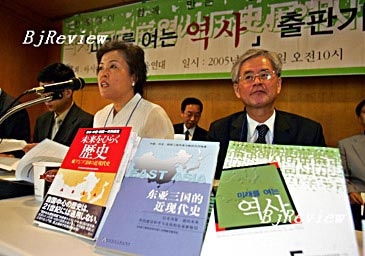
I began to take part in the editing of a joint history textbook,
which involved scholars and teachers from China, Japan and South
Korea, in 2002. The book was a hit immediately after it rolled off
the printing press. It was reprinted several times in Japan and
South Korea as the number of orders kept going up. In China, it
became a bestseller shortly after it entered the book market. The
popularity of the book shows that historical studies can help
resolve pressing social issues when their achievements are made
acceptable to the general public.
There have long been heated debates on whether China, Japan and
South Korea can reach a common understanding of history. What I
mean by "common understanding of history" is that they should reach
an agreement on the nature of the war and the evaluation of major
wartime events.
In a century that is characterized by the pursuit of peace and
development, we stand for resolving international disputes through
dialogue. This principle also applies when it comes to dealing with
disputes over historical issues.
We strongly reject Fusosha's history textbook because it
advocates "narrow nationalism." In recent years, this sentiment has
been emerging not only in Japan but also in some other East Asian
countries. Growing "narrow nationalism" may damage the friendly
relations between different nations. To check this insidious trend
requires efforts to enhance mutual trust, dispel suspicion and seek
a common understanding of history. The governments, media outlets
and scholars of the countries are all expected to shoulder
responsibilities.
The author is director of the Institute of Modern History, the
Chinese Academy of Social Sciences, and head of the Chinese
committee of the China-Japan joint history study
(Beijing Review April 10,
2007)