Pan Wang Festival of the Yao ethnic group
 0 Comment(s)
 Print
Print E-mail China Today, December 11, 2017


The Yao people are one of China's oldest ethnic groups. They live mainly in 130-plus counties across southern China, including Hunan, Guangdong, Yunnan, and Jiangxi provinces. The largest population is concentrated in the Guangxi Zhuang Autonomous Region.
In light of their languages, customs and faiths, the Yao ethnic group can be subdivided into four branches. But all Yao people regard Pan Wang, or King Pan, as their ancestor, and celebrate the Pan Wang Festival to pay tribute to the king. Originally, different Yao branches celebrated the festival on different days, usually during the slack season after autumn harvest, prior to the Spring Festival. It could be on a fixed day or unscheduled. In August 1984, representatives of the Yao ethnic group across the country gathered in Nanning, capital of Guangxi, and reached consensus on setting the Pan Wang Festival on the 16th day of the 10th lunar month, the birthday of King Pan.
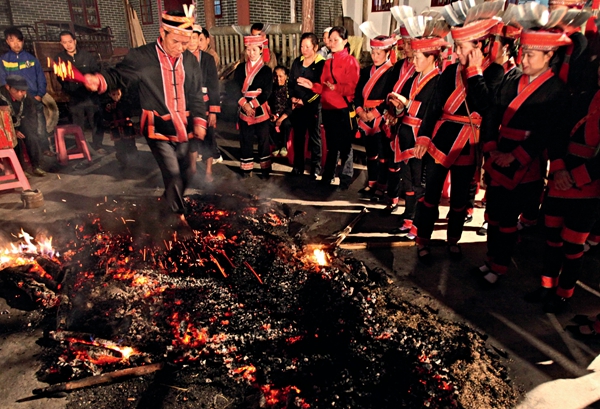
The Pan Wang Festival enjoys a history of over 1,700 years and is also a day for the Yao people to give their thanks to King Pan for his blessings. On that day, all Yao people dress in their finest attire; singing, dancing, indulging in libations and burning incense to honor the birthday of their ancestor. In 2006, the festival was included in the first batch of national intangible cultural heritage.
Legends around King Pan
For centuries, with migration, the Yao people's settlements have changed and ethnic fusion has also altered the ethnic group's cultural traditions to some extent. However, the custom to offer sacrifice to King Pan has sustained. What kind of figure is King Pan in the Yao people's perception and why do Yao people celebrate the festival? These questions have not only intrigued people of other ethnic groups, but fascinated the Yao people themselves.
In Yao people's ancient legends, King Pan was a dragon-dog named Panhu. As legend goes, in ancient times, King Ping and King Gao of the Yaoshan Mountain commenced hostilities against one another. King Ping offered an alluring reward to the courageous hero who could behead King Gao. If successful, he could marry King Ping's most beautiful daughter, Princess III. The dragon-dog Panhu heard of this, and set out with the intention of carrying out this deed.
He crossed the sea and came to King Gao. Panhu tried to curry favor with King Gao and gain his trust. One day, when King Gao was drunk, Panhu bit off King Gao's head. King Ping honored his promise and asked Princess III to marry Panhu. Later, intending to transform into a human being, Panhu asked the princess to put him into a steamer for seven days and nights. The princess followed his instruction. After six days and nights had passed, the princess was worried, and afraid that her husband might die. So she furtively removed the cover before the specified time. She saw that Panhu had indeed transformed into human form. However, as seven days and nights had not elapsed, the furry hair on his face and legs had not completely shed. Thereafter, he continued to wrap his head and legs with cloth.
After Panhu transformed into a human being, King Ping sent him to rule Kuaiji Mountain as its king under the title of King Pan. King Pan and Princess III had six boys and six girls, and King Pan granted each a family name. Thus the Yao people acquired their first 12 surnames. Despite becoming a king, Panhu still lived a simple life, teaching his children how to work and hunt.
Folk tales and legends are a distorted reflection of history. In spite of its odd plot, the story serves as proof that in the late Neolithic Age when pottery replaced natural containers, ancestors of the Yao people lived in the region that King Pan's name, Panhu, indicated. Pan means plate, the earliest pottery ware and Hu, a container made of calabash, was used as a water ladle by Chinese ancients.
Commemorating Ancestors
As to the origin of the Pan Wang Festival, folk lore tells that in ancient times, while sailing across the sea, the Yao people encountered squalls and raging waters. Their boat remained marooned at sea for 49 days constantly trying and failing to reach the shore. When on the edge of total destruction, someone began to pray for blessings from King Pan at the bow, and made a vow. The storm quieted down, and the Yao people safely landed. The day was the 16th day of the 10th lunar month, which also happened to be King Pan's birthday.
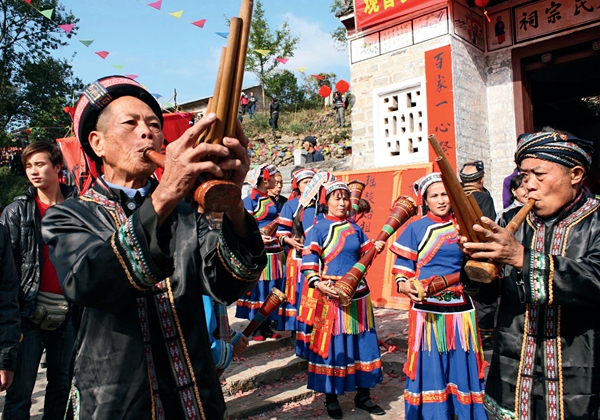
The Yao people felled trees and shaped them into tools to pestle the cooked sticky rice into glutinous rice paste. Later, people sang and danced to celebrate their new life and the birthday of King Pan. Since then, on that fateful day's anniversary, people have come together to commemorate King Pan with singing and dancing. The Pan Wang Festival has now evolved into a social event celebrating a bumper harvest. In real life, the 10th lunar month is a slack season for the Yao people in the Nanling Range region of South China. After spring sowing, summer planting, and autumn harvest, it is a season for resting. Therefore, in this season, Yao people brew wine, clean their houses, prepare chicken and ducks, and pestle glutinous rice paste to offer sacrifice to their ancestors.
During the festivities, all Yao people dress in their best traditional costumes. Led by their elderly, the Yao people offer sacrifices to King Pan, accompanied by song and dance to honor their ancestors and pay tribute to their mettle. They celebrate a bumper harvest to reward King Pan's blessings.
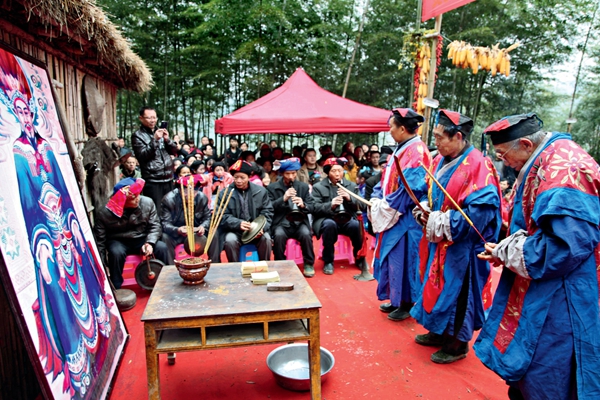
Despite different forms of celebration, ancestor worship is the most important element of the Pan Wang Festival. Usually a sacrificial altar is set up enshrining statues of various gods with King Pan's figurine in the middle. As the worshipping ceremony starts, a roer (a heavy, long barreled gun) is fired three times, and firecrackers are set off. Amid conflagrating fireworks, the Yao elders put a pigs head, glutinous rice paste, chicken and wine on the altar as sacrifice. Facing the statues, people bow their heads and pray in silence. Then they sing The Song of King Pan and perform King Pan's dance.
On the festive day, the statue of King Pan enshrined in the local temple is invited to join the deity parade and villagers carry the statue on a tour of villages and to inspect fields. It is finally placed on a stage, usually a clearing, for celebration performances. It's said that villages and fields inspected by King Pan will see a safe, prosperous life and a good harvest. Those performances give people the chance to learn their ancestors' migration routes, traditional tales, make new friends, and even find their Miss or Mr. Right.
The Song of King Pan
Without written records, the Yao ethnic group's history and culture has been passed down generation after generation through ballads and stories. The Song of King Pan is an ancient melody about history, combined with ritual activities of worshipping King Pan. In the early days, they just consisted of simple and short melodies. Later, with new content added by singers and folk artists in different regions of different eras, its volume considerably expanded to include sacrificial rituals and folk customs rarely seen in the ancient epic songs of other ethnic groups.
The Song of King Pan is the major aspect of worshipping King Pan. It vividly reflects the Yao people's basic belief through a vast expanse of content touching on such topics as entrepreneurship, migration, agriculture, hunting, love and marriage in the form of legend and mythology. The deities extolled in the song not only include the Yao people's own gods, but also those venerated by both the Han and Yao people. With multiple social functions, the song, a collection of knowledge about the Yao ethnic group, serves as both a solemn ethnic ritual melody for praying, and an epic record of the Yao people's long history.
There are three versions of the manuscripts about The Song of King Pan in Chinese characters. Each one consists of more than 3,000 lines. To sing The Song of King Pan in its entirety takes seven days and nights.
Besides its function of worshipping ancestors, the song retains valuable information about Yao people's literature, history and folk music. In Yao villages of the Naling Range area, the thousand-year-old Song of King Pan still resonates, and people dance to the ancient rhythms, honoring their ancestors. Eternally a sacred figure in the Yao people's belief systems, King Pan's blessings on them are believed to last forever.


