Partisan politics drive anti-China rhetoric in US Congress
- By Shi Peipei
 0 Comment(s)
 Print
Print E-mail China.org.cn, September 11, 2023


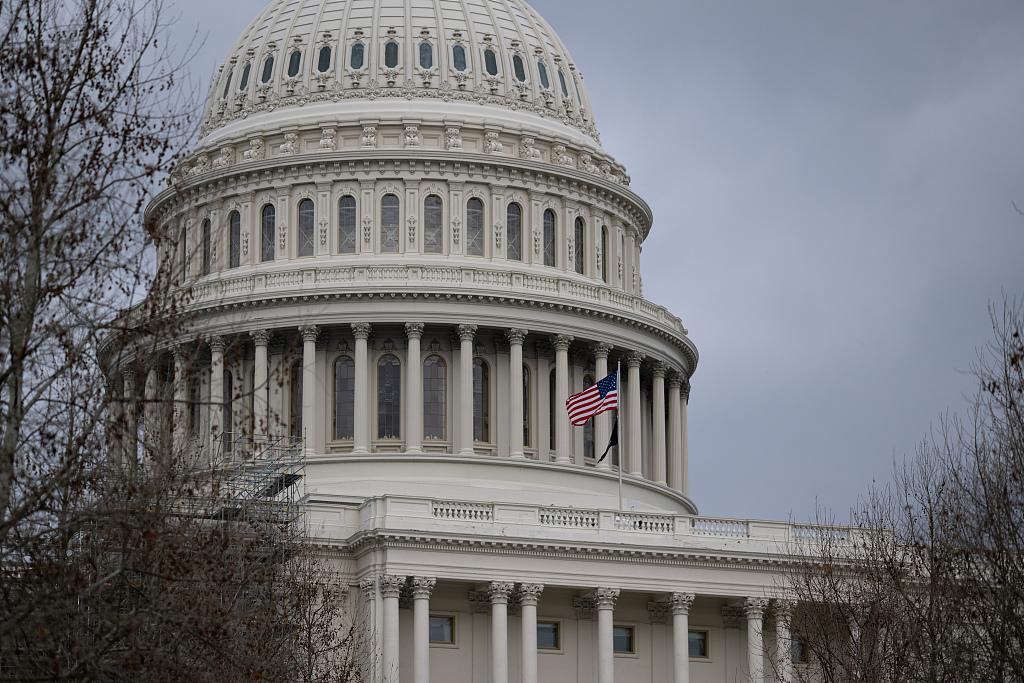
The U.S. Capitol building in Washington, D.C. [Photo/VCG]
A common method employed by members of both houses of the U.S. Congress to influence decisions regarding China is sending joint resolutions to the executive branch. Since 2017, anti-China legislators from both chambers have employed various methods to suppress China, such as repeatedly introducing China-related bills, convening hearings, submitting joint resolutions and shaping media discourse. This trend of anti-China sentiment has become the norm for Congress' involvement in shaping U.S. decisions regarding China.
Since the establishment of the 118th Congress, legislative activities related to China have surged. The formation of the Select Committee on the Strategic Competition Between the United States and the Chinese Communist Party, the introduction of the China Competition 2.0 bill and the imposition of sanctions on TikTok have significantly impacted U.S. policy toward China, having a highly detrimental effect on China-U.S. relations. The influence of Congress in shaping U.S. policy on China has notably strengthened. While the proportion of these bills enacted into law is not high, their impact on the bilateral relationship far surpasses any previous historical period.
Congress' legislation on China swings fully negative to divert from domestic conflict
In recent years, with the rise of China, internal contradictions such as political polarization and racial division have become more prominent in the United States. The sense of crisis among American policy elites regarding the "China threat" has significantly increased. After taking office, Donald Trump, in order to divert from domestic conflict, portrayed China as the "number one threat," initiating an unrestrained campaign to smear and suppress China. It is against this domestic political backdrop that different political parties have found their interests converging on issues related to China, raising the banner of anti-China sentiment and reaching a consensus on taking a tough stance against China. Furthermore, stimulated by factors such as domestic elections and the COVID-19 pandemic, public sentiment toward China in the U.S. has significantly deteriorated. The hostility toward China among voters has also led to a vicious cycle where both parties' lawmakers, in a bid to win over voters, choose more extreme rhetoric and actions against China.
Trump's "America First" policy has had a significant impact on domestic politics and foreign policy in the United States, with China-related issues being included as important national security concerns. With the U.S. government labelling China as a "strategic competitor" and a "geopolitical test," there has been an increasing focus on China by the two main political parties in the United States. As Congress frequently introduces bills related to China, the amount of specialized legislation targeting the country continues to rise. In the past, there was little legislation specifically targeted at China in Congress, with most proposals either indirectly or partially addressing China-related issues. However, since 2017, Congress has shifted toward specifically targeted legislation, in addition to incorporating China-related clauses into comprehensive bills. The shift from resolutions to legislation indicates that Congress is seeking legal grounds on specific issues to justify its interference in China's internal affairs under the guise of "legitimacy" based on domestic laws. The content of these proposals has shifted toward comprehensive attacks and defamation against China, imposing sanctions and decoupling in various areas such as national security, the economy and technology. While the likelihood of bills ultimately becoming law may not be high, the introduction of these proposals fosters a political climate and public opinion that leans toward opposing China whenever possible within both houses of Congress.
Shift toward dominating and shaping the China-related agenda
Historically, the president of the United States has had significant discretion in foreign policy, while Congress has often chosen to actively cooperate or passively respond. However, since 2017, in the decision-making process regarding China, Congress has shifted from a role of compliance to one of leadership and shaping the policy agenda. One reason for this shift is that the increasing interdependence between nations blurs the boundaries between foreign policy and domestic politics. Issues related to China have become increasingly prominent in U.S. domestic politics. Additionally, since the Trump administration, China-related affairs have been elevated to a strategic level of national security, which has to some extent stimulated and actively promoted the setting of extreme and negative China-related agendas in Congress. Taking the Taiwan question as an example, members of Congress have introduced proposals, held hearings and visited Taiwan to manipulate related issues. In 2022, the infamous Nancy Pelosi stubbornly insisted on making a provocative visit to Taiwan, using the banner of "defending democracy" to satisfy personal interests. In response, President Joe Biden said that it was her own decision. However, shortly after Pelosi's visit, Biden officially signed into law the CHIPS and Science Act of 2022 passed by both houses of Congress, aimed at shifting the global chip manufacturing supply chain from China to the United States. While one of the important agendas of Pelosi's visit was to persuade chip manufacturers like TSMC to actively cooperate with U.S. chip policies, the signing of this law revealed the true nature of the "double act" performance by Biden and Pelosi, demonstrating that the United States has never abandoned its strategic attempt to divide China.
Legislators leverage China-related concerns to accrue political capital
In the polarized and increasingly intense political landscape of the United States, China-related issues have become tools for both parties to advance their domestic agendas and create an illusion of bipartisan unity on the international stage. Both parties have reached a consensus on taking a tough stance against China, allowing unchecked escalation of anti-China politics. However, behind this show of bipartisanship, each party has its own political calculations and ambitions, using the China issue to seek partisan interests. For individual members of Congress in both houses, playing the "China card" has become an electoral weapon under the bipartisan consensus against China. It not only helps to win over key voters in the middle and lower classes, but also allows them to gain an advantage by attacking opponents for being weak on China. Based on analysis of China-related proposals in both houses of Congress, the six most active congressmen or senators on China-related issues are: Marco Rubio, Tom Cotton, Chris Smith, Robert Menendez, Michael McCaul and Mike Gallagher. Most are veteran anti-China lawmakers who hold important positions in key congressional committees such as the House Foreign Affairs Committee, Senate Foreign Relations Committee, and the Congressional-Executive Commission on China. They have developed a set of "expertise" on China and are using McCarthy-era tactics to hunt for "red elements" in China. Although not all members of Congress necessarily agree with their views, the anti-China political atmosphere in Congress, coupled with a lack of understanding and knowledge about China, has made other lawmakers the "silent majority."
Meanwhile, in addition to the long-standing presence of several anti-China senior members of Congress, legislative activities related to China by junior members have become increasingly frequent. One of the main reasons for this is that less experienced lawmakers, driven by the need to attract attention and expand their influence, frequently engage in negative discussions on China-related issues as a way to boost their political careers. For example, Mike Gallagher, the youngest member of the new Congressional class when he entered in 2017, has participated as sponsor and co-sponsor of numerous bills related to Taiwan, military security, pandemic origins, technology and other areas involving China. He has become a representative of the new generation of "anti-China pioneers" in Congress. It is precisely due to his "outstanding" performance that he was appointed as chairman of the Select Committee on China by House speaker Kevin McCarthy in the 118th Congress.
U.S. anti-globalization moves expose failure of responsibility as global leader
In recent years, the United States has been implementing decoupling and sanctions globally, as well as provoking ideological competition, treating China as an "imaginary enemy" and recklessly inciting confrontation. This has led to further disorder and division in the world, posing a serious threat to global peace and stability. Against this backdrop, the influence of the U.S. Congress on decision-making toward China is more negative than at any time in history. These negative bills related to China convey biased value judgments and ideologies. Members of Congress continuously produce similar bills related to China, solidifying the misinterpretation of China within American society, tarnishing China's image and creating a vicious cycle. The bipartisan consensus on China is not an internal unity under the praised democratic system, but merely a strategy for each party to secure greater political interests in their respective constituencies. U.S. politicians are using the "China threat" to shift attention from domestic conflict. Still, this irresponsible approach not only fails to solve their domestic problems but also exacerbates social division, fuels racism, fosters anti-China and anti-Asian hate crimes, and triggers social unrest and instability in the United States.
Shi Peipei is an associate researcher at the Institute of American Studies, Chinese Academy of Social Sciences.
Opinion articles reflect the views of their authors, not necessarily those of China.org.cn.


