Trump's Iran policy is repetition of history
- By Jin Liangxiang
 0 Comment(s)
 Print
Print E-mail China.org.cn, November 22, 2018


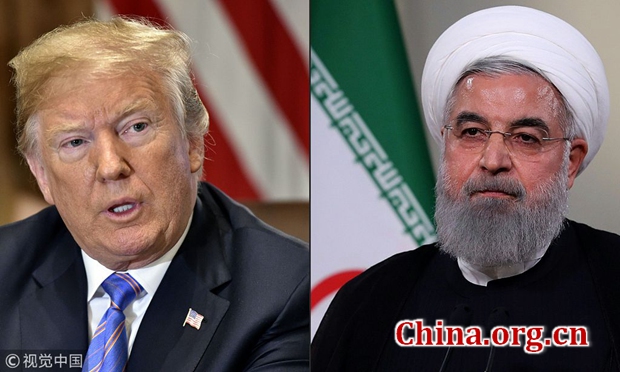
The year 2018 witnessed another major shift in U.S. policy toward Iran. President Trump announced, on May 8, U.S. withdrawal from the JCPOA, more commonly known as the Iran nuclear deal, and restored two rounds of sanctions on Iran respectively on August 6 and November 4. The shift which aroused new debates about U.S. policy toward Iran and concerns worldwide, was actually nothing new but a repetition of history within a new context.
The JCPOA was the joint plan of action agreed between Iran and the U.S., China, Russia, Britain, France and Germany while Federica Mogherini as EU representative had headed the negotiation with Iran. While the deal was multilateral, it was mainly an issue between the U.S. and Iran.
On the Iranian side, the deal signified Hassan Rouhani's resoluteness in improving Iran's relations with the U.S., which had been well reciprocated by Barack Obama with his administration's readiness to engage Iran. In contrast to his predecessor's fierce confrontational approach, Hassan Rouhani had been opting for constructive interactions with the international community, particularly the U.S. and the West. Going to the table was a major signal that Iran wanted to have good relations with the U.S. But instead of rewarding Iran with more benefits, Barack Obama's successor President Trump decided to punish Iran by withdrawing from the deal. This greatly frustrated Iran's effort to court the U.S., and suggested the unsustainability of U.S.-Iran rapprochement.
Observers might feel puzzled with the sharp shift of U.S. policy toward Iran, but actually similar scenarios have occurred time and again in the history of U.S.-Iran relations. In the middle of 1990s, the then president Akbar Hashemi Rafsanjani used to offer very favorable benefits to attract U.S. companies to invest in Iran's oil exploitation, which was a major gesture that Iran wanted to have better relations with the U.S. But unexpectedly, the U.S. Congress passed and President Clinton signed in 1996 The Iran and Libya Sanctions Act of (ILSA), punishing those companies investing in Iran's energy sector. This should be the first major setback for Iran in improving its relations with U.S.
The same story was repeated during Mohammad Khatami's presidency. After the September 11 attacks, Iran's Khatami government lent the U.S. a hand for its fight against the Afghanistan Taliban. Iran not only provided military assistance for U.S. military actions but also persuaded some Afghanistan political factions to accept U.S. arrangements of political transition. These were all signals that Iran wanted to improve relations with the U.S. by this opportunity. But these signals had not been reciprocated by the U.S. The then U.S. President Bush in his 2002 State of the Union speech included Iran in the list of the Axis of Evils, despite that as a Shiite majority state, Iran really had no links to Al Qaeda.
All these stories indicate that there is a very strange rationale behind U.S. policy toward Iran. It seems that the U.S. would always like to choose punishment instead of reward in return for Iran's favorable gesture. The more Iran demonstrated willingness to improve its relations with the U.S., the more likely punishment will be delivered from the U.S. side. And the opportunity for U.S. to change its relations with Iran always elapsed easily when it looms.
The reasons are numerous, but the most decisive is the strong anti-Iran politics in the U.S. and also anti-Iran sentiments. Many people in the U.S. still keep in their memory of the hostage crisis in 1979. Those revolutionary radicals kidnapped U.S. diplomats stationed in Tehran for 444 days from November 4, 1979 to January 20, 1981. Even with the passing of 40 years could not take away the TV image of the diplomats with their eyes covered with black belts. That's the reason why the crisis will every few years appear in U.S. public in different ways.
In 2005, a picture had been widely circulated with a certain kidnapper looking very much like Ahmadinejad shortly after Mohammad Ahmadinejad's election as Iran's president, which caused a very strong anti-Iran sentiment in the U.S. The year 2012 saw the movie Ago, which was based on the hostage crisis, receive a very large audience in the U.S. and the world at large, and the movie also won several OSCAR medals, which again brought up the bitter memory of the crisis. In 2014, the U.S. refused to issue a visa for Hamid Aboutalebi, who was appointed by Hassan Rouhani as Iran's ambassador to the UN, just because he used to be an interpreter during the hostage crisis. Memories proved to be always obstacles in the relations between the two.
Besides these domestic sentiments, Israel's lobbyists are another major part of the anti-Iran force in U.S. domestic politics. In most of the time since the Islamic revolution in 1979, Iran had been a very high-profile challenger for Israel, and Israel regarded Iran as the major enemy in the region. Though Jewish lobbyists are not necessarily all standing with Israel, yet a majority of them do share the positions of the Israeli government. The Jewish lobbyists are financially capable of influencing U.S. politicians, particularly in the Congress, and control some very important media as well. They constructed a very negative image of Iran, and persuaded congressmen to push for policies that punish Iran. Just as John Mearsheirmer and Stephan Walt argued in their famous book The Israel Lobby and U.S. Foreign Policy, the Israel lobby had dissuaded U.S. from taking a policy engaging Iran, and had undermined U.S. interests in Iran.
Israel and Jewish lobbyists are both strongly opposed to the JCPOA. While Barack Obama's administration and other major powers hailed the deal as a "historical deal," Israeli government led by Benjamin Netanyahu and Jewish lobbyists called the deal a "historical mistake." Trump had been particularly influenced by Israel and Jewish lobbyists. Many believe that Trump's Middle East policy and policy toward Iran had been very much influenced by Jared Kushner, his son-in-law.
All in all, the current U.S. administration's reneging U.S. policy approaching Iran was actually nothing new in the history of U.S.-Iran relations. Similar scenarios might also happen in the future. There are strong forces in the U.S. that strongly oppose rapprochement with Iran. And observers should not be too optimistic for U.S-Iran relations so long as anti-Iran politics is there.
Dr. Jin Liangxiang is deputy director and Senior Research Fellow with the Center for West Asian and African Studies, Shanghai Institutes for International Studies. For more information please visit:
http://www.jhzsvip.com/opinion/jinliangxiang.htm
Opinion articles reflect the views of their authors, not necessarily those of China.org.cn.


