Lenin, Deng Xiaoping, and the Kornai puzzle
- By Heiko Khoo
 0 Comment(s)
 Print
Print E-mail China.org.cn, November 6, 2017


 |
|
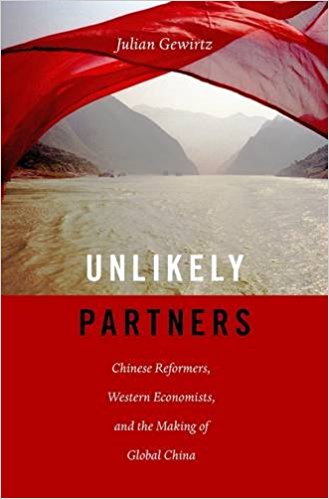
Julian Gewirtz's book Unlikely Partners [File photo] |
China's relationship with economists from around the world is the subject of "Unlikely Partners," a lively new book by Julian Gewirtz, a Sinologist working for his doctorate at Oxford University. He examines these interactions during the formulation, implementation and consolidation of China’s "socialist market economy" between 1978 and 1992.
Hungarian economist Janos Kornai is singled out as the main intellectual protagonist. However, Keynesian economist James Tobin, the monetarist and free market advocate Milton Friedman, and British economist Sir Alec Cairncross, are also on a long list of famous names that participated in Chinese debates at a theoretical and practical level during the early reform years.
Gewirtz shows that Deng Xiaoping's concept of opening to the outside encouraged Chinese scholars to scour the world for ideas and experiences possibly useful to China. It was natural and understandable the attention of China’s intellectual scouts was drawn to those countries having experience of reform socialist experiments i.e., Hungary, Poland and Yugoslavia.
In the first two countries, markets were allotted a significant role in the economy and acted as a supplement to State planning. Private ownership and profits acted as incentives to motivate individuals, as well as small and medium sized enterprises and farms.
In Yugoslavia, a rather unique system known as "self-management" allowed workers and factory managers to organize the activities and objectives of their enterprises through a semi-market system of economic coordination.
However, sluggish performance produced a series of crises in all three countries; and their most influential economists were soon urging eradication of the socialist sector of the economy and restoration of capitalism.
China also dispatched emissaries to study enterprise level and macro-level societal models, as well as technical, scientific and organizational experiences from around the world. This helped China to select and acquire the latest technology, and to adopt new forms of social organization to power the modernization drive.
Gewirtz praises Deng Xiaoping and other Chinese leaders for their promotion of the intellectual expeditions abroad, although he seems disappointed this learning process took place on Chinese terms. This was distinct from the dramatic and wholesale adoption of Western capitalist prescriptions, advice, and policies, by most East European governments after 1989.
Janos Kornai’s impact derived from the fact his method of analysis employed the same language, and rested on the common experience, of socialist economies throughout the 20th century. Kornai was an enthusiastic Marxist in his youth; and until the 1980s, he worked to facilitate the optimization of economic achievements within the socialist system.
Indeed, even when he became an outspoken proponent of capitalism, his analysis of socialism remained anchored in a scientific critique of identifiable features prevalent in 20th-century socialist economies.
Kornai is most famous for his argument that a "shortage economy" is the inevitable characteristic of bureaucratic administration within a socialist system. He developed a theory known as “soft-budget constraint” (SBC) whereby managers of State-owned firms would seek to protect their own workplace and workforce.
It operates rather like a family budget, which is not constrained by the profit motive. Kornai argues that socialism inevitably produces a "shortage economy." This is the twin of the SBC. Shortage is produced by several factors, such as State managers are pressured to meet planning objectives; investment hunger is generated; artificially low prices cause a hoarding of supplies; and sellers exercise power over buyers.
On the other hand, Kornai argued capitalism automatically produces a "surplus economy." This was because profit-seeking private companies are compelled to compete against each other in the market, meaning they emulate each other’s products and work methods, and seek to outsell competitors by cost cutting and innovation.
This inevitably leads to overproduction and surplus. Private enterprises are dominated by “hard budget constraints” (HBC). In addition, as companies attempt to reduce costs they are compelled to engage in "creative destruction." This entails the renewal of equipment, corporate restructuring, layoffs and bankruptcy.
However, under the surplus economy of capitalism, inputs are readily available, as there is fierce competition. Therefore, in Kornai’s view, capitalism is a system combining economic surplus and hard budget constraints.
Kornai accepted the theory that prices – shaped in free and private markets – act as information repositories and are the most effective coordination mechanism for economic activity. He insisted that, in a bureaucratically-planned and State-owned economy, pressure to expand enterprises and institutions is an automatic and internally driven feature of the system.
He labeled this internal driving force "investment hunger." This means investment focuses on heavy industry and on mega-projects, whereas under capitalism, profit and risk act as constraints on expanding investment.
Gewirtz argues that China's leading economists in the early reform period, adopted Kornai’s insights during an intense meeting held in 1985, known as the Bashan Steamship conference, initiated at the request of Deng Xiaoping. Thereafter they sought to devise policies that would harden budget constraints in the State economy.
It is undoubtedly true that Kornai's ideas had a big impact on Chinese economic thought. However, following the publication of his The Socialist System in 1992, the absence of any detailed analysis of China by him is striking. He offers no explanation as to why China’s system simultaneously produces surplus on a grand scale – a feature he ascribes exclusively to capitalism – and yet the “soft budget constraint” continues to operate in much of the State economy.
The commanding heights of the economy remain the dominant driving force within China. Indeed, the impact of the Great Recession was overcome by mobilizing the State economy to maintain growth and social stability. And macro level State-driven investment decisions, like the Belt and Road Initiative, are simply inconceivable in countries like the U.S., Japan or in Western Europe.
Hong Kong-based economist Xu Chenggang, Kornai’s former student and one of the world’s most influential scholars of China’s political economy today, recognizes the problem. He suggests the basic features of China’s political economy most closely resemble the Soviet hybrid system adopted between 1921-1929 under Lenin’s New Economic Policy.
Indeed, Xu notes that Deng Xiaoping explicitly endorsed Lenin’s ideas in a speech on August 28, 1985, several days before the Bashan Steamship conference. So, although China adopted and assimilated ideas from around the world, the roots of success lie in its socialist foundations.
Heiko Khoo is a columnist with China.org.cn. For more information please visit:http://china.org.cn/opinion/heikokhoo.htm
Michael Roberts is a London based Marxist economist. He published the "The Great Recession" in 2008 and "Essays on Inequality" in 2014
Opinion articles reflect the views of their authors, not necessarily those of China.org.cn.


