South Korea: corruption, cults and chaebols
- By Heiko Khoo and Michael Roberts
 0 Comment(s)
 Print
Print E-mail China.org.cn, March 28, 2017


|
|
|
Ousted South Korean President Park Geun-hye leaves the prosecutors' office in Seoul, South Korea, March 22, 2017. (Xinhua/Lee Sang-ho) |
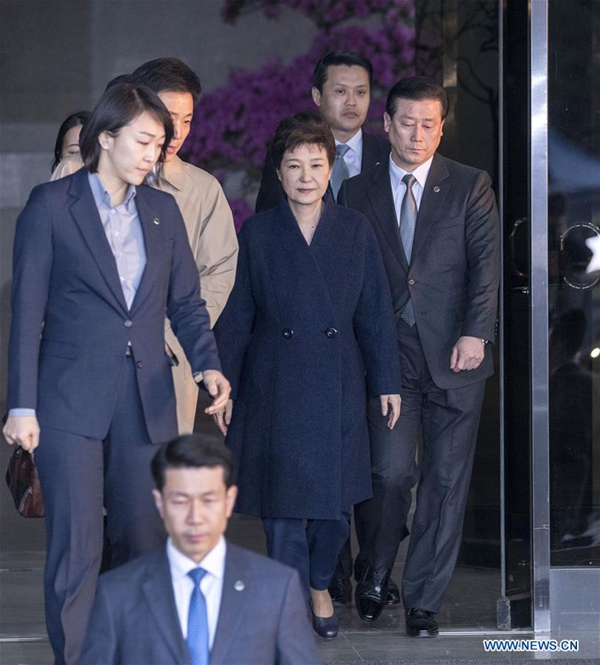
South Korean President Park Guen-hye resigned on March 12, following her impeachment and huge public demonstrations. She is accused of bribery, influence peddling, and permitting shamanistic rituals in the Presidential palace.
Senior government officials and business interests are also implicated. For example, Samsung is accused of donating 43 billion Won ($40 million) to foundations run by the former president's confidant, Choi Soon-sil. Her father Choi Tae-min is a shamanistic-evangelical cult leader; and her ex-husband Chung Yoon-hoi is Park's former chief of staff.
Samsung is accused of funding Choi Soon-sil's daughter's equestrian training in Germany. The mother now sits in jail accused of forcing local firms to "donate" nearly $70 million (?60 million) to her non-profit foundations.
In the forthcoming presidential poll in May, Moon Jae-in, a former human rights lawyer and political veteran from the opposition Democratic Party, is expected to win. He is popular with youth and promises reforms to improve their employment prospects at a time of a high jobless rate (see chart).
South Korea's political turmoil is an after-effect of the Great Recession of 2008-9. From the 1960s to the 1980s Korean capitalism grew by an average of 8 percent a year and per capita GDP rose from $104 in 1962 to $5,438 in 1989. In 2012, Korea became the seventh member of the "20-50 club" - major capitalist economies with populations over 50 million and per capita incomes exceeding $20,000.
Succeeding rulers pursued a successful State-directed industrialization and export strategy for nearly 50 years. The country's manufacturing sector grew from 14.3 percent of GDP in 1962 to 30.3 percent in 1987. And, within two generations, Korea entered the OECD and its corporate national champions became global brands.
However, Karl Marx's law of profitability offers another plausible explanation for this period of success for Korean capitalism. The Korean rate of profit rose in the 1960s until the late 1970s. Then the rate of profit declined from its 1978 peak to reach a low in 2002. So, we can observe that the decline in the rate of profit during the 1980s and 1990s was an underlying factor behind the so-called Asian crisis and slump in 1997.
The Asian crisis led to a sharp devaluation of capital values in Korea as bankrupt companies were written off and unemployment rose. This was followed by neoliberal measures to boost profitability.
However, after a mild recession in 2001, Korean profitability continued to decline until the global financial collapse in 2008, since when, Korean capitalism has experienced a long depression.
Korean capitalism also faces major structural challenges. It has one of the lowest birth rates in the world and a rapidly aging society. The working age population will peak this year and then decline rapidly. And, after 2025, the population size is expected to shrink.
Korea's exports exceed 50 percent of GDP, but U.S. President Donald Trump's protectionist agenda will undermine this. Already, industrial sectors like shipbuilding, shipping, steel, and petrochemicals face stiff competition from China, as well as suffering from a slowdown in trade.
Korea's oligopolistic chaebols dominate its corporate landscape. However, they face competition at the low end from Chinese manufacturers, and at the high end from Japanese companies, which have benefited from a deliberately-weakened yen.
Exporters are creating fewer jobs in South Korea as the chaebol move production offshore, seeking cheaper labour. This left the domestic economy struggling as small and medium-sized businesses fail, and its high-value services sector lags behind other countries.
"This has raised concerns about Korea's traditional catch-up strategy led by exports produced by large chaebol companies," says a 2016 OECD report.
Korean capitalists employ 22 percent of their workers on casual and temporary contracts. Although labour productivity rose by 5.5 percent a year between 1990-2011, it has since stagnated, and is particularly low in the service sector.
Korean companies work their staff hard, with long hours, and try to avoid meeting their social security obligations. Basic welfare and pensions provision is very low by OECD standards, and household debt has risen as retirees open small businesses to supplement their meagre pensions.
Social spending is less than half the OECD average, and household debt has leapt from 40 percent of GDP in the early 1990s to nearly 90 percent today, while corporate debt remained at about 100 percent throughout the last decade. This indicates Korean capital can't find ways to raise the rate of profit, so have to grow by borrowing.
Meanwhile, economic polarization has increased over the last decade. A remarkable 73 percent of Seoul residents now identify themselves as members of the "lower class." The cleavage between workers has also grown. About a third of the workforce is now employed in insecure job conditions. They are paid only about 60 percent of regular workers' wages but without medical insurance, severance pay or company welfare.
South Korea's top 1 percent of income earners usually work for leading conglomerates, like Samsung, Hyundai and LG, which have grown into truly world-class companies and are very profitable. In 2012, the top 10 percent of the population possessed 46 percent of the country's total wealth. The bottom 50 percent possessed only 9.5 percent.
Much of the rise in inequality originated in the real estate market. However, more recently, the stock market and financial investments became the primary source of wealth accumulation.
The poverty rate for over 65 year olds is 48.5 percent, which is 3.4 times higher than the OECD average. This may partly explain why the country has one of the highest suicide rates in the world.
Should any new economic crisis erupt in the world, Korean capitalism will suffer hard.
Heiko Khoo is a columnist with China.org.cn. For more information please visit: http://www.jhzsvip.com/opinion/heikokhoo.htm
Michael Roberts is a London based Marxist economist. He published the "The Great Recession" in 2008 and "Essays on Inequality" in 2014
Opinion articles reflect the views of their authors, not necessarily those of China.org.cn


