The miracle isn't over
- By Michael Zakkour
 0 Comment(s)
 Print
Print E-mail Beijing Review, March 24, 2017


|
|
|
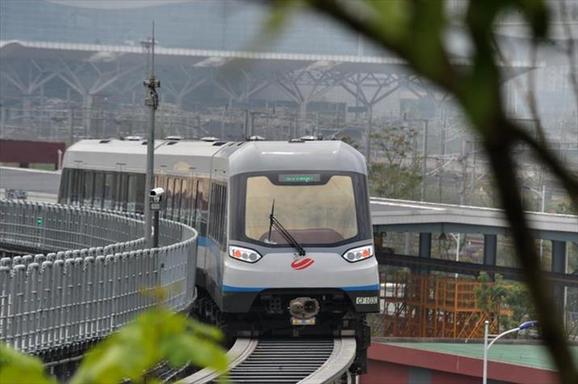
A maglev train runs on China's first medium-low speed maglev railway in Changsha, capital of central China's Hunan Province, October 2, 2016. Starting from Changsha South Station in the west, to Huanghua Airport in the east, this 18.5-kilometer-long medium-low speed maglev railway is developed with China's own property rights (XINHUA) |
From the vantage of 2017 we can look back and see that China has followed the path set out by its leadership to create a new and viable economic model, unique to China, and beat the odds to achieve what was unimaginable 40 years ago.
Last year, China's economy continued to be the world's second largest with a total GDP of $10.8 trillion, trailing only the United States ($18.5 trillion). This path has led to China lifting roughly half of its 1.3 billion people out of poverty, becoming the world's most important manufacturing and supply chain hub, producing the most rapid and consequential urbanization (350 million citizens migrating from rural areas to cities) movement in history, creating an advanced and innovative technology sector and ensuring China's re-emergence as the global economic, cultural, and political power it has been for most of the last 2,000 years.
This transformation of China has been cited and touted by economists, the media, politicians, business people and China hands like myself, over the last 10 years as "the miracle" or the "Chinese economic miracle."
The description is apt because no country before with the size, scope, complexity or history of China has risen so fast and so far in so short a time. From a largely stagnant centrally planned economy to a market economy with Chinese characteristics, that for 20 straight years grew at over 10 percent per year and for the last six years has averaged 6 to 9 percent growth, the course for China and the world's future has been forever altered.
So, on the one hand, "miracle" is a well-deserved plaudit and description, because the odds were long and the vision and commitment needed were deep. On the other hand, it, (unintentionally by those, like me who use the term) is selling the Chinese leadership, Chinese business people, Chinese factory workers and entrepreneurs, a bit short. This change was not due to divine intervention or luck, it was the result of hard work on everyone's part. Thirty years of breakneck growth have created a new China.
Over the past year or so, it has become somewhat en vogue for some of the very same economists, media, politicians and some (unlike myself this time) old China hands who touted the China miracle, to declare it over.
The miracle is not over: the miracle transformed a rural country, with a centrally planned economy and a GDP smaller than some countries one fiftieth its size, into a modern, forward-looking, economically vibrant center of innovation, productivity and relative wealth. That was the miracle and it is still happening.
So why the negativity and predictions of the good times coming to an end? Primarily it has to do with two factors.
First, the economic "slowdown" which has meant "only" 6.5 to 6.8 percent growth over the last few years. Not satisfied with the longest, greatest run of economic growth in history, there are those who would declare China heading down a road of ruin because it is "only" growing at 6.7 percent per year.
The other factor is concern over China's debt load and the persistence of shadow banking. This is a legitimate concern, but the hyper-reaction of some China observers, who see Chinese debt as the card that will bring down the house, is overblown—it does not take into consideration the remedies being applied to the issue, the still sizable growth in the economy and the resilience of the system currently in place. Yes, a serious downturn is possible, but neither sub 7 percent growth nor current debt issues will bring down the Chinese economy.
It is also worth pointing out, as a precursor to my summary of how China's economy, companies, government and culture will impact and sustain the world economy over the next 25 years, that if China "goes down," the U.S. and the rest of the world will go down with it. Much as the world economy tanked after the Wall Street meltdown of 2008, a similar meltdown in China would spell disaster.
The four pillars
Building the world's No.2 economy was hard work. Building on this accomplishment will entail hard work and vision as well.
The Chinese Government just completed this year's Two Sessions—the annual sessions of the National People's Congress and the National Committee of the Chinese People's Political Consultative Conference. A key focus was the economy and in particular "seeking progress while maintaining stability."
We can interpret this as building on the 13th Five-year Plan (2016-20) released last year, the discussions at the G20 Summit held in Hangzhou last year—focused on free trade and a more active role for China to cooperate in global economic governance—and a commitment to transforming China's economy away from heavy manufacturing and exports to more mature builders of GDP.
So how will China sustain growth and further cement the wellbeing of its citizens and build on its role as a cornerstone of the world economic, political and cultural structure? The answer is through the four pillars of growth.
Pillar 1: Consumption
China is the fastest-growing consumer market in the world. "China's Super Consumers" have now gone beyond mimicking the patterns of more established Western shoppers to being the trendsetters and innovators. There is a super-feedback loop taking place whereby consumer demands are shaping how e-commerce giants like Alibaba, JD and Amazon are developing new models of retail and technology to serve them. Retailers from around the world (brick-and-mortar and online) are catering to these shoppers and creating new demand and access to goods through innovation.
Chinese consumers are powering the growth of China and the global economy and their power will only grow in the next decade. No one could have predicted even seven years ago that major brands from Western multinational corporations, to small and medium-sized enterprises, would add 11-11 (Singles' Day), 6-18 (founding day of JD.com), October 1-7 (National Day Golden Week) and the Spring Festival (Chinese New Year Golden Week) to their holiday promotions calendar. Nor could anyone have predicted the impact that Chinese travelers would have on cities, brands and service providers around the globe. During the last National Day Golden Week, Chinese shoppers on holiday in Japan were so numerous and free spending that they actually produced an uptick in Japan's GDP.
Pillar 2: Technology and Innovation
The ability to create and commercialize technology products must be a core focus for China's growth in the next 25 years. The good news is that China is well on its way to this goal.
A recent KMPG report on the fastest growing technology hubs (chasing Silicon Valley) in the world listed Shanghai as No. 2, followed by New York. Again, this is something that would have been unlikely a short time ago. This in itself is proof that the miracle isn't over, it's just changing shape. Here again we are seeing the pattern of moving beyond following trends and technologies to real innovation and originality.
This is especially apparent in e-commerce. In many ways China is two to three years ahead of the West and other markets when it comes to e-commerce services, experience and technology.
Alibaba, for instance, is setting the global standard for online marketplace experiences through Tmall and Taobao and is already deploying advanced cloud computing, augmented reality, virtual reality and O2O (online to offline) technology that is redefining retail. JD.com has set a gold standard for supply chain and retail direct to online consumer models. China is also far more advanced in mobile payments than the West. China is investing heavily in tech research and development, and will soon be a major player in manufacturing advanced, hi-tech, high value-added products for sale around the globe.
Pillar 3: Advanced Manufacturing
In a bit of misguided and anachronistic thinking, there are those in the West who want to bring back low-end, low-value manufacturing to places like the United States, Britain and France. This is not only unrealistic but it ignores two key points.
The majority of job shifts and losses in the West have been the result of automation and robotics, and China, the leader in this space for over 20 years, is moving beyond low-end export and infrastructure investment to advanced, tech-driven, high value-added production.
A good analogy is: China is the world leader in making chopsticks and socks. They would buy the machines needed to make these products from Germany and Japan. Now, China wants to make the machines and sell them on to new low-cost production countries. We are also seeing China, through companies like Huawei, exporting advanced technologies to markets around the world.
Pillar 4: Services
Services must become the fourth cornerstone of China's future growth and wealth. As history has shown, an economy hoping to progress from exports and infrastructure must make services a major part of wealth creation.
To that end, China is advancing the FIRE + H industries (Finance, Insurance, Real Estate + Healthcare) but this pillar may be the hardest, though most important, to achieve.
For consumption to continue growing, a comprehensive healthcare system must evolve further. For those with expendable income, not only must they be able to buy products, but they also need to put their money to work for them. This capital investment system allows Chinese citizens to grow their wealth and will give innovative companies the capital they need to grow. The real estate sector in China has been a highlight of the economy in recent years, but there is a need for Chinese capital to flow into other areas of the service economy.
China's economy is now tied to the global economy and its growth is not only tied to the improvement of the lives of Chinese citizens, but key to global growth. As it stands today, China accounts for around 30 percent of global economic growth.
China can transform and build on the "miracle" by focusing on the four pillars of modern growth: consumption, technology, advanced manufacturing and services. If the past is a guide to the future, I believe the "unimaginable" will continue to be the reality in China.
The author is Vice President of China Practice at the global consulting firm Tompkins International and author of China's Super Consumers


