Why trade protectionism harms the US people
- By John Ross
 0 Comment(s)
 Print
Print E-mail China.org.cn, February 21, 2017


|
|
|
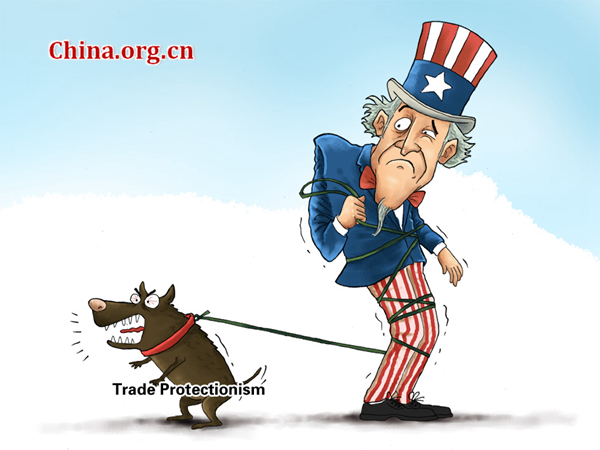
US trade protectionism [By Zhai Haijun / China.org.cn] |
Steve Bannon, U.S. President Trump's chief strategist, rightly identified the key importance of two speeches given by the presidents of China and the U.S. earlier this year. By counter posing the two, Bannon himself intended to praise protectionist statements by President Trump against President Xi Jinping's support of globalization: "I think it'd be good if people compare Xi's speech at Davos and President Trump's speech in his inaugural…. You'll see two different world views."
Unfortunately for Bannon, most international commentators arrived at the opposite evaluation. Support for Xi's policy approach came from groups well beyond those invariably sympathetic to China. Ian Bremmer, president of the Eurasia Group, the most influential Western "risk analysis" company, for example noted: "Davos reaction to Xi speech: Success on all counts."
But while support for Xi Jinping's approach was perhaps to be anticipated internationally, because of its opposition to protectionism, what is not so generally understood is that China's support for globalization is far more in the interests of the U.S. population than is protectionism. Analyzing factually why is therefore this article's focus.
An example of the U.S. tire industry
The most obvious effect of U.S. tariff protectionism would be to put up prices to U.S. consumers. If tariffs were placed on imports from China, the price of innumerable purchases by U.S. consumers, from higher end items such as iPhones to cheap consumer products, would rise, thereby lowering U.S. living standards. But some people may argue that "OK the U.S. cost of living will go up, but this will be compensated for in other ways." Therefore, it is important to be clear that: "No, the rising U.S. cost of living will not be compensated for in other ways. The U.S. population will simply be worse off with protectionism."
The reasons why can be illustrated clearly starting with a case study. One of the most important recent examples of U.S. protectionism was in September 2009 with imposition of a U.S. tariff on import of Chinese tires. President Obama, in his 2012 State of the Union address, claimed over a thousand jobs had been preserved in the U.S. tire industry by this. But this was a pure distortion of the overall effects because the president did not mention far more jobs were lost in the rest of the U.S. economy due to this policy than were saved in U.S. tire manufacturing, while the cost to U.S. consumers was quite extraordinarily high. Indeed, it would have cost less than one twentieth as much if rather than the tariff being introduced instead the tire workers had been subsidized to the full cost of their salaries.
The economic calculations on this are clear and readers are recommended to the study "U.S. Tire Tariffs: Saving Few Jobs at High Cost" by Hufbauer and Lowry of the Peterson Institute for details, which the following summarizes.
U.S. tariffs reduced tire imports from China by 67 percent. As it was a country specific tariff the great majority of Chinese tires were replaced by Mexican, Thai, Indonesian and other imports. Nevertheless, employment in the U.S. tire industry rose by 1,200 - hence President Obama's claim.
Tire imports from other countries were more expensive than China so the annual increase in the cost of tires to U.S. customers rose by $1.1 billion. Consequently 1,200 U.S. tire jobs were saved at a cost of $1.1 billion - over $900,000 each.
Furthermore, the average annual salary of U.S. tire workers was $40,070. Therefore:
? It would have been cheaper to subsidize the workers directly than impose the tariff.
? Less than 5 percent of the cost of the tariff went to tire workers, the rest was taken by tire manufactures and others - as shown by U.S. tire prices rising almost 5 percent a year faster than the average producer price index following the tariff. U.S. customers therefore had lower living standards due to this higher inflation.
As Hufbauer and Lowry accurately noted: "Most of the money extracted by protection from household budgets goes to corporate coffers, at home or abroad, not paychecks of American workers. In the case of tire protection… fewer than 5 percent of the consumer costs per job saved reached the pockets of American workers ($48 million out of $1,112 million)."
Indirect costs of protectionism
But these were only direct costs to the U.S. economy and population. The indirect negatives for U.S. living standards and jobs were more severe.
The $1.1 billion extra spent on tires could not be spent on other items, therefore other parts of the economy had lower sales and consequently suffered job losses. As "U.S. Tire Tariffs: Saving Few Jobs at High Cost" concluded: "By dividing the total number of workers employed in the retail services at the end of 2011 by annual sales… 3,507 retail sales jobs are created in the United States for every one billion dollars spent in the domestic retail market. The tire safeguards extracted an estimated $1,112 million annually from U.S. consumers; at the same time, the safeguards put $48 million in the pockets of otherwise unemployed tire workers. The net effect was to reduce consumer spending on other retail goods by about $1,064 million, indicating that the safeguard tariffs probably cost around 3,731 jobs in the retail sector…. when the retail job loss figure is offset against… 1,200 manufacturing jobs saved, it appears that safeguards actually cost the American economy around 2,531 jobs."
The effect of the tire tariffs was therefore to cost U.S. customers $1.1 billion and reduce the number of U.S. jobs by 2,500!
There were possibly also other indirect losses. China raised tariffs on U.S. chicken part imports soon after U.S. tariffs were imposed on China's tire exports - producing a 90 percent fall in U.S. chicken part exports to China. China officially denied there was any connection between these actions, but many economists point out that retaliation is usually an inevitable part of trade wars.
Therefore "U.S. Tire Tariffs: Saving Few Jobs at High Cost" concluded: "The big winners from the 2009 safeguard tariffs were alternative foreign exporters, primarily located in Asia and Mexico, selling low-end tires to the United States. Domestic tire producers were secondary beneficiaries. The members of the labor union that petitioned the ITC's investigation received only a small share of the money extracted from the pockets of American households… Jobs created in the tire manufacturing industry were more than offset by the loss of jobs in the U.S. retail sector. As an added consequence, U.S. chicken firms lost export sales in the wake of Chinese retaliation."
Alongside these losses in the U.S., Chinese tire makers also lost. This can accurately be described as a "lose-lose" outcome for both China and the U.S.
The overall costs of protectionism
It is important to be clear that the $900,000 cost per job "saved" in the tire industry in this case was not some extreme untypical example. Extraordinarily high costs for job "protection" by tariffs are typical as findings have been repeatedly confirmed over a long-time period. A 1986 survey of 31 industries found the cost to consumers per job "saved" in industries with protectionism ranged, in 2016 prices, up to $2.2 million and averaged $516,000. A study in 1994 found that the average cost of protecting a job in the U.S. by tariffs at that time was $275,000 in 2016 prices. The estimated cost of saving a job in the U.S. steel industry in 2001 by tariffs was $490,000 at today's prices.
So expensive are jobs "saved" in industries by protectionism that they cannot be used on a large scale - other factors affecting U.S. jobs are far more powerful. As Nobel Prize winning U.S. economist Paul Krugman noted: "The level of employment is a macroeconomic issue… with microeconomic policies like tariffs having little net effect." Indeed, as with tires, the microeconomic effects on jobs of tariffs are likely to be negative.
Consequences for U.S. exporters
It should be noted that so far only negative effects within the U.S. have been analyzed. But increased costs in the U.S. economy due to tariffs also raise the international cost base of U.S. companies, thereby negatively affecting U.S. exporters. Approximately one in eight U.S. goods and service is exported, therefore the negative domestic effect of U.S. tariffs extends into the international field depressing jobs and wages in U.S. exporting companies. As Mark Perry, University of Michigan professor of finance and economics, noted in an analysis with the self-explanatory title "How Trump's tactics for saving U.S. jobs could kill them instead:" "Trump's attempts to 'bring jobs back to the U.S.' or 'keep jobs from leaving the U.S.' will likely backfire and kill U.S. jobs in the long run."
Rick Newman, in an article at Yahoo Finance, analyzed the process whereby this occurred: "Pressuring companies to accept higher production costs, which Trump is essentially doing, could easily backfire and destroy more jobs than if Trump were to do nothing." Specifically analyzing pressure put by President Trump on U.S. air conditioner manufacturer Carrier, Newman noted: "Carrier's competitors include Trane and American Standard, both owned by Ingersoll-Rand, which is based in Dublin, Ireland; Rheem, headquartered in Atlanta; and Goodman, owned by Daikin, a Japanese conglomerate. Each has manufacturing operations all over the world. If any one company has higher costs than another - whether labor, components or anything else - its products will be more expensive than the competition and sales will most likely decline… compared with competitors able to undercut it on price… Businesses bear those higher costs as well, and they'll have less money to hire people if other costs go up."
It is equally a myth U.S. tariffs will protect "high paying," "middle class" U.S. jobs compared to "low paying jobs." As Tim Worstall at Forbes noted, analyzing trends since the 1980s: "America has lost some 7 million manufacturing jobs and added some 53 million jobs in services. This is just what happens with advanced economies… over time, [just as] the proportion of the workforce engaged in agriculture falls, so too does the proportion in manufacturing…
"Further, of those 53 million new jobs some 62 percent of them were in higher paying occupations than those 'high paying good jobs' in manufacturing we lost. Yes, really, 33 million higher paying jobs came along to replace those 7 million lost."
Such realities regarding tariffs, naturally, do not mean that the U.S. population should not be demanding measures to improve their wages and job prospects. It is simply that tariffs are not the method to achieve this. Instead measures such as job training, education and infrastructure investment are what is required.
"US Tire Tariffs: Saving Few Jobs at High Cost" put the real alternative to tariffs very precisely: "Tariffs extracted more than one billion dollars annually from American households, causing a net loss of jobs in the American economy, when job losses in the retail sector are off set against job gains in the manufacturing sector. Collecting a billion dollars in taxes or tolls, and spending the money on renewing dilapidated infrastructure, would create some 7,000 jobs in construction and many more in manufacturing, a far better outcome for the US economy."
John Ross is a columnist with China.org.cn. For more information please visit:
http://www.jhzsvip.com/opinion/johnross.htm
Opinion articles reflect the views of their authors, not necessarily those of China.org.cn.


