Reducing inequality remains a challenge
- By Zhuang Juzhong
 0 Comment(s)
 Print
Print E-mail China Daily, November 8, 2016


|
|
|
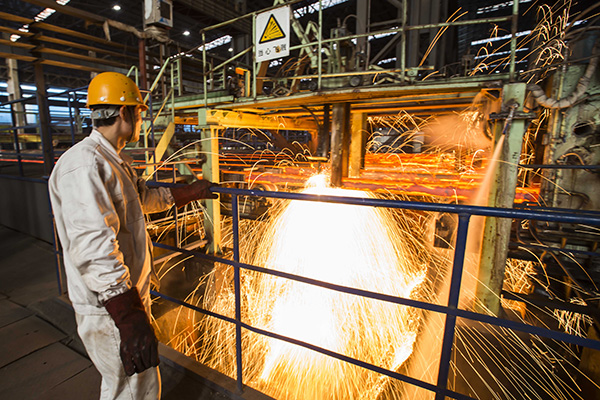
A worker at a steel company in Lianyungang, Jiangsu province, in Jan 2015.[Photo/China Daily] |
After nearly 40 years of market-oriented reforms, private wealth accumulation in China has accelerated dramatically, leading also to a massive reduction in poverty. But inequality has soared. By 2008, China's Gini coefficient of per capita household disposable income, a measure used by economists to estimate inequality (with 0 denoting complete equality and 1 complete inequality), had reached 0.491-making it one of the most unequal societies in the world.
Over the past eight years, however, China's inequality has been on the decline. The Gini coefficient has been falling each year, although marginally, reaching 0.463 in 2015. This has led many to speculate that China has reached the so-called "Kuznets turning point", where income inequality peaks and then begins to fall.
The reality is far more complex. While a combination of structural factors and government policies have helped reduce China's income disparities, there is no guarantee that inequality will continue to fall.
A prominent feature of the rise in China's inequality has been the growing gap between rural and urban incomes. This peaked in 2007, with urban households earning 3.3 times as high as their rural counterparts. But, as the pool of surplus labor shrinks in rural areas, incomes and productivity there are increasing significantly, and the urban-rural income gap has begun to fall.
Similarly, inequality in provincial per capita income-a measure of regional disparity-peaked in 2003 and has been declining since. Studies credit this to large government investments in power, regional connectivity and human capital in the interior provinces, making them develop faster than the coastal areas. Rapidly rising minimum wages are also a contributing factor.
Another feature of China's inequality has been the falling share of labor income to overall income. Recent data suggest that since 2008, workers have started to see larger shares of income. This is largely due to the decline in surplus labor from rural areas.
These are encouraging developments. But it is far from certain whether China's income inequality has peaked and will continue to decline. Inequality in the distribution of wealth, which includes factories and machines owned by households, financial assets, and properties, has more than doubled in 25 years. Wealth inequality contributes to income inequality.
One of the underlying factors of the Kuznets hypothesis is that, as a country becomes more advanced, there will be greater income redistribution through taxation and transfers. Indeed, this was the model in many Western countries. However, income redistribution through taxation and transfers play a much more limited role in China. The pre-tax and pre-transfer income inequality is not very different from the post-tax and post-transfer inequality in China while the latter is one-third lower in high-income countries.
The limited role of redistribution through fiscal measures in reducing income inequality in China is consistent with the fact that the country's total personal income tax revenue currently amounts to less than 1.5 percent of GDP, compared with high-income countries' ratio of 10 percent on average.
The need therefore is for greater redistribution through tax policy. Tax reforms coupled with ongoing inclusive growth programs in the areas of education, healthcare, social protection and the hukuo, household registration system should allow China to see further and more significant reductions in income inequality.
This will not be easy. China's new middle class may not be willing to accept larger taxes without something in return. The government will have to continue to work on increasing efficiency and quality in delivering public services.
Enacting major fiscal reforms is certainly a challenge, but China has shown time and again its nimbleness in policymaking and implementation. The government has indicated that personal income tax reform will be a policy priority going forward.
Income redistribution through taxation and transfers will have to play an increasingly important role as China continues to grow, if benefits of growth are to reach the wider population and if it is to deliver on the promises of opportunity and equality for all.
The author is deputy chief economist at the Asian Development Bank.


