Deng Xiaoping - the world's greatest economist
- By John Ross
 0 Comment(s)
 Print
Print E-mail China.org.cn, August 22, 2014


August 22, 2014 is the 110th anniversary of the birth of Deng Xiaoping. Numerous achievements would ensure Deng Xiaoping a major position in China's history – his role in shaping the People's Republic of China, his steadfastness during persecution in the Cultural Revolution, his extraordinarily balanced attitude even after return to power towards the development and recent history of China, his all-round role after 1978 in leading the country. But one ensures him a position among a tiny handful of people at the peak not only of Chinese but of world history. This was China's extraordinary economic achievement after reforms began in 1978, and the decisive role this played not only in the improvement of the living standards of Chinese people but the country's national rejuvenation. So great was the impact of this that it may objectively be said to have altered the situation not only of China but of the world.
|
|
|
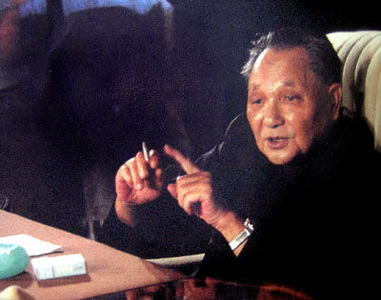
Deng Xiaoping [file photo] |
China's economic performance after the beginning of its 1978 reforms simply exceeded the experience of any other country in human history. To give only a partial list:
? China achieved the most rapid growth in a major economy in world history.
? China experienced the fastest growth of living standards of any major economy.
? China lifted 620 million people out of internationally defined poverty.
? Measured in internationally comparable prices, adjusted for inflation, the greatest increase in economic output in a single year in any country outside China was the U.S. in 1999, when it added US$567 billion, whereas in 2010 China added US$1,126 billion – twice as much.
? During the beginning of China's rapid growth, 22 percent of the world's population was within its borders – seven times that of United States at the beginning of its own fast economic development.
Wholly implausibly, it is sometimes argued that this success was merely due to "pragmatism" and achieved without overall economic theories, concepts, or a leadership really understanding the subject (particularly with no knowledge of U.S. academic economics!). If true, then the study of economics should immediately be abandoned – if the greatest economic success in world history can be achieved without any understanding of the subject, then it is evidently of no practical value whatever.
In reality this argument is entirely specious. Deng Xiaoping's approach to economic policy was certainly highly practical regarding application – the famous "it doesn't matter if a cat is black or white provided it catches mice." But it was extremely theoretical regarding foundations – as shown clearly in such works as In Everything We Do We Must Proceed from the Realities of the Primary Stage of Socialism, We Are Undertaking An Entirely New Endeavour, and Adhere to the Principle to Each According to his Work. Deng Xiaoping's outstanding practical success was guided by a clearly defined theoretical underpinning, which can be understood particularly clearly in its historical context and in comparison with Western and other economists.
As is generally known, after 1949 the newly created People's Republic of China constructed an economy, fundamental elements of which were drawn from the Soviet Union. It is important to understand that there was nothing irrational in this – the USSR, up to that time, had the world's most rapidly growing economy.
Indeed, the immediate post-1929 success of the USSR was of extraordinary dimensions. During 1929-39 the USSR achieved 6 percent annual GDP growth, which until then was by far the fastest ever achieved by a major economy, and almost twice the historical growth rate of the United States. Despite colossal destruction in World War II, by 1949 the USSR had already regained its prewar production level.
The elements which produced such historically unprecedented economic growth were clear. From 1929, Stalin, with the First Five Year Plan, launched the USSR on an economic policy never previously attempted in any country – construction of a national basically self-enclosed administered economy. Resources were not allocated by price but by material quantities – a steel factory did not buy iron ore on the market but had it allocated by administrative decision. Foreign trade was minimized. State ownership was applied even to small scale private enterprises such as restaurants. Farmers' small holdings were eliminated and agriculture organized into large scale collective farms.
Despite verbal claims that this policy was "Marxist," Stalin's economic structure was in fact radically at variance with that of Marx himself. To use the Marxist terminology common to both China and the USSR, Soviet economic policy in 1929, in a single step, replaced economic regulation by prices (exchange value) by allocation by material use (use value).
Marx had written a socialist state would: "wrest, by degree, all capital from the bourgeoisie, to centralize all instruments of production in the hands of the state... and to increase the total productive forces as rapidly as possible." In writing "by degree" Marx clearly envisaged a period during which state owned and private property would both exist. Instead, in the USSR in 1929 essentially all property was taken into the state sector.
The very word "socialism" is derived from "socialized" (i.e. large scale) production – not small scale peasant output. However in the USSR, after 1929, even small scale peasant plots were taken into state ownership – prior to their administrative elimination. However, simultaneously with suppression of small scale private output, the advantages of very large scale production were eliminated by the nationally self-enclosed character of the USSR's economy – a U.S. aircraft manufacturer like Boeing sold into the world market, but a Soviet manufacturer such as Ilyushin could produce aircraft only for the far smaller Soviet economy.
Soviet economists who pointed out these issues were executed by Stalin for doing so, but in any case such criticism appeared "theoretical quibbles" compared to proven Soviet economic success.
After 1945 this dynamic changed. In 1929 the global economy had been collapsing into "autarchic" states or empires. The United States, the British Empire, Japan and Nazi Germany, were cut off from each other by tariff walls. The international monetary system, the Gold Standard, collapsed without replacement. Amid such global economic chaos, the autarchic socialist USSR far outperformed autarchic capitalist economies.
But following World War II, the integrated world economy was gradually rebuilt. A new international payments system, the dollar standard, was created. Tariffs were reduced. The Soviet economy was small compared to this new world economy, and could not be integrated into it without relaxation of its planning system – as global economic fluctuations could not be planned for. Collectivized Soviet agriculture was unproductive and the USSR's consumer goods of low quality, due to Stalin's insistence on overwhelming priority to heavy industry – in Stalin's words: "What does a fast rate of development of industry involve? It involves the maximum capital investment in industry." By the 1970s Soviet economic growth, while more rapid than the United States, was far slower than Japan or South Korea – which were selling into the world market.
But, if the USSR's economy was heading to crisis, the free market system, its only existing alternative, was by the 1970s showing its own difficulties. After the 1973 "oil price crisis," most developed capitalist economies decelerated dramatically. The United States both slowed and from the early 1980s began the huge debt accumulation which eventually culminated in the 2008 international financial crisis. When the free market model was applied to the former USSR, from 1992 onwards, it led to the greatest economic collapse in a major economy in peacetime in history – Russia's GDP fell by 30 percent.
Confronted with decisive problems in both dominant economic models, instead of remaining trapped within one or the other, Deng Xiaoping embarked on a policy never previously seen – creation of what is now referred to in China as a "socialist market economy."
In one sense, Deng Xiaoping went from the USSR's post-1929 model "back to Marx." Underlying Deng Xiaoping's analysis from 1978, frequently in its literal wording, was Marx's famous "Critique of the Gotha Programme" – his most extensive commentary on the construction of a socialist society.


