The truth about China, statistically speaking
- By John Ross
 0 Comment(s)
 Print
Print E-mail China.org.cn, May 7, 2013


China's economic achievement is so enormous, indeed literally without parallel in human history, that it is sometimes difficult for people to take in its scale. A country which in 1978, when "reform and opening up" was launched, was one of the poorest in the world, has now reached a point where it has a higher GDP per capita than the countries containing the majority of the world's population. Only 30 percent of the world's population now lives in countries with higher per capita GDP than China.
|
|
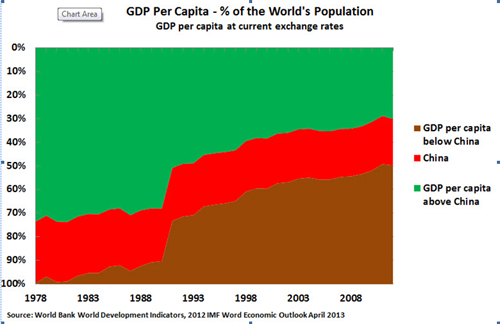
China is, therefore, now in the top half of the world as far as economic development is concerned, and to avoid any suggestions of exaggeration, it should be made clear that these comparisons are at the current market exchange rate measures usually used in China – although calculations in parity purchasing powers (PPPs), which are the measure preferred by the majority of Western economists, makes no significant difference to the result.
The chart also illustrates China's extraordinary progress. In 1978, when "reform and opening up" began, only 0.5 percent of the global population lived in countries with a lower GDP per capita than China, while 73.5 percent lived in countries with a higher GDP per capita. The transition to a situation where China has overtaken the majority of the world's population in per capita GDP is the greatest economic transformation in human history, both in terms of the short time frame required and number of people affected.
Given that the data clearly shows China has progressed into the top half of the world economy in terms of economic development, why do some persist with misrepresenting China as being "in the middle" or even more misleadingly dubbing it a "poor" country by international standards?
Such misrepresentations make elementary statistical errors which are familiar to those who analyze income distribution data. For example the following argument is sometimes presented: The IMF World Economic Outlook database gives GDP per capita statistics for 188 countries with China ranking 94th – therefore China is "in the middle". Another sometimes-cited statistic compares China to the world average – in 2012 China's GDP per capita was 59 percent of this average figure – making China appear a "poor" country.
The problem with this "list" method is that it does not take population into account. For example, the Caribbean state St Kitts and Nevis, population 57,000, has a higher GDP per capita than China while India, population 1.223 billion, has a lower one. To say China is "between the two", as though St Kitts and Nevis and India represent equivalent weights in the world economy, is playing games with words rather than carrying out serious analysis. This elementary statistical rule is particularly relevant given that the number of developed economies with small populations is disproportionately large. The population of countries must therefore be taken into account when calculating China's real relative position in the world economy.
The second mistake, comparing China to the "average", makes an error so well known in income distribution statistics that it is somewhat surprising anyone gives it any credence, let alone continues to propose it.
Statisticians know that averages, technically speaking the "mean", can be disproportionately affected by small numbers of extreme values. It is well known that this applies to incomes within countries as small numbers of billionaires artificially raise average incomes in a way that misrepresents the real situation.
This statistical distortion is clear from international data. Average world GDP per capita, that is world GDP divided by the number of people, is slightly more than $10,000 per year. But only 29.9 percent of the world's population lives in countries with GDP per capita above that level while 70.1 percent live in countries below it. Something with only 29.9 percent above and 70.1 percent below is not most people's idea of an average!
What most people understand by an average, the mid-point, is, in proper statistical terms, not the average but the median. Reputable studies on income distribution, therefore, almost invariably use the median, not averages, to avoid this distorting effect of small numbers of extreme values. Using the statistically misleading average, instead of the mid-point, bizarrely transforms the real situation – that China now has a GDP per capita above that of the majority of the world's population – into giving the impression that China is a poor country!
There are three main reasons why it is important to accurately present China's level of development.
First, policy must be based on accurate analysis – in serious matters there is no virtue in either optimism or pessimism, only in realism. As the famous Chinese phrase tells us, it is better to seek truth from facts.
Second, accurate presentation is necessary to clearly understand the real economic challenges China faces. For example China's GDP per capita is now higher than all developing South and South East Asian countries except Malaysia – clarifying why any competitive strategy for China based on low wages is unviable.
Third, China's position in the top half of the world in terms of GDP per capita makes clear its technological level – China's economy is now dominated by medium, not low, technology.
Does an accurate presentation of China's real level of development endanger its international legal status as a developing economy? The World Bank has not yet published new criteria for the GDP per capita necessary to qualify as an "advanced" economy, but the 2011 criteria and statistical data is available and it tells us that the answer to the question is "no". To classify as "high income", an economy must have an annual GDP per capita of slightly more than $12,000. Only 16 percent of the world's population lives in such economies. It will take 10-15 years for China to achieve "high income" status – although when it does this will more than double the number of people living in such economies.
Achieving the "Chinese dream" requires that the present reality is accurately understood. China has entered the top half of the world's level of economic development. Only 30 percent of the world's population lives in countries with a higher GDP per capita than China. That is the accurate analysis of China's relative position in the world economy. To achieve the "Chinese dream" requires eliminating not only any exaggerated bombast but also any systematic underestimation.
The author is a columnist with China.org.cn. For more information please visit:
http://china.org.cn/opinion/johnross.htm
Opinion articles reflect the views of their authors, not necessarily those of China.org.cn


