The economic gap between China and India
- By Sun Xiaoji
 0 Comment(s)
 Print
Print E-mail China.org.cn, July 6, 2012


The term "Chindia" has existed for a long time. However, it is rare that people use it in China. A few years ago, Pete Engardio, a writer for Businessweek, discussed the rise of China and India in a book titled, Chindia, which came from the combination of the words China and India. The title, however, doesn't mean that China and India will work together towards economic prosperity. On the contrary, I see a big economic gap between China and India. This gap could mean that the economy of India will surpass that of China in the near future.
|
|
|
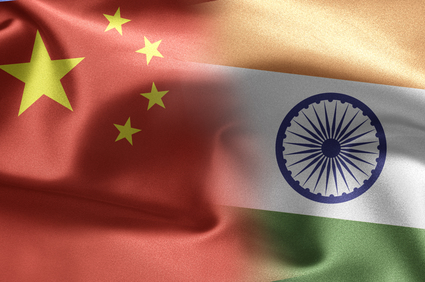
The term "Chindia" has existed for a long time. [File photo] |
After a general comparison, people will find a lot of similarities and differences between the two countries. Main similarities include that they both belong to third world countries, have high rates of economic growth and own huge labor markets. In terms of differences, the structure of their governments, society and culture are the main differentiating features. But more specifically, if you have any knowledge on the contemporary Indian political and economic situation, you will know that the political and economic differences between China and India are far greater than their similarities. These differences will determine the disparity between the two countries' economies. There is a large gap between the countries' economic development models.
Engardio mentioned in his book that China and India have very different business cultures. In China, businessmen emphasize on their so-called "relations" with other businessmen and government officials. The scale of their business depends on the strength of their "relations" with these powerful people. However, in India, although the relations between officials and businessmen are important, the technology, research and development professionals and business managers have more avenues to success than their Chinese counterparts. In India, "relations" are not the only reason for success. On the contrary, innovation, research and development capability and modern enterprise management are the backbone to India's commercial culture.
The difference in economic growth patterns is what is behind the differences in the countries' business cultures. China's economic growth mainly relies on the government's promotion of businesses, which gives state-owned enterprises and banks an absolute advantage. With this strong intervention from the government, capital and labor mobility can be "gathered up" quickly resulting in a very "strong" state-owned economy. It also makes China's economy appear to be very "prosperous" from the outside.
In contrast, small and medium-sized private enterprises are the mainstream in the Indian economy; a lot of these businesses engage in software research and development, innovative technology and service industries. Their survival and development rely on high quality products and services, as well as low prices.
India's business success consists of two things: low-cost and high innovation. Although low labor costs were a common advantage of both China and India in the past, China still focuses on low labor costs. India squeezed in the global "innovation industry chain" while using the advantage of low labor cost. The country changed the price advantage to a research and development, technical advantage by cultivating a large amount of professional research and development talents. As a developing country, innovation in India is much higher than in China.
Of course, Chinese enterprises also talk about "innovation" all the time. Unfortunately, most of these innovations are the vanity projects of officials. The innovation in India is for survival. In fact, India's government had very strict administrative regulations on business before the 1990s. The flow of capital and technology was limited by laws. Hence, it was very difficult to earn money in traditional business. In order to make a profit, a lot of enterprises began to engage in more low-cost software development industries. Then, with the government's complete "deregulation" of industry and commerce in the 1990s, the software development and innovation industries skyrocketed. A lot of top IT talents in India worked in the United States. Moreover, a lot of local IT enterprises undertook software engineering businesses for large U.S. companies. The advantage of this professional work done by Indian engineers who were paid lower wages put a lot of engineers in the U.S. on edge for fear of losing their jobs. In 2003, the United States' government was obliged to cancel a $10 million IT contract with India due to strong public opinion.
This is the gap. When people were talking about the migrant workers in the assembly plants of China's coastal areas as the cause for U.S. manufacturing workers to be laid-off, India's innovation and technology was making the engineers in Silicon Valley worried about their jobs. The total number of engineers in Bangalore surpassed those in Silicon Valley 10 years ago. In addition, the quality is no less than that of Silicon Valley. A lot of Indian engineers have worked in the computer companies of the United States. Furthermore, unlike China, a lot of these engineers graduated in the universities of India. Once Chinese people study and work abroad, their top priority is to get a green card and immigrate to the U.S. Go back to China? That is the most unsatisfactory choice.
In contrast, a large amount of business people choose to return to India to start businesses because they see the chance for success in India. Talents who graduated from Indian universities and have achieved success will give back to their universities through alumni donations. For example, although the Indian Institute of Technology (IIT) was built by the government, it hasn't depended on government funding for a long time due to alumni donations. The country's independent educational philosophy and modern donation mechanism have formed a virtuous circle. Talents support the local economy and education, and a better economy and school funding will cultivate more talents.
In a word, the success of India stems from its economic growth model which is in line with modern capitalism. Government intervention has declined to a minimal level. The creativity of private enterprises has produced a business culture that encourages innovation. More importantly, a high-quality university education has provided the basic premise for success – high quality talents.
India's population will exceed 1.4 billion by 2020; 47 percent will be 15 to 59 years old, compared to the current 35 percent. In other words, India will have a more abundant labor resource in eight years. A lot of these citizens are highly educated, have work experience in multinational corporations and know modern business rules. China's population will also increase, but its economic growth model will largely remain the same. However, the ageing population will hurt the labor resource advantage that China has, which will deteriorate in quality due to a larger percentage of people over the age of 60.
(This post was first published in Chinese and translated by Lu Na.)
Opinion articles reflect the views of their authors, not necessarily those of China.org.cn


