In early 1980s, the
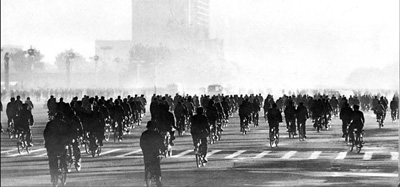
Chang'an Avenue was still a street mainly for cyclists in
Beijing.???????????
Roused in the morning by loudspeakers broadcasting propaganda.
Banned from traveling outside international zones. Drinking
Five-Star liquor at one of the few international hotels because it
was the only place with air conditioning. Life has changed
dramatically for expats in China since the "cultural revolution"
(1966-76).
Today, foreigners come in their tens of thousands and live where
they choose and travel where they like. Broadband connections keep
them in touch with friends and family around the world. They
download their favorite programs or music and buy the latest DVD
movie.
Expats who knew the country then and now say China is no longer
unique. It has an international uniformity. The infrastructure,
stores and brands are much the same as anywhere else in the world.
They look back, sometimes with rose-tinted spectacles, on the way
China used to be.
CNN bureau chief Jaime FlorCruz was one of 15 students and youth
leaders from the Philippines invited here for a three-week study
tour in 1971, by the Chinese People's Association for Friendship
with Foreign Countries. The 20-year-old's first impression of
Beijing was of it being "steeped in revolutionary fervor".
"Mao (Zedong) statues and billboards with Mao's quotations stood
tall in strategic places. His Little Red Book and other propaganda
materials were available in various languages, in many places for
free. The Chinese we met all wore Mao jackets and caps, mostly in
colors of blue and green," he said.
"We occasionally spotted detachments of Red Guards and civilian
militia marching otherwise, Beijing's streets seemed calm and
clean. Mostly we saw cyclists - tens of thousands of them - going
to and from work."
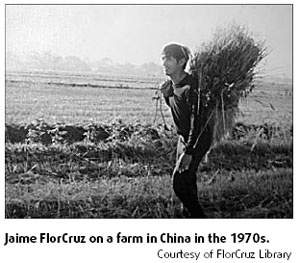
FlorCruz, an exile from the Ferdinand Marcos-led Philippines,
experienced the trials and tribulations of life in China the
following year when he was sent to the countryside. He briefly
became a farmer in Hunan Province and a fisherman in Shandong
Province. He returned to Beijing a few years later to study Chinese
history and later became a reporter for Newsweek and
Time.
There were few foreigners allowed into China during this period,
especially from Western countries. FlorCruz said those that did
make it were "segregated" and assigned housing according to their
status. Students stayed in dormitories, foreign experts were
billeted in apartments at the Friendship Hotel, while diplomats
were ensconced in diplomatic compounds. Foreigners did not have the
right to choose accommodation until 2003.
Not allowed
"Chinese took risks to befriend foreigners. They could get into
trouble from their work unit, their bosses, or the police for
simply being too cozy with foreigners. They faced the prospect of
being accused of leaking secret information or spying. Until the
mid-1970s, liaisons and marriage between Chinese and foreigners
were taboo. The friendships I made then have stood the test of
time."
FlorCruz said there were just two hospitals for expats at that
time. There wasn't much to do socially except "go to theaters to
watch yangbanxi, or model Peking opera, or modern dramas, go to
movie houses and watch revolutionary-themed films".
Until the mid-1980s, foreigners in Beijing were confined to a
radius of 20 km, from Tian'anmen Square. There were roadblocks to
control their movement outside the city and signs warned,
"Foreigners are forbidden to pass without permission", according to
a Xinhua report on the era, reprinted in the China Daily
three years ago.
The article painted a picture of James Harkness' life as a World
Wildlife Fund representative in China, 1976. He is quoted as saying
it was an "isolated, mysterious country" and added that it wasn't
until the 1990s that the "feeling of confinement" passed. Beijing
was fully opened to tourists in 1995 and "green cards" were
introduced in 2004.
Tess Johnston arrived in 1981 to work at the American Consulate
General in Shanghai. It was closed 30 years previously because of a
Cold War freeze, but opening its doors was a sign that China was
back on the world stage. Johnston said she fell in love with the
country and after retiring from the US foreign service in 1996, she
settled in Shanghai as a historian and author.
"China was on a more human scale then, people were the priority.
There were very few foreigners, no traffic, and no cars. They were
shabby, but intact and full of people. Everyone wore suits and the
women wore no makeup. There was very little glitz or glamour," she
said.
World stage
Johnston said one of her most vivid memories was of people in
the summers living on the streets, not because they didn't have
homes, but because there was no air conditioning.
"There was no chasm between the rich and the poor, everyone was
in the same boat," she said.
"There were little factories everywhere, industrial and coal
pollution, but no noise pollution. We bought our groceries from the
Friendship Stores and the rest of the stuff was bought in sacks.
Fruit was scarce, just apples, nothing imported."
At the time, foreigners were not supposed to pay for goods in
cash, but had to use instead Foreign Exchange Certificates, a
quasi-currency.
Johnston said there was little development outside of Shanghai's
city limits. Now there are gated communities and businesses forming
a dense urban spread. The hutong in Beijing and the shikumen in
Shanghai have been cleared away and instead of horizontal
development, buildings are going up.
"China has lost much of its uniqueness. It's all high rises
these days. Then, you knew you were in China, not just in another
country," she said.
As for social life, she said the expat community was more
self-reliant then. Everyone knew each other and there was a clearly
defined expat scene. "Now, it's much more mixed really. Today, the
divide is economic. Then, segregation was along national
lines."
Old hands
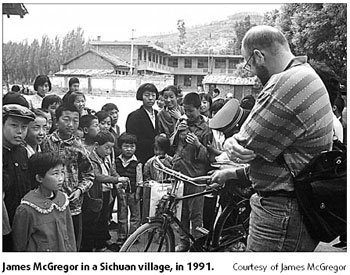
James McGregor was a reporter in Washington in 1985 when he
decided to backpack around China and see what it had to offer. He
recalled getting a tourist visa was a "rigmarole" and his first
impressions of the country were formed after being woken up in
Guangzhou by propaganda announcements, having traveled the previous
day from Hong Kong.
"I remember going to the Jianguo Hotel because it was the only
place with air conditioning. There wasn't much to do, so most of
the time we ended up wandering the streets. There were lots of
beat-up pool and ping-pong tables made of concrete," he said.
Like many other "old hands" the former Wall Street Journal
Bureau chief in Beijing, who is now a businessman and author of One
Billion Customers, said traveling by train was the best way to meet
Chinese people. Journeys on the "iron horses" could take days and
were in cramped but sociable conditions.
"I love Chinese trains, especially in the old days. Everyone was
amazed to see foreigners traveling. I remember a trip from Chengdu
to Beijing. People tried practicing their English and there was a
Chinese opera troupe from Sichuan (Province). They started goofing
around playing folk songs, then everyone joined in, including
us."
McGregor said China's makeover in the past 30 years has
transformed its cities into simulacrums of Western conurbations,
with all their conveniences, and more.
"I returned to China in the 1990s as a journalist, interested in
representing the world of business, so I saw a different aspect.
Everyone wanted to show me the economic zones and stuff. I remember
the vice-mayor of Shanghai outlining his plans for Pudong and I
thought they might do something in 30 years or so. It took a third
of the time and I wish I had bought in then."
From an expat point of view, McGregor said, the major difference
between 30 years ago and today is that foreigners used to be a
novelty. The figures tell the story. In 1979, there were 5.7
million visitors to China, according to the China National Tourism
Administration. Last year there were 124 million inbound travelers,
ranking fourth in the world.
Chinese people used to be curious about the outside world, now
they know all about it. Then they had time to talk, now they are
busy making money, McGregor said.
"In the old days people had more time. You will understand what
I mean if you go to a small village in the countryside. Where you
get off the beaten track. There, it is still the same old
China."
(China Daily December 6, 2007)