In the latter half of the 20th century, especially in the two decades after the initiation of reform and opening to the outside world, China's industry has developed rapidly. Between 1979 and 2000, the average annual growth rate of industrial increments reached 11.6 percent, as calculated in constant prices. In 2002 the combined assets of all the state and non-state industrial enterprises with annual product sales income topping five million yuan amounted to 14,479.1 billion yuan, and the nation's industrial added value came to 4,593.5 billion yuan, an increase of 10.2 percent over that of the previous year.
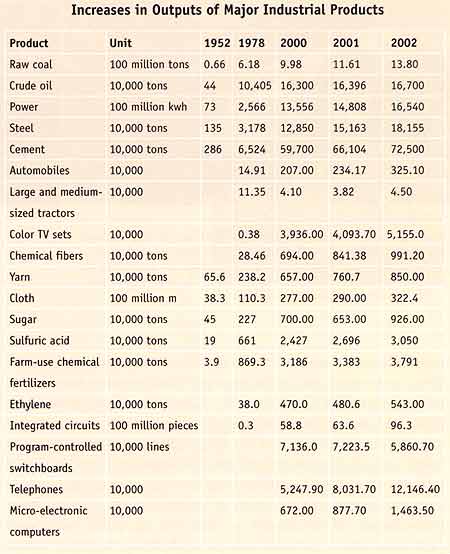
In the past five decades and more, major industrial products have increased by dozens or even hundreds of times, and many industrial products have been sold all over the world. Since 1996, China has led the world in the production of steel, coal, cement, farm-use chemical fertilizers and television sets.
Diverse Economic Sectors
In 1978, China had only the public-ownership economy, state-owned enterprises making up 77.6 percent and collectively owned enterprises, 22.4 percent. The policy of reform and opening-up has given extensive scope to the common development of various economic sectors. The individual and privately owned industrial enterprises and enterprises with foreign, Hong Kong, Macao or Taiwan
investments have developed rapidly. In 2002, of the total industrial added value of state-owned and non-state industrial enterprises with annual product sales income topping five million yuan, state-owned and state-owned holding enterprises made up 52.8 percent; collectively owned enterprises 8.8 percent; and non-public enterprises (including enterprises with foreign, Hong Kong, Macao or Taiwan investments, individual and privately owned enterprises) accounted for the rest. A lively situation had arisen, in which diverse economic sectors exist side by side.
The Reform of State-owned Enterprises
The reform of state-owned enterprises has always been the key link of China's economic restructuring. The Chinese government has made various experiments, trying every means to solve the problem of long-term, extensive losses incurred by state-owned enterprises. By 2002, of the 4,371 key enterprises in China, 3,322 enterprises had undergone reform and adopted the company system, making up 76 percent of the total; and over 90 percent of the medium-sized and small enterprises had reformed their systems. A number of Chinese state-owned enterprises, such as the China Petroleum and Natural Gas Group, China Petrochemical Group, China Offshore Oil Company and China Mobile, have been listed one after another overseas—another indication of the substantial progress made in the establishment of a modern enterprise system by state-owned enterprises in China.In 2002, Chinese companies made their debut appearance in the Far Eastern Economic Review publication of its annual survey of the top 200 Asian companies. Haier, the appliance maker, topped the list of the 10 best Chinese enterprises.Haier was followed by Legend, the computer maker; China Mobile; the Industrial and Commercial Bank of China; Shanghai Automobile Industrial Corporation Group; PetroChina Company Limited; Sinopec; China First Automobile Group; China Telecom and the Bank of China. The Far Eastern Economic Review made its selection based on rankings by the China Enterprise Evaluation Association (CEEA), an affiliated organization of the DevelopmentResearchCenter of the State Council, as reported by the China Economic Information Network.
In 2002, the total added value of state-owned and state-owned holding industrial enterprises came to 1,663.8 billion yuan, up by 11.7 percent over the previous year, and total profits came to 263.61 billion yuan. In the same year, most of the industries made up deficits or continually increased their profits. Eleven of China's state-owned enterprises now rank among the world's top 500.
Energy
Of all Chinese industries, the thermal, hydro and nuclear power industries have developed the most rapidly. In the 1990s, the installed capacity of generators increased from 100 million kw to 300 million kw, and to 353 million kw at the end of 2002. At the same time, the total generated electricity came to 1,654 billion kwh. At present, China ranks second in both installed capacity of generators and generated energy in the world.
The construction of power grids has entered the fastest development stage in history. Main power grids now cover all the cities and most rural areas of the country. Power grids of 500 kv have begun to replace the old 220-kv grids in undertaking cross-provincial and cross-regional transmission and exchange operations. An international advanced automatic control system with computers as the mainstay has been universally adopted and has proved practical. The establishment of the six cross-provincial (or cross-autonomous regional) power grids, excluding those in northwestern China, and five independent provincial 500-kv main power grids, and the commissioning of a series of large power stations indicate that China's power industry has entered a new era featuring large generating units, large power plants, large power grids, ultra-high voltage and automation.
The sufficient power supply in China is mainly because of the rapid growth of fuel coal output. Starting from the 1980s, the Chinese government made a great investment in the construction of a large number of modernized coalmines, resulting in the gradual increase of coal output. Since 1989, the annual coal output has maintained more than one billion tons, meeting the needs of the national economic development. Now China has the ability to design, construct, equip and administer 10-million-ton open-cut coalmines and large and medium-sized mining areas. China's coal washing and dressing technologies and abilities have constantly improved and coal liquefaction and underground gasification are being introduced. In 2001 China exported over 80 million tons of coal, becoming the second largest coal exporting country in the world.
Petroleum and natural gas are China's important energy resources. In 1995 the annual crude oil output exceeded 150 million tons, and for six years running from 1997 to 2002, topped the 160-million-ton mark, ranking fifth in the world. The development of oil industry has accelerated the growth of local economies and relevant industries, such as manufacturing, iron and steel industries, transport and communications. In 1996 China's natural gas output was more than 20 billion cu m, a figure that had increased steadily in the following years, and reached 32.66 billion cu m in 2002. The increases in the output of petroleum and natural gas have greatly increased the proportions of the consumption of oil and natural gas in the total energy consumption. The proportions of the consumption amount of petroleum and natural gas in the nation's total one-time energy consumption rose from 17.5 percent and 1.8 percent in 1995 to 23.4 percent and 2.7 percent in 2002, respectively.
Manufacturing and Automobiles
China's manufacturing industry can provide complete sets of large advanced equipment, including power generating equipment such as large gas turbines, large pump storage groups and nuclear power sets, ultra-high voltage direct-current transmission and transformation equipment, complete sets of large metallurgical, fertilizer and petrochemical equipment, city track transport equipment, and new paper-making and textile machinery. Electro-mechanical products have
become pillar exports for China. From 1996 to 2002, electro-mechanical products ranked first in the export volume of China for seven years in succession. In 2002, the export volume of electro-mechanical products reached 157.1 billion US dollars, an increase of 32.3 percent over that of the previous year, or 10.6 percentage points more than the growth rate of the general export trade.
In the 1990s, as one of the country's key industries, the automobile industry developed steadily, and the output of automobiles increased from 1.45 million in 1995 to 2.07 million in 2000, of which the output of cars increased from 337,000 to 607,000, and the number of privately owned automobiles grew from 2.5 million to 6.26 million, of which the number of passenger cars increased from 1.14 million to 3.65 million. In 2001, the output of automobiles in China was 2.342 million, an increase of 13.1 percent over that of the previous year. In 2002 the output of automobiles reached 3.251 million, of which the output of cars topped one million, a record figure in China's annual car production.
Astronautics
China's astronautics industry has followed its own path since its founding in 1956 to become the fifth country in the world to develop and launch man-made satellites independently, and the third country to master satellite recovery technology. China has come out in front in many important technological fields, such as the recovery of satellites, the carry of several satellites by one rocket, rocket technology, and the launch, test and control of static-orbit satellites. Notable accomplishments have been made in the development and application of remote-sensing satellites and communications satellites, and in manned spaceship and communications.
—Satellites. From April 1970, when its first satellite "Dongfanghong No.1" was launched, to the end of 2000, China successfully launched 75 satellites, including 48 developed by China itself and 27 commercial satellites for foreign customers. During the 10th Five-Year Plan period (2001-2005), China will launch about 50 percent of the total satellites it has launched in the past 30 years, and these will include 15 types of satellites, such as communications, navigation, meteorological, resource remote-sensing and space survey satellites.
—Carrier rockets. China has developed the "Long March" series of carrier rockets, in 12 models. Now China is able to launch low-earth orbit, geostationary orbit, sun-synchronous orbit satellites and spaceships. The rate of successful launching reaches more than 90 percent. In the next step, China will develop a new carrier rocket series. By the end of 2002, the "Long March" series carrier rockets had made 69 launchings. Since October 1996, China has made 27 successful launchings in a row. The Jiuquan, Xichang and Taiyuan satellite launching centers built up by China itself have become world-renowned modern launching sites.
—Manned spacecraft. On December 30, 2002, China successfully launched the "Shenzhou IV" spaceship developed by China on its own, from the JiuquanSatelliteLaunchingCenter. It was the fourth experiment in China's manned space engineering efforts (the first experiment being made in November 1999, the second experiment in
January 2001 and the third experiment in March 2002), which was fulfilled by the "Long March II F" carrier rocket, with the same technologies as those of a manned spaceship. Since 1992, when China decided to carry out the manned space engineering project, the astronautics research departments have mastered a large number of key technologies. In future, China will launch a number of unmanned spaceships, and then its first manned spaceship. At present, the training of astronauts is being undertaken according to plan.
New and High Technology
According to statistics, China has made 522,000 important scientific and technological achievements since 1981, of which nearly 20 percent have reached the advanced international levels. To speed up the transfer of scientific and technological achievements, and promote the development of high-tech industry, the Chinese government has implemented a series of policies. At present, over 80 percent of the nation's science and technology force has been engaged in economic development work and the overwhelming majority of the scientific research institutes specializing in developing technology has taken the road of independent development geared to market operations. In recent years, the business volume of the nation's technology market has increased at an annual rate of over 50 percent.
New- and high-tech development zones have developed fast. State-level development zones of this kind now number 53, and well over 600 research findings above the provincial/ministerial level have been put to use in production in those zones. In 2002, high-tech enterprises in these zones totaled 25,000, of which 1,539 had registered an annual production value of over 100 million yuan, 185 over one billion yuan, and 10 over 10 billion yuan, with over one million employees. The annual output value per capita of most of these enterprises exceeded 100,000 yuan. The average annual growth rates of major economic targets of China’s new- and high-tech development zones have maintained 60 percent for 10 years in succession, and they have become important forces to promote China’s national economic growth.
Non-governmental science and technology enterprises also have made great progress. Some of them have become group corporations with an annual output value to the tune of several hundred million or anything up to several billion yuan. High-tech products now account for more than 50 percent of the domestic market for such products.
Establishing export bases for new- and high-tech products in selected state new- and high-tech industrial development zones is an important part of the plan for developing trade by means of science and technology worked out and implemented by the Chinese government. The Beijing Zhongguancun Science and Technology Park and a number of state new- and high-tech industrial development zones in Tianjin, Shanghai, Heilongjiang, Jiangsu, Anhui, Shandong, Hubei, Guangdong, Shaanxi, Dalian, Xiamen, Qingdao and Shenzhen have been designated as the first group of export bases, thanks to their rapid overall development and rapid increase of the export volume of new- and high-tech products. As the Pearl River Delta, Yangtze River Delta and Beijing-Tia
njin region have a large number of export bases of new- and high-tech products, their exports make up over 80 percent of the nation's total new- and high-tech exports. In 2002, the export volume of new- and high-tech products amounted to more than 20 percent of the nation's total.
Environmental Protection Industry
China's environmental protection industry has grown at an annual rate of 17 percent, much higher than that of the national economy in the same period, since the start of the century. In 2002, the total production value reached 220 billion yuan, doubling the 1998 figure. In 1992, the total production value of the nation's environmental protection industry was less than four billion. At present, environmental protection enterprises are predominantly in the more economically developed areas along the coast and rivers in eastern China. Six percent of them are large ones with fixed assets worth over 50 million yuan. According to state environmental protection authorities, more funds will be invested in the environmental protection field in the following years to continue the rapid growth of China's environmental protection industry.
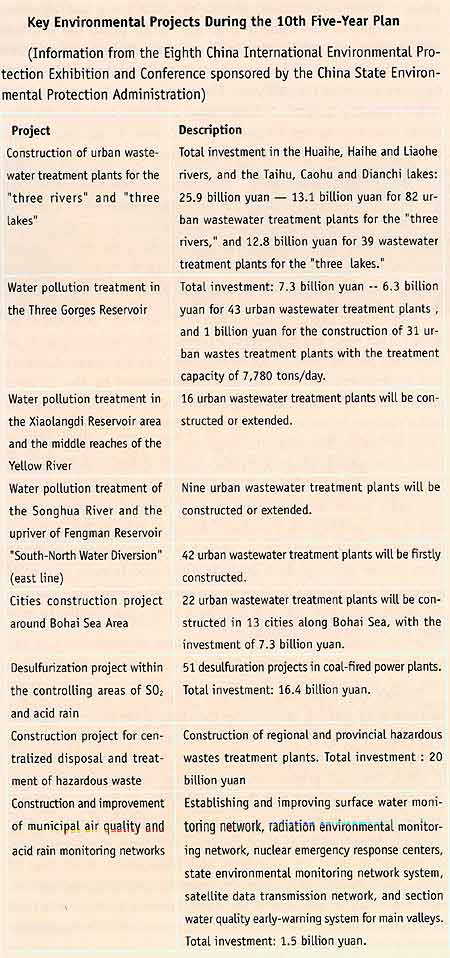
During the 10th Five-Year Plan period, the Chinese government will explore investment channels and put 700 billion yuan in environmental control, an increase of 94.4 percent over the Ninth Five-Year Plan period. With the growth of China's environmental protection industry expected to maintain 15-20 percent during the 10th Five-Year Plan period, environmental protection has attracted international cooperation and investment. For example, the Canada-China Project on Cleaner Production under the Canadian International Development Agency from 1997 to 2002 invested about US$ eight million donated by the Canadian government to help reduce pollution in China's old industrial centers. In 2003, the Canadian Government announced plans to extend this aid.
Information
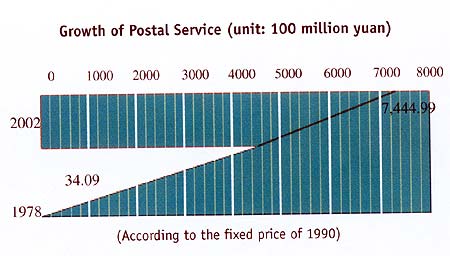
The information industry has become the key industry in China. Statistics show that the output value, sales volume and profit of the electronic and telecommunications equipment industries have all surpassed those of the traditional industries, making the greatest contribution to the growth of the national economy. Posts and telecommunications are an important component of the information industry. After decades of construction and development, the national postal network—with Beijing and other major cities as the center—links all cities and rural areas in China. By the end of 2002, China had more than 70,000 post offices, including more than 20,000 with comprehensive functions, which made up over 28 percent of the nation's total.
As for the construction of the telecommunications network, a basic transmission network featuring a large capacity and a high speed is now in place. It covers the whole country, with optical cables as the mainstay, and satellite and digital microwave systems as the supplement. In 1998, China completed its "eight from east to west and eight from north to south" lattice-type optical cable network, linking all the provincial capital cities and over 90 percent of counties and cities. With the exception of Lhasa, the capital city of Tibet, each provincial or autonomous regional capital is connected by at least two optical cables. At the end of 2002, the nation's optical cables extended 2.25 million km. In the coastal and economically advanced hinterland areas, optical cable has reached townships, towns, urban residential quarters and multi-storied buildings, thus becoming the main technological means for transmitting information. Meanwhile, all the provinces have set up satellite communication earth stations, with more than 20,000 satellite circuits, and digital microwave routes stretching more than 60,000 km. China has participated in the construction of a number of international land and sea-bed optical cables, such as the China-Japan, China-ROK and Asia-Europe sea cables, and Asia-Europe and China-Russia land optical cables. China initiated the construction of the 27,000-km Asia-Europe Land Optical Cable, which starts from Shanghai in the east and reaches Frankfurt in Germany in the west, passing through 20 countries. It is the longest land optical cable system in the world today. At present, China engages in telecommunications business with more than 200 countries and regions.
At the end of 2002, the total capacity of office exchanges reached 284 million gates and the number of fixed phone subscribers came to 21.44 million. All the cities above the county level had program-controlled telephone switchboards, and program-controlled telephones made up 99.8 percent of the telephones. There were 5.782 million circuits for long-distance business, with all the circuits automated.
In 1987, China started the mobile telecommunication business, which has developed rapidly since 1990, with an average annual growth rate of more than 100 percent. By the end of 2002 the mobile phone network covered all the large and medium-sized cities, and more than 2,000 small cities and county towns. With over 206.62 million mobile phone users, China has established automatic roaming with over 120 countries and regions.
In 1992, China started the large-scale construction of the public data telecommunications network, which has now taken initial shape, with group exchange data network, digital data network, computer Internet, multi-media telecommunications network and frame relay network as the mainstay, covering over 90 percent of counties and cities in China. The telecommunications ability reaches 610,000 ports, making it one of the largest public data telecommunications networks in the world. China has also put great efforts into the international telecommunications business, which has basically met the needs of the opening-up.
During the 10th Five-Year Plan period (2001-2005), the public telephone network will be more than doubled in scale and have a total of 200 to 300 million users, and will offer ordinary services as well as Internet on-line services to rural, border and remote areas, the latter being the major sector of growth. Mobile communications will continue to grow rapidly, and the number of users will reach about 300 million. The Internet and relevant services will develop rapidly too, and the number of users will rise to more than 200 million. A new broadband high-speed public information network on the basis of IP technology will develop rapidly. E-commerce, distance education and various other network-based forms of digital economy and social activities will be promoted. Radio and TV networks will continue to develop rapidly, and the number of radio and TV users is scheduled to exceed 200 million by 2005, when almost all villages in China will then have access to radio and TV programs.