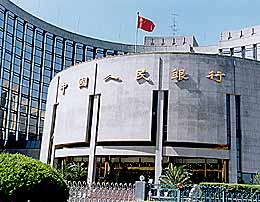
In the past few decades, the People's Bank of China has exercised the central bank's functions and powers, as well as handling industrial and commercial credits and savings business. Therefore, it was neither the central bank in the true sense, nor a commercial entity conforming to the law of the market economy. But since the adoption of reform and opening-up in 1979, China has carried out a series of significant reforms in its banking system, and strengthened its opening to the outside world. Consequently, the finance industry has
developed steadily. By the end of 2002, the balance of home and foreign currency savings deposits stood at 18,338.8 billion yuan and the balance of home and foreign currency loans came to 13,980.3 billion yuan. Now China has basically formed a financial system under the regulation, control and supervision of the central bank, with the state banks as the mainstay, featuring the separation of policy-related finance and commercial finance, and the cooperation of various financial institutions, and mutual complementarities in terms of functions.
In 1984, the People's Bank of China stopped handling credit and savings business, and began formally to exercise the central bank's functions and powers by conducting macro-control and supervision over the nation's banking system. In 1994, the Industrial and Commercial Bank of China, the Bank of China, the Agricultural Bank of China and the Construction Bank of China were transformed into state-owned commercial banks; and three policy-related banks, i.e., the Agricultural Development Bank of China, the State Development Bank and the China Import and Export Bank, were founded. In 1995, the Commercial Bank Law was promulgated, creating the conditions for forming the commercial bank system and organizational structure, and providing a legal basis for changing the specialized state banks to state-owned commercial banks. Since 1996, the financial organizational system gradually has been perfected; the commercial banks wholly owned by the state have been transformed into modern financial enterprises handling currencies; over 120 share-holding medium-sized and small commercial banks have been set up or reorganized; and securities and insurance financial institutions have been further standardized and developed.
The Renminbi and Foreign Exchange Control
The Renminbi (RMB), China's legal currency, is issued and controlled solely by the People's Bank of China. The exchange rates of the Renminbi are decided by the People's Bank of China and issued by the State Administration of Exchange Control. China operates foreign exchange in a unified way, with the State Administration of Exchange Control exercising the functions and powers of exchange control.
In 1994, China reformed the foreign exchange system, combined the Renminbi exchange rates, adopted the bank exchange settlement system and set up a unified inter-bank foreign exchange market. On this basis, China included the foreign exchange business of the foreign-invested enterprises in the bank's exchange settlement system in 1996. On December 1, 1996, China formally accepted Article Eight of the Agreement on International Currencies and Funds, and realized the Renminbi's convertibility under the current account ahead of schedule. Meanwhile, China has been active in promoting the bilateral currency exchange between the Association of Southeast Asian Nations, and China, Japan and the Republic of Korea (10+3). Especially when confronted with the Asian financial crisis, the Chinese government declared that the exchange rate of the Renminbi would remain stable and that the Renminbi would not be devalued. This, as well as offering financial aid to the countries with crises, played an important role in stabilizing the Asian financial market. At the end of 2002, China's foreign exchange reserves reached US$ 286.4 billion. The exchange rate of the Renminbi remained stable, standing at US$ 1 to 8.2773 yuan at the end of the year. The variety of financial businesses has been increasing steadily, and China has opened an array of new businesses to become integrated into the various aspects of modern international financial business, such as consumer credit, securities investment funds and investments linked with insurance.
Electronic Banking
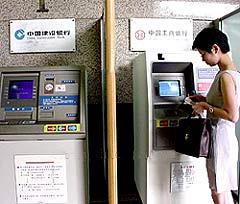
In 1994 China started to adopt the "Golden Card Project," enabling cards issued by banks to be used all over the country through a network. To date, financial institutions in China have issued 440 million cards, and installed 43,000 ATM, and 269,000 POS. The founding of the China Association of Banks has rapidly promoted the use of bank cards through the network. By the end of 2002, commercial banks wholly-owned by the state had adopted the inter-bank cards through the network in more than 300 cities, and the inter-region and inter-bank cards of different kinds of banks in more than 100 cities; and the identification card of the China Association of Banks was introduced in more than 40 cities.
The Opening-up of the Banking System
In the past some 20 years, China's financial institutions have opened wider to the outside world in a steady way, and have approved the founding of a whole body of foreign-funded and Chinese-foreign jointly run financial institutions in the special economic zones, coastal open cities and inland central cities, thus expanding the Renminbi business experiments of the foreign-funded banks. At present, there are 205 foreign-funded financial institutions within the Chinese territory, with a total assets of over US$ 38 billion. In August 1998, the experimental Renminbi business areas of the foreign-funded banks expanded from Shanghai to Shenzhen. In March 1999, foreign-funded banks were allowed to set up branches in all the central cities within the Chinese territory. In 2002, China opened up a number of cities where foreign-funded banks were allowed to handle Renminbi business, and it will continue the practice in the coming few years. In five years, there will not be any regional limitation on foreign-funded banks' handling Renminbi business in China. By the end of 2002, 45 foreign-funded banks had handled Renminbi business within the Chinese territory.
Meanwhile, all the commercial banks in China have set up branches in foreign countries, and started international credit business. The Bank of China ranks first in the number and scale of overseas outlets. In 1980, China resumed its membership of the World Bank, and returned to the International Monetary Fund. In 1984, China started business contacts with the Bank for International Settlements; in 1985, China formally joined the African Development Bank; and in 1986, China formally became a member of the Asian Development Bank.
Stock Market
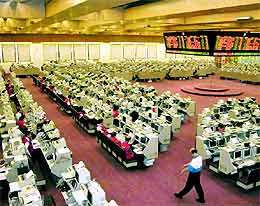
In 1990 and 1991, China set up securities exchanges in Shanghai and Shenzhen. In the past decade, the Chinese stock market has grown from the small to the large and from the disorderly to the orderly, to complete the journey that took a hundred years or more to cover in many countries. Today, China's stock market has nearly 3,832.9 billion yuan in capital, 1,224 listed companies and 68.84 million investors.
The Chinese stock market has promoted the reform of state-owned enterprises and the change of their system, and enabled a stable transition between the two systems. On the strength of the stock market in the past decade, many large state-owned enterprises have successfully realized the change of their systems one after another. As the change of the system in accordance with the market law is full of operational and demonstration characteristics, it has stimulated medium-sized and small state-owned enterprises to adopt the share-holding system, thus solving the most important problem—the system problem—during the transition from the planned economy to the market economy. As for ordinary citizens, the stock market has become another important channel for investment besides deposit accounts with banks.
The methods of trade in stocks have constantly improved. Now, a network system for securities exchange and account settlement has been formed, with the Shanghai and Shenzhen exchanges as the powerhouse, radiating to all parts of the country. Paperless distribution and trade have come to fruition, and the main technical means have reached the world's advanced level. According to statistics of 2002, China issued 102 kinds of A share, and 22 varieties of scrip issues, collecting a total of 78 billion yuan, as well as 16 kinds of B and H shares, collecting a total of 18.2 billion yuan.
Insurance
After being suspended for 20 years, China's insurance industry began to resume its activities in 1980. In 1981, the People's Insurance Company of China was transformed from a government department into a specialized company, with branches in all the provinces, autonomous regions and municipalities and sub-branches in all the counties. The year 1988 witnessed the founding of the Safety Insurance Company and the Pacific Insurance Company, which are mainly active in the coastal areas. In 1996, the People's Insurance Company of China made a big step forward in transforming its administration system and operational mode, in setting up a modern enterprise system, and in integrating with the international market. The promulgation of the Insurance Law in 1985 and the founding of the China Insurance Supervision and Management Commission in 1988 have provided the legal basis and specific rules for the operation of the insurance market. In 1980 China had only one insurance company. By 2002, China had established 54 insurance companies, 170 insurance intermediate companies, and over 70,000 insurance agencies.
At present, 34 foreign-funded insurance bodies have started business in China with approval, and 112 foreign-funded insurance companies from 19 countries and regions have set up 199 agencies in 14 cities of China, ready to enter the Chinese insurance market.