 It is A.D. 633 in Chang'an, capital of the Tang Dynasty.
Brandishing their halberds, armored generals and their troops practice changes in battle formation, but in the ritualistic, graceful style of martial arts, and to the accompaniment of a military refrain. This is not real war, but a dance depicting a past battle -- an emperor's historical retrospect.
This spectacular music and dance performance, Prince Qin's Cavalry, was choreographed and directed by Li Shimin, Emperor Taizong of the Tang Dynasty. At the time it was first performed, 15 years had passed since the founding of the Tang Dynasty, and wars with the objective of seizing political power were already a thing of the past. This performed depiction of a bygone battle was the emperor's way of maintaining readiness for any future conflict that might arise. Li Shimin, who at the age of 19 followed his father in an uprising, had fought countless battles. He knew all too well the sacrifices that had been made in order to establish the Tang Dynasty. After he became ruler of the great Tang Empire, this dance performance was his way of maintaining martial vigilance in peace-time. He told his subordinates more than once, "China is at peace, but it would be disastrous if the people were to become complacent about the possibility of war."
Martial Dance
"Prince Qin's Cavalry" is a tribute to the illustrious military exploits of Li Shimin, who bore the title "Prince Qin" before he became emperor. The aim of the dance was to remind Tang Dynasty soldiers and civilians always to be on the alert and prepared for war.
Dances in the Tang Dynasty fell into the two categories of martial and civil, and were also known as "gentle" and "vigorous" dances. As their names suggest, the "civil dance" was soft and graceful, while the "martial dance" was vigorous and bold.
"Prince Qin's Cavalry " is a martial dance that celebrates the power and grandeur of the imperial army. Its performance called for 120 dancers, a choir of 100, and 100 musicians. The dance music was Tang court composer Lu Cai's adaptation of various folk melodies. The dance formation is circular to the left and square to the right, with war chariots to the fore, and foot soldiers bringing up the rear. Its music leads the dance formation through 12 variations, which the audience would watch, awestruck, beating time on the floor with their scabbards.
Another aspect of the martial dance is the "sword dance," devised by master swordsmen. Ancients sought to combine the ethos of swordsmanship with the sword dance, calling it "sword vigor." The most famous sword dancer of the Tang Dynasty was legendary beauty, Gongsun. As a child, celebrated Tang poet Du Fu once watched her dance, and the specter created by her superb skill remained forever fresh in his memory. The square in Yancheng, Henan Province was a sea of people. Following a roll of drums, Lady Gongsun appeared, rapier in hand. The sword glinted with every change of posture and stance, whispering like silk on being unsheathed and flashing at each thrust. Her dancing seemed to evince a power that could hold back rivers and repulse oceans. Years later, Du Fu watched the sword dance performed by Li Shi'erniang, one of Gongsun's adherents. Her execution of it was so reminiscent of Gongsun's original performance that Du Fu, now in his 50s, was fired with new vitality, and wrote a poem, The Sword Dance performed by a Girl-Pupil of Lady Gongsun.
According to historical records, the calligraphic skills of Zhang Xu, great Tang calligrapher famous for his wild, uninhibited cursive hand, greatly improved after watching the sword dance. His brush strokes were inspired by its dynamism, and the structure of his characters reflected their sense of rhythm. He claimed to have inherited the spirit of Gongsun after watching her sword dance.
Civil Dance
On his succession to the throne, Li Shimin discussed strategies for national administration with his ministers. He believed that although he had gained political power by force, he should govern the country by civil virtue. He adopted in both martial and civil approaches according to different times and circumstances. In the emperor's view, in times of peace the emphasis of state governance should be on economic construction and education of the populace.
In 633, the 6th year of the Zhenguan reign and a time of Tang prosperity, Li Shimin went back to his birthplace, Qingshan Palace in Wugong County. He treated his ministers to a grand banquet, and wrote poetry in celebration of prevailing peace and plenty. He also commissioned musicians and choreographers to create the spectacular "Qingshan Dance." This was one of the representative civil dances of the early Tang Dynasty, and reflects Emperor Taizong's theory of governing the country by civil virtue.
In the following decades, this civil dance advocated by Emperor Taizong gained popularity and reached its zenith in the early 8th century, during the reign of Emperor Xuanzong.
Both Emperor Xuanzong, named Li Longji, and his concubine Yang Yuhuan had a deep love of music and dance. They married when Li was 56 years old and Yang was 22. The Rainbow Skirt and Feathered Coat was a romantic, enchanting dance personally choreographed by Li Longji for Yang Yuhuan. He combined emotional mortal love with the magical beauty of the fairy world, rendering a perfect blend of reality and fantasy.
Li Longji was a gifted actor, a talented composer, and a skilled musician. He excelled at the jie-drum (a drum with skin stretched over both ends of its hourglass-shape frame). According to ancient writings, his jie-drum playing hastened the blooming of spring buds and the falling of autumn leaves.
Li Longji gained inspiration for his creation of the Rainbow Skirt and Feathered Coat dance from gazing at Nu'er Mountain, shrouded in clouds and mists, and traditionally believed to be inhabited by immortals, where he fancied he could see a dancing fairy maiden. The music he composed for this dance was imbued with a spiritual Indian flavor so as to give full rein to Yang Yuhuan's dancing prowess, as she not only excelled at the stately Han style dance, but was also adept at the more spirited Hu rhythms. This dance called for specific costumes and accessories. The dancer's skirt and embroidered tasseled cape were in the colors of the rainbow, and the long sleeves of her costume flared and billowed as she danced. Her long skirt was decorated with feathers, and her headgear with various ornaments that swayed and tinkled with her every move. Yang Yuhuan's skill was such that after briefly scanning the score, she could execute the dance faultlessly.
The musical instruments played in accompaniment encompassed those of the Central Plains area and of the Western Regions. The music itself is in three main parts and comprises 36 segments. The first part consists of instrument solos, or qing, xiao, zheng and flute ensembles. In the second part, slow-tempo, lyric melodies are sung and danced to, and the third part comprises both slow and up-tempo dances. It was originally intended for just one or two dancers, but gradually evolved into the formation dance performed by hundreds of palace girls.
Hu Dance
There existed outside the imperial city a still broader world of song and dance. Tang Dynasty exotic songs and dances were popular among the common people, from Chang'an, the capital, to border areas, and from cities to the countryside.
Throughout the whole of Chinese history poet Li Bai had the exclusive honor of being summoned to the imperial court to write poems for the imperial family. Ironically enough, whenever eunuchs were dispatched to bring him to the court, they generally found him dead drunk in one or another of the Hu-owned wine shops on Chang'an's streets. Large numbers of Hu people migrated to the Tang Empire along the Old Silk Road, and wine shops run by the Hu people were commonplace in Chang'an. They served Western Region cuisine and wine made from grapes, and staged Hu song and dance performances. Most popular was the Hu whirling dance, of which many Tang poets other than Li Bai, Li Duan for one, spoke. These wine shops thus enriched the life of the local people, and contributed to the development and popularity of the music, song and dance of the Tang Dynasty. In his two years as court poet, Li wrote very little for the emperor, but penned a wealth of poems inspired by the wine shops he frequented. He was just one of many who were fascinated by the Hu whirling dance and the beautiful Hu dancers. Their exotic songs exerted an overpowering enchantment that tempted many nobles and high officials, as well as scholars and men of letters, to linger.
Traditional Chinese dances are lyrical, in a slow tempo, and solemn in contrast to the wild, tempestuous Hu dances. After spreading to the Central Plains area, they became widely popular. Songs and dances from the Western Regions gradually blended in with local life until they came to form an aspect of traditional Chinese performing arts. Among the ten official early Tang Dynasty dances, eight were introduced from the outside, and of these, one was from Korea, and seven were from the Western Regions.
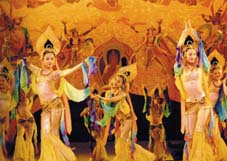
The Tang Dynasty was a time when all people, from the emperor to the lowest commoner, regarded being bestowed with an aptitude for singing and dancing as a great honor. This was the zenith of performance art in ancient China, when there were more than 100 large-scale dances. Unfortunately, hardly any Tang court dances survived. The Rainbow Skirt and Feather Coat Dance, for instance, was never performed again after the An-Shi Rebellion of A.D. 755. Li Yu, emperor of the Southern Tang (937-975), later wanted to re-stage the Rainbow Skirt and Feather Coat Dance, but failed owing to social disturbances and inadequate finance. For the one thousand years or so that followed, it was only possible to imagine the grandeur of Tang dances from poetry. Then, in the 1980s, on discovering that the dance scenes depicted in the Mogao Grottoes murals concur with descriptions of dances in Tang poetry, it became possible to recreate their splendor. Choreographers subsequently recreated the Tang dances according to these murals, and they began to be performed once more. Dance dramas created in the 1980s include Flower Rain on the Silk Road, A Great Dream of Dunhuang, Imitating-Tang Music and Dance, Going West of Yangguan, and Sword Dance. The dance drama Dunhuang Ancient Music included 25 pieces of Tang music discovered and deciphered by scholars and were performed for the first time. Tang dance thus became a new genre in China, and in less than 20 years is popular once more. Imitating-Tang Music and Dance and Chang'an Music and Dance have been staged over 10,000 times. A whole new wave of Tang music and dance has now emerged in China after a silence of 1,000 years, and the response it evokes is as rapturous as ever.
(China Today January 9, 2003)
|