|
Population: 1,158,989
Major area of distribution: Yunnan
Language: Dai
Religion: Buddhism
The Dai ethnic group lives in the southern part of Yunnan Province, mainly in the Xishuangbanna region. The area is subtropical, with plentiful rainfall and fertile land.
Local products include rice, sugar cane, coffee, hemp, rubber, camphor and a wide variety of fruits. Xishuangbanna is the home of China's famous Pu'er tea. The dense forests produce large amounts of teak, sandalwood and medicinal plants, and are home to wild animals including elephants, tigers and peacocks.
The Dai language belongs to the Chinese-Tibetan language family and has three major dialects. It is written in an alphabetic script.
Customs and habits
The marriage of the Dais was characterized by intermarriage on strictly equal social and economic status. Polygamy was common among chieftains, who also humiliated the wives and daughters of peasants at will. The patriarchal monogamous nuclear family was the common form among peasants. Pre-marital social contact between young men and women was quite free, especially during festivals. It was common for the groom to move into the bride's home after the wedding.
The graveyards of aristocrats and poor people were strictly separated. When a monk or a Buddhist leader died, he was cremated and his ashes placed in a pottery urn to be buried behind a temple.
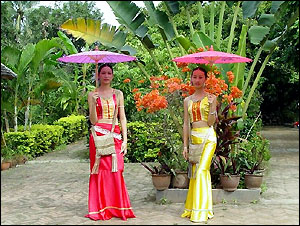
Men wore collarless tight-sleeved short jackets, with the opening at the front or along the right side, and long baggy trousers. In winter they drape a blanket over their shoulders. They wore black or hite turbans. Tattooing was common. When a boy reached the age of 11 or 12, a tattoo artist was invited to tattoo his body and limbs with designs of animals, flowers, geometric patterns or the Dai written script. Traditionally, women wore tight-sleeved short dresses and sarongs.
Rice is the staple food. The Dais in Dehong prefer dry rice, while those in Xishuangbanna like sticky rice. All love sour and hot flavors. In addition to beef, chicken and duck, they enjoy fish and shrimp. Cabbages, carrots, bamboo shoots and beans are among the popular vegetables. The Dais also love wine, liquor, and betel nuts.
The villages of the Dais in Dehong and Xishuangbanna are found on the plains, near rivers or streams, and among clusters of bamboo. The buildings generally are built on stilts. Some of the houses are square, with two stories. The upper story serves as the living place, while the lower space, without walls, is used as a storehouse and for keeping livestock.
Dai festivals, closely related to religious activities, included the "Door-Closing" festival in mid-June by the lunar calendar, the "Door-Opening" festival in mid-September, and the "Water-Splashing" festival in spring. "Door-Closing" started three months of intensive religious activities. "Door-Opening" marked the beginning of normal life. "Water-Splashing," still held every year, is the most important festival, during which the Dais splash water on one another, and hold dragon boat races in the hope of chasing away all the illnesses and bad fortune of the past year and bringing about good weather and bumper harvests.
The Dais have a rich, colorful culture. They have their own calendar, which started in AD 638. There are books in Dai script for calculating solar and lunar eclipses. Dai historical documents carry a rich variety of literary works covering poetry, legends, stories, fables and children's tales. They love to sing and dance, accompanied by their native musical instruments.
For a long time the Dais had grown rice as their main crop, and they had developed a rather complete, intensive farming system and gained rich experience in irrigation.
Religion
The religious beliefs of the Dai people were closely related to their economic development. Residents on the borders generally were followers of Hinayana, a sect of Buddhism, while retaining remnants of shamanism. There were many Buddhist temples in the countryside, and it was a common practice, especially in Xishuangbanna, to send young boys to the temples to learn to read and write and chant scriptures, as a form of schooling. Some of them became monks, while most of them returned to secular life. While staying in the temple, the boys had to do all kinds of hard work, and the Dai people had to bear all the financial burden of the temples.
History
The history of contact between the Dai and Han peoples dates back to 109 BC, when Emperor Wu Di of the Han Dynasty set up Yizhou Prefecture in southwestern Yi (the name used to signify the minority areas of what are now Sichuan, Yunnan and Guizhou provinces). The Dais in subsequent years sent tribute to the Han court in Luoyang, and among the emissaries were musicians and acrobats. The Han court gave gold seals to the Dai ambassadors and their chieftain was given the title "Great Captain."
According to Chinese documents of the ninth century, the Dais had a fairly well developed agriculture. They used oxen and elephants to till the land, grew large quantities of rice and had built an extensive irrigation system. They used kapok for weaving, panned salt and made weapons of metal. They plated their teeth with gold and silver.
In the 12th century, a Dai chieftain named Bazhen unified all the tribes and established the Mengle local regime with Jinghong as the capital, and called it the "Jinglong Golden Hall Kingdom." According to local records, the kingdom had a population of more than one million, and was famous for white elephants and fine-breed horses. It recognized the Chinese imperial court as its sovereign. When Bazhen ascended the throne, he was given a "tiger-head gold seal" by the Emperor, and the title "Lord of the Region." Previously, the Dais in the Dehong region had established the Mengmao Kingdom, with Ruilijiang as the capital.
During the Yuan Dynasty (1271-1368), the Dai area was subordinate to Yunnan Province and the system of appointing hereditary headmen from among the ethnic minorities was instituted; this system was consolidated during the Ming Dynasty (1368-1644).
(China.org.cn June 21, 2005)
|