|
Population: 415,000
Major area of distribution: Taiwan and Fujian
Language: Gaoshan people speak 13 languages
Religion: Polytheism
The Gaoshan people are about 415,000 in total, according to 2001 statistics. The majority of them live in mountain areas and the flat valleys running along the east coast of Taiwan Island, and on the Isle of Lanyu. About 1,500 live in such major cities as Shanghai, Beijing and Wuhan and in Fujian Province on the mainland.
The Gaoshans do not have their own script, and their spoken language belongs to the Indonesian group of the Malay/Polynesian language family.
Taiwan Island, home to the Gaoshans, is subtropical in climate with abundant precipitation and fertile land yielding two rice crops a year (three in the far south). Being one of China's major sugar producers, Taiwan also grows some 80 kinds of fruit, including banana, pineapple, papaya, coconut, orange, tangerine, longan and areca. Taiwan's oolong and black teas are among its most popular items for export.
The Taiwan Mountain Range runs from north to south through the eastern part of the island, which is 55 percent forested. Over 70 percent of the world's camphor comes from Taiwan. Short and rapid rivers flowing from the mountains provide abundant hydropower, and the island is blessed with rich reserves of gold, silver, copper, coal, oil, natural gas and sulfur. Salt is a major product of the southeast coast, and the offshore waters are ideal fishing grounds.
The Gaoshans are mainly farmers growing rice, millet, taro and sweet potatoes. Those who live in mixed communities with Han people on the plains work the land in much the same way as their Han neighbors. For those in the mountains, hunting is more important, while fishing is essential to those living along the coast and on small islands.
Gaoshan traditions make women responsible for ploughing, transplanting, harvesting, spinning, weaving, and raising livestock and poultry. Men's duties include land reclamation, construction of irrigation ditches, hunting, lumbering and building houses.
Customs and habits
The Gaoshans are monogamous and patriarchal in family system, though the Amei tribe still retains some of the vestiges of the matriarchal practice. Commune heads are elected from among elderly women and families are headed by women, with the eldest daughter inheriting the family property and male children married off into the brides' families. In the Paiwan tribe, either the eldest son or daughter can be heir to the family property. All the Amei young men and some of the Paiwan youths have to live in a communal hall for a certain period of time before they are initiated into manhood at a special ceremony.
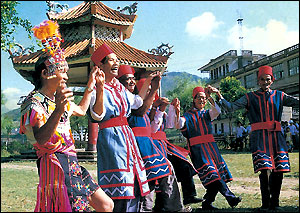
Gaoshan clothes are generally made of hemp and cotton. Men's wear includes capes, vests, short jackets and pants, leggings and turbans decorated with laces, shells and stones. In some areas, vests are delicately woven with rattan and coconut bark. Women wear short blouses with or without sleeves, aprons and trousers or skirts with ornaments like bracelets and ankle bracelets. They are skilled in weaving cloths and dyeing them in bright colors and they like to decorate sleeve cuffs, collars and hems of blouses with beautiful embroidery. They also use shells and animal bones as ornaments. In some places, the time-honored tradition of tattooing faces and bodies and denting the teeth has been preserved. Some elderly Gaoshan women, though having lived on the mainland among the Han people for many years, still take pride in their distinctive embroidery.
For transportation in rugged terrain, the Gaoshans have built bamboo and rattan suspension or arch bridges and cableways over steep ravines. They are also highly skilled in handicrafts. Their rattan and bamboo weaving, including baskets, hats and armors, pottery utensils, wooden mortars and pestles and dugout canoes are unique in design and decoration. In the mountains, the Cao and Bunong tribes are experts in tanning hides, while the Taiya tribe makes excellent fishing nets.
Songs and dances are very much a part of Gaoshan life. On holidays, they would gather for singing and dancing. They have many ballads, fairy tales, legends, odes to ancestors, hunting songs, dirges and work songs. Instruments include the mouth organ, nose flute, and bamboo flute. One musical form unique to the Gaoshans is a work song accompanying the pounding of rice.
Gaoshan art includes a great deal of carving and painting of human figures, animals, flowers and geometric designs on wooden lintels, panels, columns and thresholds, musical instruments and household utensils. Hunting and other aspects of life are also depicted, and figures with human heads and snake bodies are a common theme.
The Gaoshans are animists who believe in immortality and ancestor worship. They hold sacrificial rites for all kinds of occasions including hunting and fishing. The dead are buried without coffins in the village graveyard. There are vestiges of the worship of totems – snakes and animals – and certain taboos still remain.
History
The name Gaoshan was created for the minority people in Taiwan following victory over Japan in 1945. There are several versions of the origin of the ethnic minority. The main theories are: they are indigenous, they came from the west, or the south, or several different sources. The theory that they came from the west is based on their custom of cropping their hair and tattooing their bodies, worshipping snakes as ancestors and their language, all of which indicate that they might have been descendants of the ancient Baiyue people on the mainland. Another theory says that their language and culture bear resemblance to the Malays from the Philippines and Borneo, and so the Gaoshans must have come from the south. The third and more reliable theory is that the Gaoshan ethnic group originated from one branch of the ancient Yue ethnic group living along the coast of the mainland during the Stone Age. They were later joined by immigrants from the Philippines, Borneo and Micronesia.
Cementing close economic and cultural ties through living and working together over a long period of time, these peoples had by the time of the Ming and Qing dynasties (1368-1911) welded themselves into a new ethnic group known as Fan or Eastern Fan, which is today called the Gaoshan ethnic group.
Archaeological evidence suggests that the Gaoshan ethnic group has all along maintained close connections with the mainland. Until the end of the Pleistocene Epoch 30,000 years ago, Taiwan had been physically part of the mainland. Fossils of human skulls belonging to this period and Old Stone Age artifacts found in Taiwan show that humans probably moved there from the mainland during the Pleistocene Epoch. Neolithic adzes, axes and pottery shards unearthed on the island suggest that New Stone Age culture on the mainland was introduced into Taiwan 3,000 to 4,000 years ago.
In AD 230, two generals of the Kingdom of Wu led a 10,000-strong army across the Taiwan Straits, and brought back several thousand natives from the island. At that time, the ancestors of the Gaoshans belonged to several primitive, matriarchal tribes. Public affairs were run collectively by all members. Their tools included axes, adzes and rings made of stone and arrowheads and spearheads made of deer antlers. Animal husbandry was still in an embryonic stage.
By the early 7th century, the Gaoshans had started farming and livestock breeding on top of hunting and gathering. They planted cereal crops with stone farm tools. Each tribe was governed by a headman who summoned the membership for meetings by beating a big drum. There was neither criminal code nor taxation. Criminal cases were tried by the entire tribe membership. The offender was tied with ropes, flailed for minor offences or put to death for serious crimes.
These early Gaoshans had no written language, nor calendar; and they kept records by tying knots. People worshipped the Gods of Mountain and Sea, and liked carving, painting, singing and dancing.
In the Song and Yuan dynasties (960-1368), central government control was extended to the Penghu Islands and Taiwan, which were placed under the jurisdiction of Jinjiang and Tongan counties in Fujian Province. During the Ming Dynasty (1368-1644), farming, hunting and animal husbandry further developed in Taiwan. In the early 17th century, an increasing number of Hans from the mainland moved to Taiwan, lending a great impetus to economic development along the island's west coast.
The Gaoshan and Han people in Taiwan worked closely together in developing the island and fighting against foreign invaders and local feudal rulers. Japanese pirates invaded Chilung, the major seaport in Northern Taiwan, in 1563. In 1593 the Japanese rulers tried to coerce the Gaoshan people into paying tribute to them but this demand was firmly rejected. The invasions of Japanese pirates from 1602 to 1628 were repeatedly beaten back.
Towards the end of the Ming Dynasty (1368-1644), the Dutch and the Spanish time and again made forays into Taiwan, but were repulsed by the islanders. Finally, in 1642, the Dutch defeated the Spanish, seized the island and imposed tyrannical rule on the local people. This touched off immediate resistance. The anti-Dutch armed uprising led by Guo Huaiyi in the mid-17th century was the largest in scale. In April 1661, China's national hero Zheng Chenggong led an army of 25,000 men to Taiwan and freed it from under the Dutch with the assistance of the local Gaoshan and Han people, ending the Dutch invaders' 38-year-old colonial rule over Taiwan.
After recovering Taiwan from the Dutch, Zheng Chenggong instituted a series of measures to advance economic growth and cultural development there. He forbade his troops engaged in reclamation to encroach on the Gaoshan people's land, helped the local people improve their farm tools and learn more advanced farming methods from the Han people, encouraged children to attend school, and expanded trading. With the growth of production, the feudal system of land ownership came into being, and the gap between the rich and the poor was getting wider and wider. The feudal landlord economy developed in the Qing Dynasty (1644-1911), when the Gaoshans began using ox-driven carts, ploughs and rakes developed by the Hans.
Zheng died five months after recovering the island, and his son succeeded him. The Zhengs governed Taiwan for 23 years. In 1683, the Qing court brought the island under central government control and this rule lasted for 212 years till Taiwan fell under Japanese rule following the signing of the Sino-Japanese Treaty of Shimonoseki in 1895.
After the Opium War of 1840, British, American, Japanese and French colonialists invaded and plundered Taiwan one after another. The foreign invasion and plundering were met with fierce resistance. To fight the British invaders, the local people formed a volunteer army of 47,000 troops who beat back all the five British invasions.
Taiwan fell into the hands of the Japanese in 1895 after China's defeat in the Sino-Japanese War. Fighting shoulder to shoulder for five months, Gaoshan and Han people inflicted 32,315 casualties on the Japanese invaders.
During the 20 years from 1895 to 1915, the people of Taiwan staged some 100 armed uprisings against Japanese occupation. One of them was the Wushe Uprising mounted by the Gaoshan people in Taichung County in 1930. Enraged by the murder of a Gaoshan worker by Japanese police, over 300 Gaoshan villagers wiped out the 130 Japanese soldiers stationed there and held Wushe for three days. In the following months, the insurgents killed and wounded more than 4,000 Japanese occupationists. In retaliation, the Japanese moved in most of their garrison forces in Taiwan along with planes and guns and crushed the uprising. They slaughtered over 1,200 Gaoshans including all the insurgents.
After victory over Japan in 1945, Taiwan was returned to China and placed under Kuomintang rule.
Gaoshans on the mainland
Twenty-nine hundred Gaoshans now live on the mainland. Though small in number, these Gaoshans have their deputies to the National People's Congress, China's supreme organ of power. They enjoy equal rights in the big family of all ethnic groups on the mainland.
(China.org.cn June 21, 2005)
|