|
Population: 634,912
Major area of distribution: Yunnan and Sichuan
Language: Lisu
Religion: Polytheism
The Lisu ethnic group numbers 634,912 people, and most of them live in concentrated communities in Bijiang, Fugong, Gongshan and Lushui counties of the Nujiang Lisu Autonomous Prefecture in northwestern Yunnan Province. The rest are scattered in Lijiang, Baoshan, Diqing, Dehong, Dali, Chuxiong prefectures or counties in Yunnan Province as well as in Xichang and Yanbian counties in Sichuan Province, living in small communities with the Han, Bai, Yi and Naxi peoples.
The Lisu language belongs to the Chinese-Tibetan language family. In 1957, a new alphabetic script was created for the Lisu people.
Geography
The Lisus inhabit a mountainous area slashed by rivers. It is flanked by Gaoligong Mountain on the west and Biluo Mountain on the east, both over 4,000 meters above sea level. The Nujiang River and the Lancang River flow through the area, forming two big valleys. The average annual temperature along the river basins ranges between 17 and 26 degrees Centigrade, and the annual rainfall averages 2,500 millimeters. Main farm crops are maize, rice, wheat, buckwheat, sorghum and beans. Cash crops include ramie, lacquer trees and sugarcane. Many parts of the mountains are covered with dense forests, famous for their China firs. In addition to rare animals, the forests yield many medicinal herbs including the rhizome of Chinese gold thread and the bulb of fritillary. The Lisu area also has abundant mineral and water resources.
History
According to historical records and folk legend, the forbears of the Lisu people lived along the banks of the Jinsha River and were once ruled by "Wudeng" and "Lianglin," two powerful tribes. After the 12th century, the Lisu people came under the rule of the Lijiang Prefectural Administration of the Yuan Dynasty, and in the succeeding Ming Dynasty, under the rule of the Lijiang district magistrate with the family surname of Mu.
During the 1820s, the Qing government sent officials to Lijiang, Yongsheng and Huaping, areas where the Lisus lived in compact communities, to replace Naxi and Bai hereditary chieftains. This practice speeded up the transformation of the feudal manorial economy to a landlord economy, and tightened up the rule of the Qing court over Lisu and other ethnic groups. In the years preceding and following the turn of the 20th century, large numbers of Han, Bai and Naxi peoples moved to the Nujiang River valleys, taking with them iron farm tools and more advanced production techniques, giving an impetus to local production.
For a long time the Lisus, under oppression and exploitation by landlords, chieftains and headmen, as well as the Kuomintang and foreign imperialists, led a miserable life. In Eduoluo Village of Bijiang County alone, 237 peasants out of the village's 1,000 population were tortured to death in the 10 years prior to liberation by local officials, chieftains, headmen or landlords. The Lisus also suffered exorbitant taxes and levies. The household tax, for example, was 21 kilograms of maize per capita, accounting for 21 percent of the annual grain harvest. Moreover, there were unscrupulous merchants and usurers. The arrival of imperialist influence at the turn of the 20th century put the Lisus in a far worse plight.
During the period between the 18th and 19th century, the Lisus waged many struggles against oppression. From 1941 to 1943, together with the Hans, Dais and Jingpos, they heroically resisted the Japanese troops invading western Yunnan Province and succeeded in preventing the aggressors from crossing the Nujiang River, contributing to the defense of China's frontier.
Patriarchal slavery existed in the Nujiang River area in the period between the 16th century and the beginning of the 20th century. The slaves were generally regarded as family members or "adopted children." They lived, ate and worked with their masters, and some of the slaves could buy back their freedom. The masters could buy and sell slaves, but had no power over their lives. The slaves were not stratified. All these reflected the characteristics of exploitation under the early slavery system.
In post-1949 days, the remnant of the clan system could still be found among the Lisus in the Nujiang River valley. There were more than a dozen clans there, each with a different name. They included Tiger, Bear, Monkey, Snake, Sheep, Chicken, Bird, Fish, Mouse, Bee, Buckwheat, Bamboo, Teak, Frost and Fire. The names also served as their totems. Within each clan, except for a feeling of kinship, individual households had little economic links with one another.
The clan and village commune played an important part in practical life. The "ka," or village, meant a place where a group of close relatives lived together. Some villages were composed of families of different clans. Every village had a commonly acknowledged headman, generally an influential elderly man. His job was to settle disputes within the clan, give leadership in production, preside over sacrificial ceremonies, declare clan warfare externally, sign alliances with other villages, collect tributes for the imperial court. Under the rule of a chieftain, such headmen were appointed his assistants. When the Kuomintang came, they became the heads of districts, townships or "bao" (10 households). When there was a war, the various communal villages might form a temporary alliance; when the war was over, the alliance ended.
Apart from common ownership of land and working on it together, clan members helped one another in daily life. When there was wine or pork, they shared it. When a girl got married, they shared the betrothal gifts given to her parents; and when a young man took in a wife, the betrothal gifts for the bride's family were borne by all. Debts too, were to be paid by all. These collective rights and obligations in production and daily life made it possible for clan relations to continue for a long time.
The Chinese People's Liberation Army liberated the vast area in northwestern Yunnan Province in early 1950, bringing a new life to the Lisu people.
In August 1954 the Nujiang Lisu Autonomous District was established, covering Lushui, Bijiang, Fugong and Gongshan counties. The autonomous district was changed into an autonomous prefecture in January 1957, and Lanping County, too, was placed under its jurisdiction.
Religion
In the past the Lisu people worshipped many gods, nature and a multitude of other things. This appeared to be a remnant of totemism. Religious professionals made a living by offering sacrifices to ghosts and fortune-telling. During the religious activities, animals were slaughtered and a large sum of money spent. In the middle of the 19th century, Christianity and Catholicism were spread into the area by Western missionaries.
Customs and habits
The monogamous family was the basic unit of Lisu society. Sons left their parents and supported their own families after getting married. The youngest or only son remained with the parents to take care of them and inherit property. The daughter had no right of inheritance but could take her husband into her parents' home instead of being married off. Marriages were arranged by parents, with enormous betrothal gifts.
The dead were buried. Generally the village or the clan had its own common graveyard. For a man, the cutting knives, bows and quivers he had used when alive were buried with him. For a woman, burial objects were her weaving tools, hemp-woven bags and cooking utensils, to be hung by her grave. When an elderly man or woman died, the whole village stopped working for two or three days. People tendered condolences to the bereaved family, bringing along wine and meat. Generally the mound on the burial ground was piled one year after the burial, and respects to the dead were paid three years after the burial, and offerings ended.
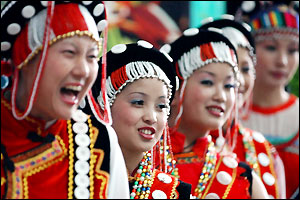
In most areas the Lisu people wear home-spun hemp clothes. Women put on short dresses and long skirts. Their heads are decorated with red and white glass beads and their chests with necklaces formed by strings of colored beads. Men wear short dresses and pants reaching the knee. Some of them wear black turban. A cutting knife dangles at a man's left waist, and a quiver hangs at his right waist.
Their main staple foods are maize and buckwheat. Hunting yields abundant meat. During their major festivals, they slaughter oxen and pigs. Both men and women are heavy drinkers.
The Lisu people live in two types of house. One is of wooden structure, with the four sides formed with 12-foot-long pieces of timber, and on top of them is a cover of wooden planks. It looks like a wooden box. The other is of bamboo-wooden structure, supported by 20 to 30 wooden stakes and surrounded with bamboo fences, with a thatched or wooden roof. In the center of the house is a big fireplace.
The festivals of the Lisus living closer to the hinterland are nearly the same as those of the Han, Bai, Naxi and other peoples around. During the Lunar New Year, the first thing they do is to feed their cattle with salt to show respect for their labor. They have the Torch Festival in the sixth month of the year, and the Mid-Autumn Festival in the eighth month. The Lisus in the Nu River and Weixi areas enjoy their "Harvest Festival" in the 10th month, during which people exchange gifts of wine and pork. They sing and dance till dawn.
(China.org.cn June 21, 2005)
|