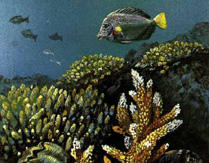
The next few months are set to be the busiest time of the year for Huang Hui, one of the youngest coral reef ecologists in China. Last year, together with her colleagues, she spent most of her time on the Xisha Islands in the South China Sea and conducted a survey of coral reefs in the area.
Her study laid the ground work for scientists from the South China Sea Institute of Oceanology, Chinese Academy of Sciences, to conduct further, more comprehensive ecological research and assessment of coral reef conditions in the whole South China Sea this year. The underwater survey will enable scientists to closely study the coral species and systematically calculate the actual rate of cover.
A world under threat
The ecological importance of coral reefs to the whole ocean ecosphere is similar to that of tropical forests to the land.
Coral reefs are among the most diverse and productive communities on Earth. They are commonly found in the warm, clear, shallow waters of tropical oceans worldwide.
Though their coverage area only accounts for 0.01 percent of the whole ocean, they perform significant ecological functions. They range from providing food and shelter for fish and invertebrates, to reducing natural disasters by weakening the power of storm, typhoon and tsunami, by protecting the shore from tidal erosion.
However, in the past two decades, coral reefs around the globe have declined significantly. Their natural enemies are the increased frequency and severity of El Ninos coupled with global warming. Higher water temperatures have triggered the death of large areas of the fragile coral reefs. Their environment has also been undermined from being battered by tidal waves and typhoons, and large quantities of fresh water flowing into the sea during the flood season.
"However, comparatively speaking, all these natural occurrences are only ephemeral and coral reefs are capable of recovering to their original scale within just a short period," said Huang, who will lead the latest survey team.
The fundamental threat to coral reefs is from human activity.
Thriving industrial development along coasts has produced a huge amount of waste water, silt and sediment that washes out to sea and pollutes the ocean's ecosystems.
Overfishing has also had a disastrous impact.
Plundering the seas
For the fishermen living along the coast of the South China Sea, the revenue from catching fish can be a significant source of income.
But the past two decades have seen these areas overfished, with huge trawling nets sweeping up tons of fish throughout the coastal waters.
"After the nets pass by, almost nothing remains on the sea bed, including the coral reefs," said Lian Jiansheng, a coral reef ecology expert, and a member of Huang's team.
Years ago, even the coral itself provided a fair catch for fishermen who could sell to local factories to produce lime.
In recent years, owing to the drastic decrease of fish resources, and desperate to secure a catch, the fishermen have resorted to "harvesting" practices that use poison, electricity and explosives, said Huang.
The impact of such methods has not only decimated sea life, a number of young fishermen have had limbs blown off handling explosives they made themselves.
Making basic explosives, using fertilizer is simple, and enables the fishermen to catch a good haul in a short time.
Not surprisingly, these homemade explosives destroy patches of coral. They have massive destructive power and leave craters on the sea bed.
"Poor fishermen only want to capture more fish by every possible means, but most of them don't know that the coral reefs provide the habitat for the fish to spawn. Their activity can only result in less and less fish to catch," said Huang.
Over the course of her surveys Huang has watched many rare species of fish, shells, and lobster in the coral reefs vanishing before her eyes.
In the market, the once common large yellow croaker now fetches a high price of 1,800 yuan (US$216) a kilogram.
Also in recent years, local fishermen have been using poisons, such as sodium cyanide, to fish.
They dive into the water and spray large amounts of the chemical into the coral reefs knocking out the fish which are then easy to catch alive.
Effective in the immediate term, the poison eventually turns the coral reef, once teeming with life, into a graveyard.
"The fish living in the reef areas generally have much higher economic values. And driven by the huge profit margins to be had, fish poisoning has become the new enemy for coral reefs," said Huang.
Live fish fetch four to eight times more in the market than the same species dead.
Every year, local fishermen catch large numbers of expensive groupers and coral trout, as well as other tropical fish species for display.
Coral reefs contain a complete biological system and disturbance on any level of the food chain can undermine the whole cycle.
The most recent report on the coral reefs of Sanya, Hainan Province, last month showed the number of starfish, a natural killer of coral reefs, has increased dramatically. They eat up coral reefs. Also, they excrete a kind of chemical, which attracts many others of their species to gather there, thus hastening the destruction of whole areas of coral.
"The fishermen have caught most of the coral reef fish and shellfish, which are the natural enemy of starfish," explained Huang.
With dwindling numbers of wild fish available to be caught in the sea, a number of fishermen have begun, in recent years, to turn to aquaculture.
In the process they changed many shallow sea areas, the habitat of coral, into fishponds.
"We understand that the fishermen need to make a living, but the utilization of ocean resources should be sustainable. Otherwise, overfishing and biological deterioration of coral reefs will become a vicious circle," she said. "It is not simply a fishing or environmental issue. Conservation of coral reefs demands the cooperative efforts of government, fishermen and scientists."
Getting a true picture
Confronting large-scale crises requires a major scaling-up of management efforts based on an improved understanding of the present ecological conditions of coral reefs.
"So far, a complete picture of the status of coral reefs in the South China Sea is still unclear. What we now have are only some odd pieces of data," said Lian Jiansheng.
By comparison, scientists know far more about the coral reefs along the coast of Guangdong and Hainan provinces. Past surveys have revealed an alarming level of damage there.
"Basically, they stem from the coral reefs in the Xisha and Nansha islands. Successful restoration of the ruined ecology of the reefs along coastal areas lies where they originated," said Lian.
But as scientists know little about the condition of the reefs off Xisha and Nansha, surveying them will form an important part of the team's work in 2005.
Last year, Lian and his colleagues received extensive diving training to prepare for the survey.
"One can get the basics of diving within just 10 days, but many skills come by practice and are improved on ourselves in the field," said Lian.
Because the coral reefs are generally found in shallow waters, there is no need to dive deeper than about 10 to 40 meters.
Last year, the survey group visited several Xisha islands in a trial underwater research run.
What they saw lifted their spirits somewhat.
"It was the first time for me to see the beautiful and spectacular coral reefs," said Lian.
What he observed were well-preserved reefs in some atolls. When damaged, the unique branch-like aspect of the fragile coral disappears leaving only its main body. This is a simple way for scientists to tell at a glance whether damage has occurred.
Lian estimates that in general, coral reefs in Xisha have survived far better than those in coastal areas.
"The ecological function of coral reefs in the region is significant. If they remain healthy, they could replenish the already severely damaged reefs in coastal regions," he explained.
In addition to the survey the team will draw up a detailed plan for the establishment of a protected nature reserve in Xisha.
Lifeweek, a Beijing-based magazine, contributed to the story.
(China Daily March 15, 2005)