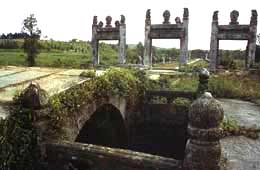
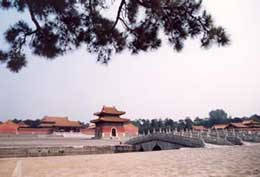
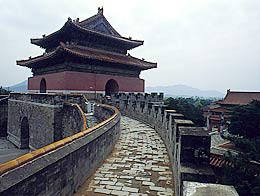
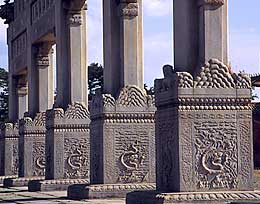
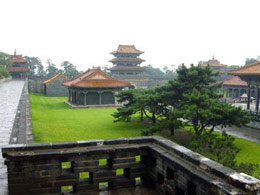
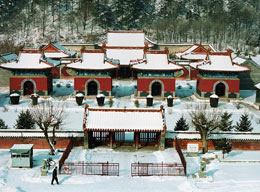
The Ming and Qing imperial tombs are natural sites modified by human influence, carefully chosen according to the principles of geomancy (Fengshui) to house numerous buildings of traditional architectural design and decoration. They illustrate the continuity over five centuries of a world view and concept of power specific to feudal China.
The Ming Dynasty (1368-1644) Xian Tomb is the burial site for Prince Xingxian and his wife, parents of Emperor Jiaqing (reigned 1522-66). They were buried together at Mt. Songlin in present Zhongxiang County, Hubei Province. The tomb occupies an area of 136.47 hectares and is hemmed in by high walls. Started in 1519 and completed in 1540, the Xian Tomb resembles the Ming Tombs near Beijing, but it takes up more space. It is the only Ming Tomb found in southern China and is often referred to as the 15th Ming Tomb. The Xian Tomb was put under key state protection in 1985.
The Dong Tombs of the Qing Dynasty (1644-1911), the first imperial tombs established by the Manchu rulers, are located 125 km east of Beijing in Zunhua County, Hebei, and occupy an area of 2,500 square km.
The tomb area consists of two sections: the Houlong and the Qianquan. The Houlong, the source of an auspicious tomb site according to geomancy, starts from the Great Wall, extends along Mt. Shaozu and Mt. Wuling near Chengde, and borders Zunhua on the east and Miyun on the west. The area is characterized by ranges of mountains and a beautiful landscape. The Qianquan is where the tombs are located, which occupies 48 square km, and is enclosed in geomantic walls of some 20 km both on the east and on the west, with a red gate that was erected to the south of the location.
Construction of the Dong Tombs began in 1661. There are altogether 14 tombs containing the remains of emperors, empresses, consorts, and princesses. They include the Xiao Tomb of the first emperor of Qing, Emperor Shunzhi (reigned 1644-61), the Jing Tomb of Emperor Kangxi (reigned 1662-1722), the Yu Tomb of Emperor Qianlong (reigned 1736-95), the Ding Tomb of Emperor Xianfeng (reigned 1851-61), the Hui Tomb of Emperor Tongzhi (reigned 1862-74), and tombs of the empresses Xiaozhuang, Xiaohui, Ci'an, Ci'xi, and five consorts. All were erected over a span of 272 years.
The Xi Tombs of the Qing Dynasty are located among the mountains some 100 km west of Beijing. This site is smaller than that of the Dong Tombs and with fewer emperors and empresses buried. Construction of the Xi Tombs began in 1730. The burial site has the Tai Tomb of Emperor Yongzheng (reigned 1723-35), the Chang Tomb of Emperor Jiaqing (reigned 1796-1820), the Mu Tomb of Emperor Daoguang (reigned 1821-50), the Chong Tomb of Emperor Guangxu (reigned 1875-1908), and the tombs of various empresses, consorts, princes and princesses. The one for the last emperor, Xuantong, was incomplete when the Qing Dynasty ended.
On November 30, 2000, the three tomb sites were chosen for the List of the World Cultural Heritage by the United Nations Heritage Commission.
Xiaoling Tomb
Xiaoling Tomb, located on the southern slope of Purple Mountain in eastern suburban Nanjing, capital city of Jiangsu Province, buried the first emperor of the Ming Dynasty (1368-1644), Zhu Yuanzhang, and his empress. Looking grand and magnificent, it represents the greatest attainment of architecture and stone-engraving art, having a great impact on subsequent emperors' tombs scattered in Beijing, Hubei, Liaoning and Hebei in the following 500 years.
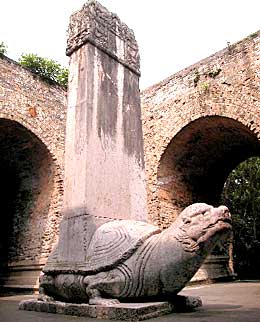
Construction of the Xiaoling Tomb was officially started in 1381 and took 25 years to complete in 1405. Some 100,000 military soldiers and civilians were deployed to carry out the project. Damaged by war, the Xiaoling Tomb site has now only the Sacred Way, Archway for Dismounting, Great Golden Gate and Rectangular City still preserved in addition to the tomb itself.
In 1398, Emperor Zhu Yuanzhang died after ruling his dynasty for 31 years. The coffin chamber where he and his queen were buried is called Baocheng (Precious Hall), a clay vault some 400 meters in diameter and with walls made of rectangular stone slabs. After being exposed to the elements for some 600 years, part of the walls collapsed and huge cracks appeared in some other parts due to earth subsidence. Nanjing municipal authority in charge of cultural heritage has so far invested over 3 million yuan (US$0.36 million) in the repairing and maintenance of these walls.
Xiaoling Tomb starts with the Archway for Dismounting and extends to the Precious Hall in the rear, having a depth of over 2,600 meters. Along the way are scattered some 30 functional constructions and stone sculptures of different styles and uses.
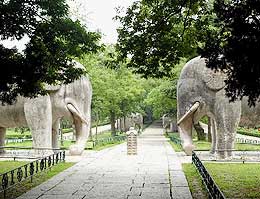
The creativeness of Xiaoling Tomb is also embodied in the winding Sacred Way flanked by stone animals and figures, representative of high-level stone engraving art in the early period of Ming Dynasty.
Ming Tombs (Shisanling)
The Ming tombs lie in a broad valley to the south of Tianshou Mountain (Longevity of Heaven) in Changping District, about 44 km northwest of Beijing proper. To the southwest of this valley, a branch of the Yanshan Range suddenly breaks off and forms a natural gateway to the 40-square-km basin in which the bombs were built. Thirteen out of the 16 Ming emperors as well as 23 empresses, 1 highest-ranking concubine and a dozen immolated imperial concubines were buried in this peaceful valley.
It was widely held in the Ming Dynasty (1368-1644) that although dead physically, a person's soul remained, still having human needs. Consequently, the 13 emperors' tome complexes look like imperial palaces.
Under the guidance of traditional Chinese Fengshui (geomancy), the whole process from site selection to designing of the tombs paid attention to harmony between tomb architecture and the surrounding mountains, rivers and vegetation to embody the philosophical view that man is an integral part of nature.
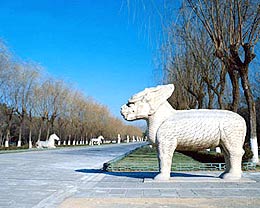
Of the 13 tombs, Dingling, the tomb of Emperor Wanli (reigned 1537-1619), was under archaeological excavation in 1956, and all other tomb architecture has remained intact. The Sacred Way (Shendao) in front of each tomb as well as other main architectures including the marble memorial archway, the Great Red Gate (Dahongmen), a tall square stele pavilion, Avenue of the Animals, and Dragon and Phoenix Gate (Longfengmen) are still in perfect condition. Lots of pines and cypress planted in the Ming Dynasty inside and outside the tomb complexes and flanking the Sacred Way are still growing well. The tombs for imperial concubines and eunuchs inside the mausoleum area were reclaimed as farmland during the later years of the Qing Dynasty, but the underground coffin chambers have remained intact.
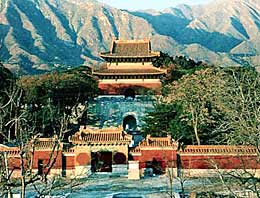
Though varying in size and architectural complexity, these tombs are similar in general layout: the plan takes an oblong shape with a round (or oval) Precious Hall (Baocheng) at the rear. Each tomb complex starts with a stone bridge, followed by a front gate, a stele pavilion, the Gate of Eminent Favor, the Hall of Eminent Favor, a watchtower and then the Precious Hall. The layout of these Ming Tombs produced a far-reaching impact on the construction of the Dong Tombs and Xi Tombs of the Qing Dynasty.
The Ming tombs were put under protection of the Beijing municipal government in 1957.
In July 2003, the UNESCO World Heritage Committee at its 27th session officially inscribed the Xiaoling Tomb in Nanjing and Ming Tombs (Shisanling) in Beijing on the World Heritage List as assemblage of the Imperial Tombs of the Ming and Qing Dynasties.
Three Qing Dynasty Imperial Mausoleums in Liaoning
In July 2004, three imperial mausoleums of emperors and empresses of the Qing Dynasty (1644-1911) in northeast China's Liaoning Province, were added to those above in the list of the World Heritage sites.
Two of the mausoleums, Fuling (East Tomb) and Zhaoling (North Tomb) are in Shenyang, capital of Liaoning Province, while Yongling is situated in Xinbin Manchu Autonomous County, Fushun City.
Fuling Tomb is set in a forested area 5 miles (8 kilometers) from Shenyang. Entombed here is Emperor Nuerhachi (1559-1626), founder of Great Jin or Later Jin (1616), predecessor of the Qing Dynasty, and Empress Yehenala (Xiaochigao). Construction started in 1626 and was completed several years later, with subsequent additions and renovations.
The Zhaoling Tomb is the finest sight in Shenyang. Set in a huge park, the tomb is the burial place of Huangtaiji (1592-1643), who founded the Qing Dynasty, and Empress Boerjiteshi. The tomb took eight years to build and the impressive animal statues on its approach are reminiscent of Ming tombs.
Originally known as Xingjing Tomb and built in 1598, this mausoleum lies south of Qiyun Mountain near the Suzi River and northwest of the Yongling Township in Xinbin. It was restored many times during the Kangxi and Qianlong reigns and renamed Yongling in 1659. It covers an area of about 12,000 square kilometers surrounded by mountains and rivers that create the impression of luxuriant surroundings. Four of Nuerhachi's ancestors are buried in this tomb: his father, Takeshi; grandfather, Juechangan; great-grandfather, Fuman; and one other, Gaitemu.
The mausoleum is composed of a front courtyard, the Fangcheng (square castle) and Baocheng (tombs surrounded by additional high walls like a castle) all within a vermilion wall. At the center of the southern yard stands the Red Gate, inside of which are four pavilions each with a stone tablet praising the four ancestors. To the east and west are teahouses, washing and changing rooms.
The main building at the center of the Fangcheng is Qiyun Hall. Inside this is a warm pavilion and treasure bed for offering sacrifices. Two side halls stand on the east and west sides of Qiyun Hall, in front of which is a silk burning furnace. Behind Qiyun Hall are tombs, most of whose occupants have been removed and re-interred elsewhere, some containing only the clothing of the dead.
Originally there was an old elm here called the "fairy tree". When Emperor Qianlong, in the 43rd year of his reign, traveled to the east he wrote a poem about it called The Song of the Fairy Tree. This was inscribed on a stone tablet and placed beside the tree, but is now in the western side hall.
Yongling Mausoleum is not large. Inside the Square Castle are castle-like watchtowers with embrasures, turrets, passages and a mausoleum with an underground palace. The mausoleum, nestled among the hills with Qiyun Mountain towering behind it, is opposite Yancong Mountain with Suzi River running between them. From a distance it appears as a red dot on the green carpet of the forest.
Xian Tomb (Ming Dynasty) Manament Office, Zhongxiang County, Hubei. Tel: 86-724-4217387
Estern Qing Tombs Cultural Relics Management Office, Zunhua City, Hebei. Tel: 86-315-6945471
Western Qing Tombs Cultural Relics Management Office, Yixian County, Hubei. Tel: 86-312-6945471
Nanjing Xiao Tomb (Ming Dynasty) Administration (Dr. Sun Yat-sen's Mausoleum), Nanjing City, Jiangsu. Tel: 86-25-84431991 84446111-2157
Beijing Ming Tombs Management Office Tel: 86-10-60761423
(China.org.cn January 25, 2003)