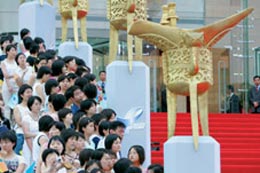
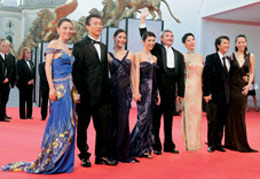
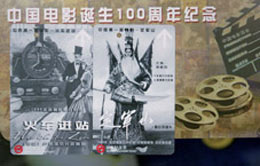
At the 62nd Venice Film Festival held in 2005, the Chinese film Seven Swords was selected to be the first film shown at the opening ceremony, and the Chinese musical, Perhaps Love, was chosen to be screened at the event's closing ceremony. These gestures honored the 100th anniversary of the birth of China's film industry, and the festival's spotlight thus fell on the nation's films and filmmakers.
Concurrent with the nation's rising profile in the world, China's film industry has also become increasingly more global in scope. Chinese films are today known around the world, and the Chinese film industry continues to develop while maintaining the nation's cultural traditions, its diversified cultural traits and long-held values. In such a way China has moved to the forefront of the international film scene.
Are Chinese Films Only Martial Arts Movies?
In 2004, when director Zhang Yimou's 2002 martial arts epic, Hero, began its North American run, for two weeks it remained the top box office draw in the US, and film audiences and critics became even more enthusiastic about Chinese martial arts films.
It is true that Bruce Lee's unyielding spirit, Jackie Chan's humorous sideshow kung fu, and Jet Lee's handsome movements and postures have long been emblematic of China's kung fu films. To many Westerners, they also represented and the whole of Chinese films.
Zhang Yimou, who has won many awards at international film festivals, has made major contributions to introducing Chinese films to the world. As a successful director, Zhang shot films on a wide variety of subjects; films such as Red Sorghum and Raise the Red Lantern explored and discussed people's lives, their status and their feelings. In fact, the martial arts film, Crouching Tiger, Hidden Dragon, which was popular worldwide in 2001 and won the Best Foreign Movie Award of the year, is more than just a show of impressive fighting arts. Directed by Ang Lee, who has a profound understanding of traditional Chinese culture, the film exhibits a strong understanding of Confucianism and its deeper meaning.
December 2005 marks the centenary of the Chinese film industry, so let's take look at its 100-year history by examining the numerous brilliant filmmakers, stars and classic films of yesterday and today.
The First Chinese Film and the Early Development of the Industry
In 1905, Ding-Jun Mountain made its appearance amidst quite a stir and marked the beginning of the Chinese film industry. It was a silent film, produced at the Fengtai Studio in Beijing, with the martial arts roles played by male actors from the Peking Opera.
In the late 1920s, catering to the needs of commercial competition, a new trend emerged with a taste for ancient costumes, swordsmen and films focusing on gods and spirits. Due to the excessive competition and confronted with the threats imposed by foreign elements on society, many Chinese filmmakers began to adapt social themes for their movies in the 1930s. National salvation and concerns for the lower and middle classes were subject matters in which Chinese filmmakers took great interest, and this period saw the creation of many classics.
After World War II, the industry returned in strength. Epics such as The Spring River Flows East and Eight Thousand Li of Cloud and Moon reflected the difficulties and hardships experienced during the war.
The Development of Films on the Mainland, in Hong Kong, Macao and Taiwan
After the founding of the People's Republic of China in 1949, Chinese films began to develop separately on the mainland, in Taiwan and Hong Kong. However, in the last few years, these three regions have begun to work together, and this united effort has proved greatly successful for Chinese-language films.
Since the late 1980s, filmmakers on the mainland have been exploring strategies for international development in recognition of the global nature of the industry. The process can be divided into three phases.
The first phase, from the late 1980s to the early 1990s, is known as the "folklore film period." Zhang Yimou's Red Sorghum is seen as marking its beginning, while Chen Kaige's Farewell My Concubine signified the end of this period. During this time, the fifth generation of Chinese film directors began to emerge at international film festivals and became more widely known around the world.
The second phase took place from the mid-1990s to the late 1990s, and is called the "independent film period." The so called "sixth generation" and "seventh generation" of directors represented by such young directors as Zhang Yuan, Wang Xiaoshuai and Jia Zhangke, retained the key features prevalent in mainland films, and they continue to exert their influence on the film world. These young directors grew up amidst the opening and reform policy in China, and this experience saw them place an emphasis on the individual. Their films examined the effects of growing-up and explored the innermost experience of the ego. Hair, Weekend Lover, The Days, Xiao Wu and others are perhaps the best known, and each shows a distinctive individual style. These young directors to varying degrees echoed the styles of art films in Europe, and the subjects of their films were mostly marginalized members of society.
Since 2000, the third phase of development, a "multinational production period," has been underway. Once China joined the WTO and allowed the opening of its film industry, its markets attracted global investment. The fifth and sixth generations of mainland directors were pushed into this market and Zhang Yimou's swordsmen film, Hero, was produced amidst these circumstances.
During this period, mainland films developed in accordance with the political, economical and cultural progress on the Chinese mainland, and showed their distinct multinational characteristics. Meanwhile, entertainment films based on the domestic market also began to develop, and Feng Xiaogang's "urban comedies" belong to this category. Most of the comic stars in Feng's films displayed charming self-deprecation and took great delight in finding solutions to life's problems by the use of various and humorous colloquialisms. Feng's Be There or Be Square and Big Shot's Funeral achieved high-ticket sales. Most of his films were jointly produced with Hollywood's large film production companies, which introduced foreign investment and this saw a new system of international cooperation in filmmaking.
Hong Kong saw a gathering of filmmakers from Shanghai after the 1950s. While they started their own careers, they also laid foundation for the local film industry. In the 1970s, Jing wu men, Enter the Dragon and other films brought Bruce Lee worldwide fame. After Lee's death, Jackie Chan became a compelling star with his comedy action movies. In the 1980s, a new wave appeared in the Hong Kong film industry, and several young directors began to shoot films with a new look. Comedies, kung fu and police-and-bandits films prospered, and had their own places in the Asian market. That was a peak period for the Hong Kong film industry. In the 1990s, Hark Tsui's new swordsmen films, such as the series on Huang Feihong, updated the look of kung fu films, and also introduced Jet Lee, a new generation of kung fu star, to the audience. At the same time, Jing Wong and Seishu Hase's comedy films were also very popular. Directors with strong artistic color like Kar Wai Wong and Stanley Kwan emerged.
In Taiwan, a group of young directors represented by Hsiao-hsien Hou and Edward Yang emerged in the 1980s. Reflecting on the society and history of Taiwan, they shot films such as City of Sadness and A Brighter Summer Day. Audiences were inspired and these films won acclaim from the international film circle. In the 1990s, a new generation of directors represented by Ming-liang Tsai emerged. Their movies focused on the spiritual obsessions of urban residents in a modern society, and had very strong personal characteristics. Vive L'Amour was a representative work of the kind.
Entering the International Arena
Since the 1980s, Chinese films have frequently won awards at film festivals in Europe. European audience members have come to know Chen Kaige, Zhang Yimou and a few other Chinese film directors, and they also come to appreciate Chinese stars. To Western audiences, in the past there were only male stars displaying stunts, like Bruce Lee and Jackie Chan in China. But today, female film stars like Gong Li, Zhang Ziyi and Maggie Cheung have gradually become well-known worldwide. The Eastern charm they displayed has constructed another image for the Chinese film industry.
To cope with the competition from Hollywood and other markets, filmmakers from the Chinese mainland, Hong Kong, Macao and Taiwan often cooperate and plan together for the future development of the Chinese language films. Films like Farewell My Concubine and Crouching Tiger, Hidden Dragon, are results of the joint efforts. The result of the recent frequent cooperation between mainland and Hong Kong filmmakers includes Seven Swords, The Myth and other films that generated big box office sales in the market. At the same time, the production of Chinese films has become more international. For instance, popular actors and actresses from South Korea are invited to take roles in Chinese films to help increase the sales of the tickets while South Korean films gain popularity throughout Asia. Seven Swords, directed by Hark Tsui, The Myth, in which Jackie Chan was the lead, and The Promise, directed by Chen Kaige, all cast stars from South Korea.
The Chinese film industry has advantages in moving more into the international market. First, from the economic prospective, low cost in filmmaking provides it with some advantages in market competition; second, from the cultural prospective, the Eastern culture is generating increasingly more interest in the West in the current climate of expanding globalization; third, from the prospective of cultural tradition and geography, the Chinese-speaking areas - including the mainland, Hong Kong, Taiwan, Macao, Singapore, Malaysia, and other Asian countries - are influenced by Chinese culture. And overseas Chinese communities in every corner of the world have contributed to the building of a market for the exchange of Chinese film culture. Lastly, a review of Hollywood films produced in recent years reveals that the human elements and narrative function exhibited have experienced an obvious decline. This might be attributed to the digital, suppositional and large-scale production of films in Hollywood. Objectively, this has provided opportunities for growth of those low cost films focusing on subject matters of humanity and existence.
With the persisting efforts of filmmakers, the Chinese film industry that has witnessed one hundred years of glorious development is bound to have a brighter future.
(China Pictorial December 12, 2005)