|
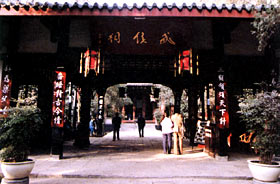
Inside Zhuge Liang Memorial Temple in Chengdu, Sichuan Province, there are a couple of facing couplets, the one on the right reads "Recall that I went for a walk to the east of Jingting Pavilion" while, to the left, "Emperor Liu and Prime Minister Zhuge worshipped in the same temple," excerpts from the poem Song of Old Cypress written by the Tang Dynasty poet Du Fu (712-770) in depicting the close relationship between Zhuge Liang (181-234) and Liu Bei (161-223). The closeness extended to death as their temples were built close together and nearly identical. Thus, this introduction to Liu Bei's Huiling Mausoleum and temple also introduces the Zhuge Liang Memorial Temple.
Zhuge Liang Memorial Temple
West of Zhuge Liang Hall in the Zhuge Liang Memorial Temple lies a quiet and secluded mausoleum, the tomb of Liu Bei, the first ruler of the State of Shu. It has, through history, been called the Huiling Mausoleum. A stone pillar inscribed with "The Tomb of Zhao Lie, Emperor of Han" still stands in front of the tomb, erected in the 53rd year of the Qian Long reign (1788) of the Qing Dynasty. And on the back of the wall is inlaid a horizontal board on which are inscribed "The Tomb of Han Emperor Zhao Lie" placed in the 7th year of the Kang Xi reign (1669).
Tombstone at Huiling, tomb of Liu Bei during the Three Kingdoms period
Further west, across a small bridge, and through Guihe Tower, Qinting Pavilion and the moon-gate named "The Han Family Cloud Ground," one enters a narrow zigzag vermilion wall lane. At the end of the lane lies the tomb of Liu Bei amid a bamboo grove, in a quiet, secluded environment.
According to the History of the Three Kingdoms, in the fourth month of the third year of the Zhang Wu reign (223), Liu Bei died in the Yong'an Palace in Baidi Town (present-day Fengjie County). His remains were shipped to Chengdu in May and buried in Huiling with his wives, Gan and Wu.
Why did Liu Bei die in Baidi Town at the entrance to the Yangtze Gorges in eastern Sichuan? It was because Guan Yu, a military hero of the Three Kingdoms period, had been defeated and killed at Maicheng (present-day Dangyang County, Hubei Province) in 219. Despite a political situation that was just moving toward stability and in which long-neglected tasks were now being done, and with a powerful enemy, Cao Cao, in the north glaring southward like a tiger eyeing its prey, Liu Bei was determined to lead his troops eastwards to fight against the State of Wu to avenge the defeat and death of his sworn brother, Guan Yu. The following June, Liu Bei, knowing nothing of his enemy's situation, nevertheless moved his troop into battle, suffering a crushing defeat by Wu's troops in Xiaoting (present-clay Yidu County, Hubei Province). He could not but retreat to and defend Baidi Town. There, for a year, Liu was so worried and indignant that he fell iii, taking to his bed, which he never left. At the same time, Zhuge Liang hurriedly left Chengdu to join Liu. There, a critically ill Liu entrusted Zhuge Liang with the care of his son, the crown prince. This resulted in the story of Entrusting Zhuge Liang with an Orphan in Baidi Town handed down from ancient times. The death of Emperor Liu Bei was a heavy loss to the State of Western Sbu during the Three Kingdoms.
Nobody knows the date of original construction of the tomb of Liu Bei. However, conditions at the time made it impossible for the State of Western Shu to spend much money and materials on a mausoleum.
Neither an arch nor stone inscriptions were found in front of Huiling. The sleeping chamber at the front of the mausoleum is very simple and narrow. The earth covering on the tomb was only 12 metres deep and the tomb is circled by a round, ancient brick wall with a circumference of 180 metres. Grass and greenwoods cover the tomb's earth slopes. In ancient times cypresses and pine trees grew around the tomb and formed a line to the Zhuge Liang Memorial Temple. Li Shangyin, a poet of the late Tang Dynasty wrote a classical-style poem, "Old Cypresses of the Zhuge Liang Memorial Temple":
Cypresses grow in front of Shu Prime Minister's Hall,
So their branches, like dragons and snakes, cover the temple;
Their shade so wide it reaches the riverside.
All this faces always toward Huiling Temple.
This poem shows that as late as a thousand years ago dense pine and cypress growth graced the tomb areas.
Because Liu Bei made valuable contributions in history and because his tomb is located near the Zhuge Liang Memorial Temple, he was worshipped in ancient times. According to the work Geographical Records of Northern Song (Tat Ping Huan Yu Ji), during the Da Zhong reign of Emperor Xuan Zong in the Tang Dynasty, these tombs were protected and sacrifices were offered throughout the year, at least when Li Hut, prefecture garrison commander, guarded Chengdu.
There are couplets on Liu Bei Hall dating from the Xian Feng reign (1851-1861) of the Qing Dynasty. The couplets read:
Even now it is a towering pile of earth on the tomb,
Yet the three bronze-bird mound has been damaged,
And one knows of the tombs of Cao Cao along the Zhanghe River;
……
Tripartite states still exist,
But only the ancient stone passage remains,
To make people think of officials of the Han Dynasty.
The first couplet boasts that the earth covering of Liu Bei's tomb still majestically stands while Cao Cao's three bronze-bird mound in Yecheng is damaged and nobody knows the locations of his seventy-two false tombs along the Zhanghe River. It indicates the author's orthodoxies in eulogizing Liu Bei while denouncing Cao Cao. There is no confirmation that Cao Cao had built seventy-two fake tombs for himself as a means of preventing looting of his real tomb. It is a mystery handed down from ancient times.
The second couplet is a sign from the author about the rise and fall of the tripartite situation during the Three Kingdoms period. The author cherished a memory of Han officials in his imagination that envisioned various stone inscriptions and other signs of respect and honor in and around the mausoleum. In fact, stone inscriptions in front of Liu Bei's tomb disappeared long ago, and history shows there were never any carved stones by Liu Bei's tomb.
The Zhao Lie Temple commemorating Liu Bei was built for the Huiling Mausoleum. It is located by the mausoleum. Originally, this temple was separated from the Zhuge Liang Memorial Temple. However, since Liu Bei had a dose relationship with Zhuge Liang, the Zhao Lie Temple and the Zhuge Liang Memorial Temple were gradually, over the centuries, combined into one. Actually the Zhuge Liang Memorial Temple is the Zhao Lie Temple, this can be seen in a sign above the gate of the temple, on which are engraved in golden characters "The Zhao Lie Temple of Han. "
Surrounded by a vermilion wall, the temple occupies 56 mu of land. Just inside the temple is a quiet and secluded courtyard planted with green cypresses and fragrant nanmu (a hard wood species). Inscribed pillars stand on both sides of the courtyard.
Through a second door, one sees a high and spacious building. It is Liu Bei Hall connected to east and west corridors, forming a courtyard in the center which is densely wooded and carpeted with lush flowers and grass. Liu Bei's statue stands in the middle of the main hall. About three meters high, the statue shows Liu in golden robes, with an imperial crown on his head and holding a scepter. He seems to have a respectful and modest expression, reminding one of an impressive-
looking emperor.
Left of the main hall is the attendant statue of Liu Zhan, Liu Bei's grandson. However, the statue of Liu Can, the emperor's son and Liu Zhan's father isn't there, prompting questions about the exclusion. Liu Can was left out because he intended to surrender at a time when enemy forces were bearing down on the border and the State of Shu was in dire peril. Meanwhile, Liu Zhan tried his best to stir resistance to the enemy. He was awe-inspiring in his righteousness and filled with grief and indignation, saying "If we cannot find good reasons for fighting and defending ourselves and thus yield to the enemy, it will be a disaster for our state. So, the whole country should stand with backs to the city wall and fight to win or die. We should prefer to die in battle. Then, we can meet our forefather emperor." His effort was in vain; his father surrendered.
Liu Zhan protested tearfully at his ancestor's temple and, finally, killed himself for his country. To honor Liu Zhan's act of facing danger fearlessly, later generations erected the statue for him. As for Liu Can, he was ignored by later generations because he surrendered himself to the State of Jin and even said to Sima Zhao after his surrender,-'This is much better than Shu, so I never think of that country any longer."
East of the main hall stand statue of Guan Yu (?-219) and his sons Guan Ping and Guan Xing as well as his general, Zhao Lei, while the statues of Zhang Fei (?-221) together with his son and grandson stand in the west side hall. These statues depict Guan Yu's impressive demeanor and Zhang Fei's irascible temperament.
Fourteen statues of ministers and generals line the east and west corridors from the main hall. In front of each statue stands a small stone tablet on which is recorded the life story of the person. Among famous persons of Shu in statue are Pang Tong, Jiang Wan, Fei Yi and Dong Yun, as well as generals Zhao Yun, Ma Chao, Huang Zhong, Jiang Wei, and others. With different expressions and styles, these statues seem to be accurate images of those generals of the State of Shu mentioned in the book Romance of the Three Kingdoms.
Records show that Zhuge Liang Memorial Temple and Zhao Lie Temple were merged in the early Ming Dynasty when Zhu Chun, emperor Shu Xian, noting that the Zhuge Liang Memorial Temple was close to the Huiling Mausoleum, ordered a damaged Zhuge Liang's statue restored into the Zhao Lie Temple, forming the joint temple of emperor and minister. The present Zhao Lie Temple was rebuilt in the 1lth year of the Kang Xi reign (1672) on ruins left from wars of the late Ming Dynasty.
Du Fu, poet of the Tang Dynasty, wrote the following lines in his Prime Minister of Shu with seven characters to a line:
Where is the Prime Minister's temple,
Deep amidst cypresses outside ]inguan (Chengdu).
Lush growths of trees and grass make spring,
But orioles among the leaves sing in vain.
Heeding Liu's three calls at the thatched cottage and masterminding the schemes,
He devoted his efforts to helping the Lius found the Han and govern state affairs.
Unfortunately, he died before victory on an expedition,
That makes heroes' eyes fill with tears.
This poem written in the first year of the Shang Yuan reign (760) shows that pines and cypresses at the tombs were already green and luxuriant. Generally speaking, cypresses grow very slowly; at least, two or three hundred years are needed for these trees to grow large. So, we may imagine the temple was probably moved there from Shaocheng, around 400 or 500 to place Zhuge Liang's temple near Liu Bei's tomb and temple.
After Zhuge Liang Memorial Temple was moved to the nearby Liu Bei's tomb and temple, the Prime Minister was still worshipped separately for nearly a thousand years. People of those times respected and admired Zhuge Liang at least as much as they did Emperor Zhao Lie, so, construction details of the temple were magnificent, and pillars and tablets with numerous poems and' inscriptions by poets of past ages were included. However, because of the relations between prince and minister, the status of the temple was much lower than before as soon as it was merged into the Zhao Lie Temple. Not only was the title of the main gate changed to Zhao Lie, but also the Zhuge worship hall was placed behind the Zhao Lie Temple. It was also smaller than the Liu Bei Hall.
From Liu Bei Hall, one enters Zhuge Liang Hall by descending steps behind Liu's hall and passing through a connecting hallway. Although it is smaller than that of Liu Bei Hall, Zhuge Liang Hall is elegant and exquisite in construction, comprising a main hall and two corridors as well as a courtyard. Blue stones serve as barristers edging the corridors, and stone pillars are carved with rare birds and beasts in various postures, vividly true to life. At the sides of the main hall stand the bell and drum towers each with flying rafters. Indeed, they are magnificent.
Seated clay statues of Zhuge Liang, and his son and grandson covered with gold leaf occupy the center of the hall. With feather fan in hand and head wrapped in silk ribbon, the statue of Zhuge Liang sits with dignity in
the middle, denoting the experience and prudence of a strategist who thought deeply and planned carefully. To the left of Zhuge Liang's statue is the statue of Zhuge Zhan, son of Zhuge Liang while the statue of Zhuge Shang, grandson of Zhuge Liang is on the right.
Zhuge Zhan was good at painting and calligraphy and had a good memory. Both Zhuge Zhan and Zhuge Shang fought the enemy bravely when the State of Shu was about to be subjugated. Both finally lay down their lives for their country.
Three generations of the Zhuge family were unswerving in their loyalty to the State of Shu and accounts of their deeds were widely read by people over generations owing to Zhuge Liang's great talent and bold vision, especially his merits and achievements in assisting Liu Bei in governing the State of Shu.
Today, there still exist not a few poems and inscriptions admiring their deeds. A couplet written on scrolls and hung on the pillars of Liu Bei Hall, says that during the southward expedition in 225, Zhuge Liang made a psychological move in persuading Meng Huo, then the chieftain of the Yi nationality who had been defeated and captured seven times by Zhuge Liang to capitulate again. Finally Meng was convinced and surrendered himself to Zhuge Liang. Zhuge and the couplet reminded his successors to take this strategy carefully into consideration. This couplet was written by a person of the late Qing Dynasty. (However, it is signed by Zhao Fan, commissioner-in-chief of salt and the tea in Sichuan, in the first ten-day period of November 1902, in the 28th year of the Qing Dynasty, during the Guang Xu reign.)
The memorial Asking for the Emperor's Marching Orders was written by Yue Fei, a well-known national hero in China. It was said he had mixed feelings of grief and joy and was moved to tears as he wrote the plea. With its intense sentiment, the couplet was an inspiration to many generations.
A bronze drum on display in front of Zhuge Liang's statue was called "Zhuge drum." Originally, such a drum was a cooking utensil used by some minority groups in southwestern China, which appeared in the Spring and Autumn (770-476 B.C.) and Warring States (457-221 B.C.) periods. Later it developed as a musical instrument. Zhuge Liang's tremendous influence among the people in southwestern China led them to erroneously attribute invention of the drum to Zhuge Liang.
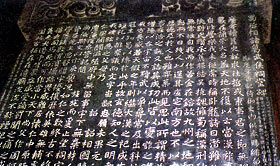
There is a famous Tang Dynasty stone tablet in Zhuge Liang Memorial Temple called "three-unique stone" for several hundred years. The "three-unique" means that the text, calligraphy and carving of the stone were done by separate well-known persons. For example, the text was written by Pei Du, a famous Prime Minister who advocated unification of the state during the middle of the Tang Dynasty and assisted the Tang Emperor in smashing attempts at a separatist regime by Fan Zhang. When he wrote the tablet text in the 4th year of the Yuan He reign (809), he was an official under Wu Yuanheng, Xichuan Prefecture in Sichuan Province. And soon after he was promoted to palace aide to the censor-in-chief, high minister and finally prime minister. The text was written when he and Wu Yuanheng went sightseeing to the Zhuge Liang Memorial Temple.
Part of the "Three-Unique Tablet"
The carver and engraver were Liu Gongchuo and Lu Jian, well-known calligrapher and engraver of the Tang Dynasty. With a calligraphic style similar to that of his younger brother, Liu Gongquan, Liu Gongchuo nevertheless had an originality of his own, writing in bold hand with vigorous strokes, while Lu Jian's engraving was bold and extremely skillfully carved.
In short, the stone tablet incorporated strong points of three different schools, earning it the name "three-unique stone."
There are many evaluations of Zhuge Liang at his early stage. However, Pei Du's text on the stone tablet is fairly complete and sets a high value on Zhuge Liang. It declares that Zhuge Liang was well-known in the world and "had moral courage to assist an emperor, talent to found a country, a way of establishing an unassailable position and a method for remolding persons."
He could be mentioned in the same breath with Guan Zhong and Yan Ying of the Spring and Autumn Period, Xiao He and Zhang Liang in the Western Han Dynasty and he even demonstrated many of their strong points.
Pei Du especially appreciated Zhuge Liang's policy of ruling by law, saying that Zhuge Liang established policies and criminal law in troublesome border areas, so even those sentenced to death were not resentful.
The historical story, "Killing Ma Su with hearts full of tears" illustrates that any one would be punished who violated the military law, no matter how great the contributions he made.
The "three-unique stone" is erected behind the gate of the temple. It is well preserved although more than one thousand years have elapsed, making it a treasured relic of important historical and artistic value.
|