|
The mausoleum of Emperor Qinshihuang (the first Emperor of Qin) is five kilometers east of Lintong County, 35 kilometers from Xi'an City in Shaanxi Province. On its south is Lishan Mountain and to the north is Weihe River. It is the biggest imperial mausoleum in ancient China. In 196I, the State Council decided the Mausoleum of Emperor Qinshihuang would be a key cultural relic under state protection.
Emperor Qinshihuang was named Ying Zheng and was a great politician and militarist of China's ancient feudal society. He made many political decisions that had enhanced the State of Qin and built its military might. He used his strong military force to annex other six states in the east and founded the first united and centralized state in Chinese history. After unification he adopted many measures to develop politics and the economy and consolidate centralization. Because of his tyranny and excessive tax collections the Qin Dynasty ended soon after his death.
Portrait of Emperor Qinshihuang
As the first huge ancient mausoleum in China, with a river in front and a mountain towering behind, Qin Shi Huang's mausoleum displays the skill and craftsman-ship of the country's tomb construction and has spawn many anecdotes which have endured through the ages.
According to historical records, Emperor Qinshihuang spared neither labor nor money to construct his huge Epang Palace. Because he wanted a long life in this ornate palace, he sent the necromancer Xu Fu to lead several thousand boys and girls to look for elixir vitae in the sea. A couple of years later they returned empty-handed and lied to the emperor: "There is a huge fish in the sea so our ships can't reach Penglai Hill."
Then Emperor Qinshihuang himself, carrying many bows and arrows, went to shoot the huge fish in the sea. It is said he actually killed a huge fish in the sea northeast of Fushan County in Shandong Province. After that Xu Fu and the children went to the sea and never came back. According to popular legends they settled in Japan.
Still, Emperor Qinshihuang attached much importance to construction of his mausoleum while searching for elixir vitae.
According to the Records of the Historian: Emperor Qinshihuang succeeded to the throne of Qin at the age of 13 (246 BC). Soon after his enthronement he started building the mausoleum north of Lishan Mountain.
After he united the country he requisitioned more than 700,000 laborers from all over China to help in the construction. Despite the efforts, the mausoleum was not yet complete when the Emperor died 37 years later at the age of 50 (210 BC). The project lasted another two years after the Second Emperor of Qin ascended the throne. When adding the first phase of construction, nearly 40 years were used in building the mausoleum.
There is some description about the underground tomb and its layout in the Records of the Historian. The tomb was very deep and solid and lined with stones. A vermilion stone wall blocked off groundwater, making it waterproof. Inside the tomb were palaces and the burial places of all the high officials of Qin. Treasures and jewels were kept there and candles of man-fish oil (from a type of man-fish with four feet multiplying in the East Sea) burned 24 hours a day. Automatic hidden arrows protected the tomb from robbers and looters. A belt of quicksilver poured in a ditch around the tomb looked like a protective river.
On the ceiling was the pictographic celestial body and on the ground were pictographic mountains and rivers. According to records, at the burial ceremony of Emperor Qin Shi Huang, the Second Emperor of Qin forced all the imperial palace maids who had no children to be buried alive with the dead ruler. In order to prevent disclosure of secrets from the tomb's interior, the door
was closed on the builders and craftsmen as they completed their work inside the tomb.
According to writers from the Three Kingdoms Period (220-265), the Mausoleum of Emperor Qinshihuang "is more than 120 meters high and 2, 167 meters around at the base." Grasses and trees planted on the tomb mound made it look like a normal mountain. According to Li Daoyuan (466 or 472-527), the great geographer of the Northern Wei, the geological structure around the tomb was sandy and lacked the more compactable loess soil, so the loess needed was carried from the low-lying land near Wujia Village, 5 li northeast of the tomb. Thus, the tomb hill was a completely man-made mountain and its grandeur could rival the Great Pyramid of Egypt. Both demonstrate the great intelligence and capability of laborers of ancient times.
However, the loess-made tomb of Emperor Qinshihuang has, over the centuries, been lowered to 64.97 meters (to slightly more than half its original height) by wind erosion and man-made damage. In spite of this, its location in such a plain still hints of its former magnificence.
To offer sacrifice to deceased emperors and kings in ancient times burial temples were built to contain articles and dresses used by the deceased and spirit tablets for worship. A city wall was built around the tomb to protect it, and this combination of temple and wall was called Yuanqin (Garden Temple). This custom began in the Qin Dynasty.
A distinctive characteristic of the tomb of Emperor Qinshihuang was that it had two city walls, one interior and one exterior, the shape of the tomb was like the Chinese character "回," but somewhat longer from north to south. The rectangle formed by the exterior wall was 2,173 meters from north to south and 974 meters from east to west, making it more than 6,000 meters around the base. Originally, watchtowers were built at the four comers of the mausoleum's city wall. The rectangular tomb was located in the southern portion of the mausoleum. Three doors in the outer wall on the closest sides (east, west and south) were built opposite the three doors in the inner wall to the tomb.
Only scattered debris, packed earth and exposed stone steps remain in the northern part of the mausoleum where the sacrificial hall and its auxiliary structures had stood. It was called in surviving documents the "Dew Terrace Shrine," namely, Emperor Qin Sift Huang's Shrine or Emperor Qin Shi Huang's Temple. In the ruins of the city gates and buildings, piles of tiles, brown clay and ashes can be found. There are probably the ruins of "the former palace ground," according to the "Biography of Liu Xiang' in the History of the Han Dynasty. Other ruins of Qin buildings can be seen, such as a doorstone, a post stone, tile ridges, big eave tiles 0.5 meter in diameter, stone waterways, ceramic waterways, etc. No burial treasures have been found from the tomb, but the ruins inside and outside suggest the tomb's luxury of old.
There were passageways to the underground tomb from the four directions of east, south, west and north. These passages were very large and peculiar in layout. For example, horses and chariots were excavated in one of the chambers in the western tomb passage. Some were painted wood with canopies, others were bronze, hitched to horses and decorated with colored drawings. Every chariot had a single shaft and double wheels and was harnessed to four horses. These bronze chariots and horses, excavated in November I980, were two groups of imperial chariots: Four of "security" and four high ones. High chariots, driven by drivers wearing swallow-tailed caps, battle robes and swords preceded the "security" chariots ridden by drivers sitting back to the rear. The castings are in proportions half the size of live men, horses and chariots. These vivid excavations are precious bronze arts.
Raising horses was a tradition for people in the Qin Dynasty. Horses were indispensable for fighting and transportation, so great importance was attached to horse breeding and management, with horses placed under strict public control according to their classification and specific uses. Figurines depicting various aspects of horse-raising and burial pits for horses were discovered on the east and west sides of the tomb wall of the Qin mausoleum, and the name of a stable and proper feeding portions were inscribed on a manger.
For its location on a piece of flood plain at the north foot of Lishan Mountain, the mausoleum of Emperor Qinshihuang included a dam 10 meters high and 1,400 meters long to prevent flood. The river to the south of the mausoleum was diverted to run northwest, and into the Weihe River in the north. So the mausoleum was given complete safety from mountain floods.
The entire plan testifies of a massive project. It is estimated that I2.8 million cubic meters of earth were needed just for the coffin pit, auxiliary burial pits for pottery figurines and the dam. In addition, some 1.2 million cubic meters were required for the tomb itself. A great deal of manpower was likewise needed for excavation, filling and hauling of the earth. The engineering and construction of the coffin chamber, tomb passages, paved paths leading to the tomb, side rooms, side halls, burial pits and ritual pits outside the tomb required large number of designers and craftsmen, including carpenters, masons, bricklayers and repairmen. Other crafts-men must have spent years on burial articles of gold and silver jewelry, paintings, drawings, clothing, ceramics and chariots. Labor, materials and time for all these works are difficult to calculate.
Stones needed in building the mausoleum were quarried from Ganquan Mountain, more than 200 kilometers northwest near Chang'an (modern Xi'an). A ballad tells about the stone quarrying: "Stones were carried from Ganquan Mountain and the Weihe River was stopped. With work songs by the laborers, stones were piled mountain high."
Under primitive conditions without modem means of transportation, it was a gigantic task for people to push, pull and move the stones that distance. There is no way of knowing how much manpower, blood and sweat went into the project, nor how many lives were paid on the way to construction of the burial site in Lintong. In Zhengzhuang Village, northwest of the mausoleum, iron fetters, iron hammers and semi-finished stones were discovered, suggesting that Zhengzhuang Village was a stone-processing site.
Those who worked on the mausoleum included social criminals, unpaid feudal peasants, craftsmen and slaves. A tomb for criminals was excavated in Yaochitou, 1,400 meters southwest of the mausoleum. It was a burial pit covering an area of 1,020 square meters containing a very thick layer of bones. That was the end-result of the lives of many of the builders.
The mausoleum itself was evidence of the crimes of oppression and exploitation of the people by feudal rulers. A poem titled "Passing by the Mausoleum of Emperor Qin Shi Huang" was written by Wang Wei (701-761) of the Tang Dynasty:
Like a green ridge is the ancient tomb,
Deep is the palace like a purple terrace.
……
The soughing of pines can be clearly heard,
It sounds like the wail of the people.
The wondrous monument made by the laboring people of ancient China was destroyed in the war-tom years of the late Qin Dynasty. According to Commentary on The Canon of Rivers, Xiang Yu (232-202 BC) led his 300,000 soldiers to loot all the burial articles in the tomb and set many architectural structures on fire. The great fire lasted for three months. Later a shepherd went into a cave of the mausoleum, dug by Xiang Yu, to look for his sheep with a torch in his hand and a second fire was ignited to burn away all the remaining tomb structures inside and out.
Wen Tao, a warlord of the Five Dynasties (907-960), emptied the mausoleum again under the pretext of raising funds for soldiers' pay and provisions. What was left then were scattered rubble and scorched earth in evidence of Xiang Yu's burning and looting.
Found in recent few years are a set of bronze chimes inscribed with "Official Music Conservatory," a bronze weight inscribed with imperial edicts on the unification of weights and measures, a bronze bell of "Beautiful Lishan Garden" and spears and arrowheads on the mausoleum site. These are the remaining reminder of great calamities.
In the spring of I974, however, when peasants sank a well near Xiahe Village three li east of the Mausoleum of Emperor Qinshihuang burial terracotta warriors and horses were found. A team of archaeologists was sent to the burial site and after several years' excavation, an unrecorded wonder was brought to light that had caused a sensation all over China as well as throughout the world. It has provided another opportunity for study of the civilization of that period.
Excavators found three burial pits for terracotta figures of warriors, horses and chariots. One is to the south and the other two lie north of the mausoleum site. All the figures face east. The pits are designated as numbers 1, 2 and 3. The two pits of the north are over 20 meters from Pit No. 1 which is the southern pit. Pits 2 and 3 are northwest and northeast, respectively, of Pit 1.
The burial pits are 1,000 meters from the east wall of Emperor Qin Shi Huang's mausoleum and north of the east gate. The figures are placed in battle array as palace guards to protect the underground imperial palace.
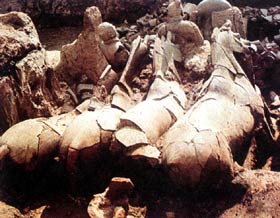
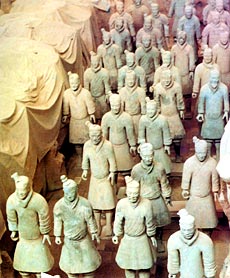
Thousands of life-sized pottery figures of warriors and horses were buried in battle array from 5 to 7 meters deep in the earth of the three pits.
Qin terracotta soldiers and horses
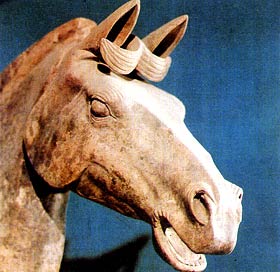
Head of a Qin terracotta horse
Qin terracotta soldiers in battle array
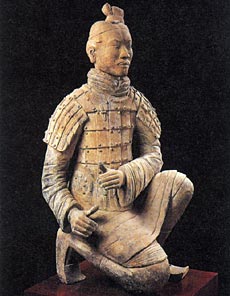
A Qin terracotta soldier
The three pits differ in size and shape. Pit 1 is 230 meters from east to west and 62 meters from north to south. It is rectangular and covers and area of 14,260 square meters. There is a long corridor and eleven compartments in which pottery figures of warriors, chariots and horses are lined up in a 38 column formation. About 500 pottery warriors, six chariots with four horses each, and such weapons as bronze swords, bending knives, spears, crossbows, arrowheads and tongyi (a kind of bronze weapon) have been found in the pit. It is estimated that, based on the area excavated, about 6,000 pottery warriors and horses are expected to be unearthed in Pit 1 when it is fully excavated.
Pit 2 covers about 6,000 square meters in the shape of a carpenter's square. The formation is mixed with foot soldiers, crossbow soldiers, chariot soldiers and cavalry carrying such weapons as bow, crossbow, spear, dagger axe, halberd, axe and sword, according to their services and positions.
Pit 3 covers an area of 500 square meters, with a "U" shape. At the front of the pit, a canopied chariot facing east was followed by four armored figures with long hats. In each of the two side rooms of north and south there are 64 armored guards. According to experts, it was the headquarters commanding Pits 1 and 2. Pits 2 and 3 have been filled in and closed after initial excavations while excavation on Pit 1 is continuing and expanding.
The figurines are vivid and artistic, and those who have seen them associate them with the strong and powerful military forces of the Qin which conquered other Six States and united China, garrisoned the Five Ridges and drove back the Xiongnu people more than 2,000 years ago.
These terracotta warriors, horses and bronze weapons represent the high level of handicraft of the Qin Dynasty. Each life-size warrior and horse figurine was made individually. Some of the warriors look majestic, some seem deep in thought and some look intelligent. Each has a facial expression and posture of its own. A few figures of leaders wear helmets and Armour, the rest wear short war robes with waistbands and leg wrappings, carry bows and arrow-bags and look vigorous.
Colored drawings can still be seen on the robes of some figurines. All the life-size terracotta horses, some with and some without saddles, stand with t
heir heads up, eyes wide open and ears erect. They seem ready to neigh to jump out of the pit.
Some weapons excavated from the pits are still in perfect shape and glittering sharp despite a 2,000 year burial.
Swords are included, reminders of the poem Emperor Qinshihuang Drinks Himself Drunk by the Tang Dynasty poet Li He (790-816): "Emperor Qinshihuang tours everywhere riding on a tiger, the light of his sword makes the sky blue."
Chemical tests show that excavated swords and arrowheads were made mainly of bronze and tin, with traces of rare metals. Chromium treatment on the surface of the weapons made them rustproof for centuries.
Discovery of the terracotta warriors and horses provides very important material for research of the history, politics, military affairs, economy, culture, art and science and technology of the Qin Dynasty. Excavation of Pit 1 has excited the archaeological world, known as "the Eighth Wonder of the World." To protect, study and exhibit these cultural relics the people’s government has built the Museum of Qin Terracotta Warriors and Horses at the Mausoleum of Emperor Qinshihuang.
|