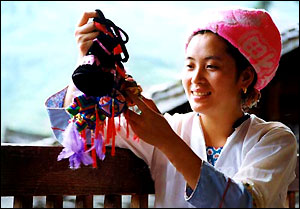
Population: 16,178,811
Major area of distribution: Guangxi
Language: Zhuang
Religion: Polytheism
The Zhuang ethnic minority is China's largest minority group. Its population of about 16.18 million approaches that of Australia. Most of the Zhuangs live in southwest China's Guangxi Zhuang Autonomous Region, which is nearly the size of New Zealand. The rest have settled in Yunnan, Guangdong, Guizhou and Hunan provinces.
While most Zhuang communities concentrate in a compact area in Guangxi, the others are scattered over places shared by other ethnic groups such as Han, Yao, Miao, Dong, Mulao, Maonan and Shui.
Lying in Guangxi's mountainous regions, the Zhuang area is high in the northwest, undulating in the middle and low in the southeast. Limestone is widely distributed in the area, which is known round the world for its karst topography. Many rocky peaks rise straight up from the ground, and the peaks hide numerous fascinating grottoes and subterranean rivers. Guilin, a tourist attraction in Guangxi, is an excellent example of such landscape. As the saying goes: "The landscape at Guilin is the best on earth; and the landscape at Yangshuo is the best in Guilin." Wuming, Jingxi and Lingyun counties are also known for their scenic splendors.
Crisscrossing rivers endow the Zhuang area with plentiful sources of water for irrigation, navigation and hydropower. The coastline in south Guangxi not only has important ports but also yields many valuable marine products including the best pearls in China.
The Zhuang area enjoys a mild climate with an average annual temperature of 20 degrees centigrade, being warm in winter and sweltering in summer in the south. Plants are always green, blossoming in all seasons. Abundant rainfall nurtures tropical and subtropical crops such as rice, yam, corn, sugar cane, banana, longan, litchi, pineapple, shaddock and mango. The mountains in southwest and northwest Guangxi abound in Liuzhou fir, silver fir and camphor trees, rare elsewhere. Mineral resources include iron, coal, wolfram, gold, copper, tin, manganese, aluminum, stibium, zinc and petroleum. The area is also rich in tung oil, tea, tea oil, mushroom, Chinese cinnamon, pseudo-ginseng, Chinese gecko (used in traditional Chinese medicine to help regain vitality), fennal and fennal essence. The last four items are the Zhuang area's special products.
History
"Zhuang" was one of the names the ancestors of the ethnic group gave themselves. The term was first recorded some 1,000 years ago, in the Song Dynasty. The Zhuangs used to call themselves by at least a dozen other names, too.
The Zhuang areas first came under the administration of China's central authority 2,000 years ago. In 221 BC, the First Emperor of Qin, China's first feudal emperor to unify the country, conquered the area and established three prefectures there. The emperor had the Lingqu Canal built to facilitate irrigation. He also started a project to move people from other places to the area, strengthening its political, economic and cultural ties with the central-south part of the country.
In the centuries that followed, a number of powerful clans emerged in this area, who owned vast tracts of land and numerous slaves and servants. Still later, during the Tang and Song dynasties, social and economic development was such that irrigated rice paddies, farm cattle, iron, copper and spinning and weaving spread far and wide.
However, the Zhuang area still lagged behind central China economically. Quite a number of places retained the primitive mode of production, including slash-and-burn cultivation and hunting. The dominant social system was feudal serfdom and people were classified into three strata: hereditary landowners, tenant farmers and house slaves. The system was eliminated during the Qing Dynasty (1644-1911), the last feudal monarchy in China.
Administratively, most of the Zhuang area was governed by the headmen system all through the over 1,000 years from the Tang to Qing dynasties. Backed by the central authorities, the local headmen oppressed and exploited the Zhuangs, forcing them into hundreds of uprisings.
In 1851, the Taiping Revolution, the biggest of peasant uprisings in Chinese history, broke out in this area. Thousands of Zhuangs joined the Taiping Army, forming its spine in its march to the north. Many of them became important leaders of the army and the Heavenly Kingdom of Taiping.
Inhabiting China's southern frontier areas, the Zhuangs have played an important role in defending the country's territory. In the 1070s, they repulsed the Annamese aggressors; in the middle 16th century, they beat back the invading Japanese pirates.
Towards the end of the 19th century, French troops that had occupied south Vietnam pushed northward and invaded China. People of Zhuang and Han nationalities in Guangxi formed the Black Banner Army and trounced the French invaders near Hanoi in 1873. They again routed the French at Hanoi in 1882.
When the French invaders made new incursions into China in 1885, the local Zhuang and Han people helped the Chinese army win a crucial victory at Zhennanguan, a pass on the Sino-Vietnamese border.
The Zhuangs also made great contributions to the Revolution of 1911, China's first democratic revolution led by Dr. Sun Yat-sen. Many Zhuangs became key members of the Tong Meng Hui, an organization Dr. Sun formed to advance his revolutionary cause.
Culture
The Zhuang language belongs to the Chinese-Tibetan language family. Ancient Zhuang characters appeared in the South Song Dynasty (1127-1279), but never got popularized. So, the Zhuangs wrote in the Han script until 1955, when the central government helped them create a writing system based on the Latin alphabet. The Romanized script has been used in books, magazines and newspapers.
The Zhuang ethnic group's ancient culture and art are not only rich and colorful but also outstanding with their indigenous characteristics. For example, 2,000-year-old frescoes have been found at more than 50 spots on the precipices hanging over the Zuojiang River running through southwest Guangxi. The best known of them is the Huashan fresco in Ningming County which is over 100 meters long and 40 meters wide, featuring 1,300 figures. Drawn in rugged and vigorous lines, it reflects the life of the Zhuangs' ancestors.
Bronze drum, a special relic of minority groups in central south and southwest China, dates back well over two millennia. Guangxi alone has unearthed more than 500 of such drums, which are in different designs and sizes. The largest exceeds one meter in diameter and the heaviest weighs over half a ton while the lightest several dozen kilograms. The tops and sides of the drums are decorated with designs done in relief.
However, explanations are diverse in so far as the use of these drums is concerned. Some people believe that they were meant for military music, others argue that they were for folk music, and still others think they were for religious rites or to symbolize power and wealth.
Zhuang brocade is a splendid handicraft which originated in the Tang Dynasty (618-907). Woven in beautiful designs with natural cotton warp and dyed velour weft, the brocade is excellent for making quilt covers, table-clothes, braces, aprons and handbags. Winning national fame during the Ming and Qing dynasties (1368-1911), Zhuang brocade has been steadily improved and at least 40 new designs have been developed in the past few decades.
Legends, fairy tales, stories and ballads frame the folk literature of the Zhuangs who have also been reputed for their singing. Sweet songs can be heard wherever you go in the Zhuang area. Extemporaneous melodies and lyrics and clever use of metaphors, riddles and cross-examinations add charm to their songs. It is said that, in the Tang Dynasty, a Zhuang woman singer called Third Sister Liu became known not just for her beautiful singing but especially for the courageous exposure in her songs of the crudeness of local tyrants. Today her name is a household word throughout China thanks to a successful film about her made in the 1950s.
In the old days, every Zhuang community held its regular songfests at given venues. On those occasions, young people from nearby villages would come together in their holiday best to meet each other and choose their lovers through songs.
Common Zhuang musical instruments include suona (Chinese cornet), bronze drum, cymbal, gong, sheng (Chinese wind pipe), xiao (vertical bamboo flute), di (Chinese flute) and huqin (a stringed instrument) made of horse bones.
Zhuang dances are characterized by distinct themes, forceful and nimble steps, jocular and humorous gestures and true-to-life emotions. The Rice-Husking Dance, Silk-Ball Dance, Shrimp-Catching Dance, Tea-Picking Dance, Shoulder-Pole Dance and Bronze-Drum Dance not only vividly depict the Zhuangs' life and work, but also display their straightforward, unbending nature.
Yet what combines the Zhuangs' folk literature, music, dance and other forms of art is the Zhuang Opera, which first originated from religious rites in the Tang Dynasty.
Customs and habits
Most Zhuangs now live in one-story houses the same as the Hans. But some have kept their traditional two-story structures with the upper story serving as the living quarters and the lower as stables and storerooms. The old housing style, they think, suits the mountainous terrain and the humid climate.
Contemporary Zhuang clothing is in general close to the wear of the Han people. But traditional dresses remain in many places or are worn for special occasions. In northwest Guangxi, for instance, elderly women like collarless, embroidered and trimmed jackets buttoned to the left together with baggy trousers, embroidered belts and shoes and pleated skirts. They fancy silver ornaments. Women of southwest Guangxi prefer collarless, left-buttoned jackets, square kerchieves and loose trousers – all in black.
Tattoo used to be an ancient Zhuang custom. A great writer of Tang Dynasty, Liu Zongyuan, mentioned it in his writings. Chewing betel nuts is a habit still popular among some Zhuang women. In places such as southwest Guangxi, betel nuts are a treat to guests.
Rice and corn make up the Zhuangs' staple food, and glutinous rice is particularly favored by those in south Guangxi.
The Zhuangs are monogamous. But they have a strange custom – the wife stays away from the husband's home after marriage. At the wedding, the bride is taken to the bridegroom's home by a dozen girls of the same generation. She returns to live with her parents the next day and visits her husband only occasionally during holidays or the busy farming seasons. The woman will move permanently to the man's home two or three years later. This convention, which often impairs the harmony between husband and wife, has been going out of existence.
While sharing many festivals with the Hans, the Zhuangs have three red-letter days of their own: the Devil Festival, the Cattle Soul Festival and the Feasting Festival. The Devil Festival, which falls on July 14 on the lunar calendar (usually in August on the Gregorian calendar), is an important occasion next only to the Spring Festival. On that day, every family would prepare chicken, duck and five-colored glutinous rice to be offered as sacrifices to ancestors and ghosts.
The Cattle Soul Festival usually follows the spring ploughing, when every family would carry a basketful of steamed five-colored glutinous rice and a bundle of fresh grass to the cattle pen. After a brief sacrificial rite, they would feed the cattle with the grass and half of the rice. They believe that the cattle have lost their souls because of the whipping during the spring ploughing and that the ritual would call back the lost souls.
The Feasting Festival is celebrated only by people who live near the Sino-Vietnamese border. Legend has it that a group of Zhuang soldiers, having repulsed the French invaders in the late 19th century, returned in late January and missed the Spring Festival. To pay tribute to them and celebrate the victory, their neighbors prepared a sumptuous feast for them.
The Zhuangs are polytheists, worshipping among other things giant rocks, old trees, high mountains, land, dragons, snakes, birds and ancestors. Taoism has also had a deep influence on the Zhuangs since the Tang Dynasty. In the old days, there were semi-professional Taoist priests in the countryside, and religious rites cost a lot of money. Foreign missionaries came to the area in the 19th and early 20th centuries, but their influence was limited to cities and towns.
(China.org.cn June 21, 2005)