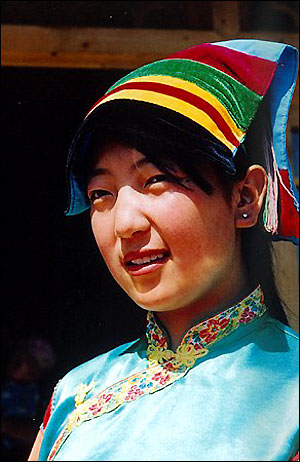
Population: 241,198
Major areas of distribution: Gansu and Qinghai
Language: Tu and Han
Religion: Lamaism
The Tu ethnic minority, known for their simplicity and industriousness, lives in the northwestern part of China – to the east of Qinghai Lake and south of Qilian Mountain Range and along the banks of the Huangshui and Datong rivers. It is concentrated mainly in the Huzhu Tu Autonomous County in Qinghai Province, and also in the counties of Minhe and Datong. Others are scattered in Ledu, Menyuan and the Tianzhu Tibetan Autonomous County in Gansu Province.
The language of the Tu people belongs to the Mongolian branch of the Altaic language family. Its basic vocabulary is either the same as or similar to that of the Mongolian language, but it is much closer to the languages of the Dongxiang and Bonan ethnic minorities. Quite a number of religious terms are borrowed from the Tibetan language, while a good portion of everyday words, as well as new terms and phrases, come from the Han language, which has long been the medium of communication among the Tus of Datong County. The Tu people do not have a written language of their own; they use that of the Hans instead.
The costumes and personal adornments of the Tu people are strikingly unique. Men and women alike wear shirts with delicately designed embroidered collars whose colors are bright and well blended. Men like to dress in cloth robes, putting on high-collared fur gowns with waist belts in winter. They often dress up in felt hats with brocade brims. For women, jackets are tilted in the front with sleeves made up of five different kinds of cloth. Sometimes they slip on a sleeveless garment done in black, indicating formal attire. They used to be very particular about hairstyles, which numbered seven or eight different varieties. But this custom was suppressed under the Kuomintang regime before the founding of the People’s Republic in 1949. Nowadays, simple hairstyle topped by a brocaded felt hat has become fashionable among Tu women.
Historical origins
The fact that the Tus claim to be "Mongguer" (Mongolians) or "Chahan Mongguer" (White Mongolians) gives expression to the close relations that existed between the early Tus and the Mongolian ethnic . Popular legends among the Tus of Huzhu Autonomous County have it that their ancestors were Mongolian soldiers under one of Genghis Khan's generals by the name of Gerilite (Geretai). They intermarried with the indigenous Houers of what is now Huzhu County.
Chinese records also tell of Mongolian troops under Genghis Khan making their appearance in Xining (now capital of Qinghai Province), which exercised jurisdiction over Huzhu County during the Yuan Dynasty (1271-1368) founded by Genghis Khan. All historical records have accounts of Mongolian troops having either been stationed in Xining during the Mongolian western expeditions or moved into the place at some point in history.
Especially worth mentioning is the account of Yuan imperial clansman Buyan Tiemuer's troops being attacked and defeated in Andingwei during the reign of Ming Emperor Zhengde (1506-1521). The survivors settled down to the east of Weiyuan City near Xining. The area is now under the administration of the Huzhu Tu Autonomous County. This shows that a portion of the Tu people in Huzhu County are descendants of Mongolians that moved in from Andingwei during the Ming Dynasty.
"Huoer" was long ago a Tibetan name for the nomadic herdsmen who lived in northern Tibet and vast areas north of Tibet (or north of the Yellow River, according to a different interpretation). In modern times the term refers specifically to the Tu people.
Herders and Farmers Economically, the Tu people started off as livestock breeders, especially of goats and sheep. This was due to the abundance of water and grass in the fertile mountainous area that they inhabited. The Tus used to be well known among the locals for their expertise in animal husbandry. According to historical documents, they began to familiarize themselves with farming at least from the early period of the Ming Dynasty.
Also starting from that period, the Tu area fell under the rule of 16 hereditary headmen, whose titles and territories were granted by the Ming Emperor. Since the land tilled by the Tu people belonged to the headmen, the former had to shoulder a multitude of labor services and extortion enforced by the landlords, apart from taxes of various descriptions. The headmen made full use of their "inspection tours" once every three years to exploit their people. It was only in 1931 that the Kuomintang government formally abolished the headman system. The displaced headmen were, however, appointed as deputy county heads, district heads or township heads to continue their function as tools of the regime. Economically, most of them retained their positions as rich landlords and continued to dominate the means of production.
Like elsewhere in China, the Tu area was gradually being reduced to a semi-colonial and semi-feudal society when history entered its modern stage. The only difference was that, due to lack of modern means of transportation and the existence of serious feudal separatist tendencies, the Tu society had then more of a feudalistic nature. Nevertheless, the imperialists did manage to rob the Tu people of their wealth by plundering their raw materials and local produce while dumping foreign products on the Tu market. The penetration of foreign influence was also manifested in missionary activities. In the period from 1915 through to the eve of liberation in 1949, seven churches and four church-run primary schools were set up in the area.
Feudal oppression and exploitation in the Tu area was extremely ruthless in the first half of this century. For 38 years, the Tu people toiled under the barbarous rule of the warlords of the Ma family. Just ordinary taxes and corvee in the form of grain as enforced by the Ma family could be of more than 40 different kinds. About half of the peasants' annual income went to the Ma family. This, coupled with forced labor and military service, brought the Tu people to a state of real disaster. In addition to ruthless exploitation through land rent and non-economic extortion in various forms, the practice of usury functioned as another major means of economic plunder. Many poor peasants were heavily in debt as much as several generations on end.
The Ma warlords were also bureaucrat capitalists marked by a strong feudalistic tendency. A commercial enterprise owned by the Ma family, for example, not only had the power to requisition of laborers and means of transportation from the people, but also the right to set up its own court and carry out inquisitions by means of torture. It had its own squad of bodyguards and hired roughnecks equipped with guns and horses. The warlords also ran a number of workshops in the Tu areas, whose workers were mostly poor peasants either requisitioned or arrested by the reactionary regime for not having been able to repay loans. The interest on loans was around 150 percent and could be as high as 400 percent.
Drastic change
The Tu people did not, however, submit tamely to such oppression. On many occasions they rose in resistance, along with people of the Han and other nationalities.
In September 1949 the Tu people ushered in their liberation with great jubilation. With the help of the central government in Beijing, they did away with the reactionary social system and set up an administration of their own. This was followed by a struggle to eliminate bandits and bring down local despots, which paved the way for the final successful drive for land reform.
The Huzhu Tu Autonomous County was established in February 1954, in spite of the fact that the Tu people account for only 13.5 percent of the population of the county. Autonomous townships have also been set up in areas where there are concentrated populations of the Tus. The Tu people have their representatives in the People's Congresses at both the Qinghai provincial and the national levels.
Religious reform
The Yellow Sect of Lamaism used to have a wide-spread following among the Tu people. To strengthen their domination over the ordinary people, the ruling classes of previous regimes had, without exception, collaborated with the upper clerical elements. The latter enjoyed the support of the authorities as well as all kinds of privileges.
After 1949, the Tu people carried out a religious reform under the leadership of the people's government. They burned the feudal deeds and loan receipts of the Lama landlords and abolished all religious privileges, forced apportions and labor services.
These struggles helped further emancipate the minds of the Tu people, who threw themselves actively into the drive for socialist construction. Whereas superstition forbade the disturbing of "sacred" mountains and springs, the Tu people began transforming mountain slopes into farmlands and digging irrigation canals. Women, who began enjoying unprecedented political rights, took an active part in all these constructive endeavors.
The traditional practice of cremating the dead persists in most parts of the Tu-populated areas.
Birth of industry
Prior to 1949 no modern industry of any kind had been developed in the Tu areas. Agricultural production and transportation were backward. Since the founding of the People's Republic, the Huzhu Tu Autonomous County has set up a fair number of industrial and mining enterprises turning out more than 200 kinds of products including farm machinery, chemical fertilizers, wine, ores and coal. Whereas the entire county did not have a single motor vehicle or farm machine before 1949, it now has a substantial number of trucks, cars and buses, tractors, harvesters, threshers and processing machines. The opening of roads to motor traffic throughout the county has helped bring about a big change in its agricultural production. Over 1,00 hectares of irrigated farmland has been newly developed, along with the construction of 60 reservoirs and ponds for draining waterlogged areas. The building of seven hydro-electric stations has made electricity available throughout the county.
Cultural, educational and public health facilities have been gradually developed. By 1981 the county had founded more than 500 schools of various kinds with a combined Tu student population of over 10,000. College graduates, engineers, artists, journalists, teachers and doctors of Tu origin are playing active roles on all fronts. Quite a few officials from the ethnic group have been promoted to leading positions at the provincial, prefectural and county levels.
People of the Tu ethnic group are renowned for their talent for singing and dancing. Ballads with beautiful melodies, as well as oral literature with stirring plots can be heard everywhere in the Tu populated areas. A traditional ballad-singing festival is held once a year, when thousands upon thousands of singers and young people gather from all over the area to get together and sing to their hearts' content.
(China.org.cn June 21, 2005)