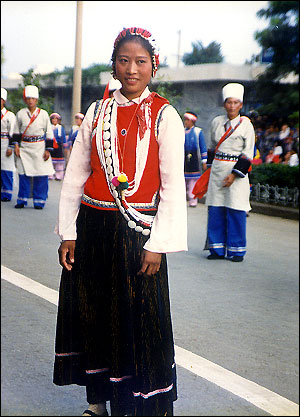
Population: 28,759
Major area of distribution: Yunnan
Language: Nu
Religion: Polytheism
The Nu ethnic minority, numbering some 28,759, live mainly in Yunnan Province's Bijiang, Fugong, Gongshan and Lanping counties, which comprise the Nujiang Lisu Autonomous Prefecture. Others are found in Weixi County in the Diqing Tibetan Autonomous Prefecture.
The Nu people speak a language belonging to the Tibetan-Myanmese group of the Chinese-Tibetan language family. It has no written form, and, like many of their ethnic minority neighbors, the Nus used to keep records by carving notches on sticks; educated Nus nowadays use the Han language (Chinese) for administrative purposes.
The Nu homeland is a country of high mountains and deep ravines crossed by the Lancang, Dulong and Nujiang rivers. The famous Grand Nujiang Canyon is surrounded by mountains, which reach 3,000 meters above sea level. Dense virgin forests of pines and firs cover the mountain slopes and are the habitat of tigers, leopards, bears, deer, giant hawks and pheasants.
The area is rich in mineral deposits and valuable medicinal herbs. In addition, with a warm climate and plentiful rain, it promises great hydroelectric potential.
Origins and history
In the eighth century, the area inhabited by the Nus came under the jurisdiction of the Nanzhao and Dali principalities, which were tributary to the Tang (618-907) court. During the Yuan and Ming dynasties it came under the rule of a Naxi headman in Lijiang. From the 17th century, rulers comprised various Tibetan and Bai headmen and Tibetan lamaseries. These rulers usurped the Nus' land and carried many of them off as slaves.
From the mid-1850s, the British colonialists who had conquered Myanmur pushed up the Nujiang River valley. They were followed by American, French and German adventurers. This caused friction with the Nu and other minority peoples in the area, such as the Lisu, Tibetan and Drung ethnic minorities. In 1907, these peoples banded together to stage a mass uprising against the encroachments of French missionaries.
Culture and customs
Before the founding of the People’s Republic of China in 1949, social development was uneven among the various Nu communities. The Nu people in Lanping and Weixi counties had long entered the feudal stage, and their methods of production and standard of living were similar to those of the Hans, Bais and Naxis. There were vestiges of primitive communalism in the Nu communities in Bijiang, Fugong and Gongshan, where private ownership and class polarization had only just begun.
Bamboo and wooden farm tools were the main implements of production, and major crops were maize, buckwheat, barley, Tibetan barley, potatoes, yams and beans. Output was low, as fertilizer was not used and crop techniques were primitive. The annual grain harvest was some 100 kg short of the per capita need and the diet was supplemented by hunting and fishing using bows and poisoned arrows.
Industry was represented by handicraft products made on a cottage-industry basis – linen, bamboo and wooden articles, iron tools, and liquor. Surplus handicrafts were bartered for necessities in the small markets.
Before China’s national liberation in 1949, land ownership took three forms: primitive communal type, private and group-ownership. The older Nu villages in Bijiang and Fugong retained vestiges of the ancient patriarchal clan system; there were ten clan communes located in ten separate villages, which each had communal land. According to a 1953 survey, a landlord economy had emerged in Bijiang County, with an increasing number of land sales, mortgages and leases. In some places, rich peasants exploited their poorer neighbors by a system called "washua," under which peasants labored in semi-serf conditions. Slavery was practiced in a fraudulent form of son adoption.
Monogamy was the general practice, although a few wealthy landlords and commune headmen sometimes had more than one wife. After marriage, men would move out of the family dwelling and set up a new household with some of the family property. The new family, however, still retained a cooperative relationship with the parental family and the whole clan. The youngest son lived with his parents and inherited their property. Women had low social status, doing the household chores and working in the fields but having no economic rights at all.
The traditional burial forms dictated that males be buried face upward with straight limbs, while females lay sideways with bent limbs. In the case of a dead couple, the female was made to lie on her side facing the man and with bent limbs -- symbolizing the submission of the female to the male. When an adult died, all the members of the clan or village commune observed three days of mourning.
The Nus live in wooden or bamboo houses, each usually consisting of two rooms. The outer one is for guests and also serves as the kitchen. In the middle is the fireplace, with an iron or stone tripod for hanging cooking pots from. The inner room is used as a bedroom and grain storage, and is off-limits to outsiders. The houses are built by the common efforts of all the villagers and are usually erected in one day.
Until the mid-20th century, both men and women wore linen clothes. Girls after puberty wore long skirts and jackets with buttons on the right side. Nu women in Gongshan wrapped themselves in two pieces of linen cloth and stuck elaborately-worked bamboo tubes through their pierced ears. Married women in Bijiang and Fugong wore coral, agate, shell and silver coin ornaments in their hair and on their chests. For earrings they used shoulder-length copper rings. Besides, all Nu women like to adorn themselves with thin rattan bracelets, belts and anklets. Nu men wear linen gowns and shorts, and carry axes and bows and arrows.
The staple food of the Nus is maize and buckwheat. They rarely grow vegetables. In the past, just before the summer harvest they had to gather wild plants to keep alive. Both men and women drink large quantities of strong liquor.
The Nus were animists, and objects of worship included the sun, moon, stars, mountains, rivers, trees and rocks. The shamans were often clan or commune chiefs and practiced divination to ensure good harvests. Apart from that, their duties also included primitive medicine and the handing down of the tribe's folklore. Any small mishap was the occasion for holding an elaborate appeasement rite, involving huge waste and hardship to the Nu people. In addition, Lamaism and Christianity had made some headway among the Nus before liberation.
The Nus practice an extempore type of singing accompanied on the lute, flute, mouth organ or reed pipe. Their dances are bold and energetic – mainly imitations of animal movements.
New life
China's national liberation came to the Nu areas in 1950. Local governments gave out free food grains, seeds, farm implements and articles of daily use to the Nu people to help them tide over their difficulties and boost production. In 1954 the Nujiang Lisu Autonomous Prefecture was established, which had under its jurisdiction the counties of Bijiang, Fugong, Gongshan, Lushui and Lanping (this last incorporated in 1957). On October 1, 1956 the Gongshan Drung and Nu Autonomous County was set up.
The pace of social reform varied in the different Nu areas. For instance, in the more-developed Lanping County, where feudalism had gained a strong hold, land reform was carried out, followed by the establishment of cooperatives in 1956. In Bijiang, Fugong and Gongshan counties, where vestiges of primitive communalism still survived, the government adopted a policy of first developing production and then gradually eliminating exploitation and primitive practices.
People from outside were sent in to promote advanced production techniques, and start up educational and public health projects. Special funds were earmarked for irrigation projects, land reclamation, paddy-field development and sideline production.
Light industries and mining, too, have gained a foothold among the Nus, and grain production has increased several times owing to the transformation of poor land into paddy fields. The formerly isolated Nu communities are now linked to each other by a network of highways, and some 20 chain bridges now span the Nujiang, Lancang and Dulong rivers.
At the time of the mid-20th century, only about 20 people of Nu origin had received primary education. Now there are primary schools in all townships and most villages, and a middle school in every county. The majority of Nu children are in school.
Four hospitals and a network of clinics and community healthcare centers have done much to control dysentery, typhoid, cholera and other epidemics.
(China.org.cn June 21, 2005)