Few question the fact that the Palace Museum, better known as the Forbidden City, is where people see the best of ancient Chinese porcelain pieces.
Even fewer would dispute the fact that Jingdezhen, in east China's Jiangxi Province, was the ancient "capital of porcelain."
Most of the valuable ceramics kept at the Forbidden City, which date back to the Ming (1368-1644) and Qing (1644-1911) dynasties, were made there.
But at which kilns were the works for royals kneaded and fired?
The answer remained elusive as ancient imperial annals recorded that the one and only kiln complex with the five centuries' patronage from two dynasties was destroyed in a peasants' rebellion in the late 19th century.
The restored version later disappeared without even an oral or paper trail, following the downfall of the Qing Dynasty in 1911.
Since the founding of New China in 1949, the porcelain town sprawled. Houses and porcelain factories were built and roads were opened in Jingdezhen.
It was not until the early 1980s that researchers stumbled upon the possible ruins of the royal kiln complex in the central area of Jingdezhen.
Liu Xinyuan, professor of ceramics history with a local college, spent years searching every possible building site. In early 1982, he was walking by a construction site when he watched piles of broken porcelain pieces fall from a bulldozer.
The construction workers had seen too many broken pieces in the area to pay attention to them. But Liu was different. With his knowledge and a pair of keen eyes, he believed the broken pieces he saw could only have come from the royal kiln complex. It was said that Liu practically had to stand in front of a bulldozer to stop the construction.
But extensive excavations at the ruins started some 20 years later in 2001.
A group of archaeologists from Peking University, Jingdezhen and provincial archaeological institutions have kept very busy over the past four years on the northeastern and southern part of the kiln complex site.
According to Quan Kuishan, one of the leading archaeologists in the investigation team from Peking University, they have unearthed a large amount of valuable remains and relics at the kiln sites.
With the artifacts, archaeologists and historians have begun to piece together the puzzle of the royal porcelain making in the Ming and Qing dynasties, and rewrite the history of ceramics of the Ming and Qing dynasties.
Unknown wares
For porcelain connoisseurs, the highlight in the archaeologists' work has been the discovery of the rich varieties of porcelain pieces.
"We've found many types of porcelains that were not in the record books or among the ceramic works handed down," said Quan.
These include a blue underglazed jar decorated with the drawings of the sea and dragon and a red underglazed brushbox embellished with incised plum blossom and bamboo. A blue and white glazed porcelain spoon of the Yongle period (1403-1424) in the Ming Dynasty is 33.5 centimeters long, bearing scriptures of good wishes in Sanskrit.
The excavated pieces were mainly fired in the early and middle stages of the Ming Dynasty. During the reigns of Emperor Chengzu (1403-24, reign title Yongle) and Emperor Xuanzong (1426-35, reign title Xuande), the porcelain production was of the largest quantity and finest quality.
The colors of the items varied at different times, such as mainly red glaze and red underglaze during Yongle period, and primarily white glaze and classic blue and white during Xuande period.
The items were bowls, jars, vases and other dish wares. The major decorations are carved designs, printings or drawings.
Some ceramic pieces bear inscriptions indicating the time of manufacture, which offers important clues to the puzzling ceramic production development.
Kiln shapes
"These items add a new dimension for us to explore the porcelain production skills at those times," said Quan, who with his co-researchers, have been able to make out the size and the shapes of the royal kilns.
"They are indispensable in revealing the great changes of firing activities of the kilns," he added.
The excavation now covers an area of nearly 1,000 square meters.
Judging from their position and age, the archaeologists concluded that the size of the royal kiln complex was much larger in the early stage of the Ming Dynasty than in the Qing Dynasty.
Two shapes of kilns were unearthed, one resembling a gourd and the other steamed bread.
Excavated in the northeastern part of the site, the Gourd Kiln Hulu Yao is surrounded by a brick wall. The kiln is huge in size, and the kiln bed slightly rises from the front to the back.
Drawing on the best functions of the common Dragon Kiln (Long Yao) and the Steamed Bread Kiln (Mantou Yao), the Gourd Kiln enabled the craftsmen to better control the fluctuation of temperature.
"The Gourd Kiln was already common during the Yuan Dynasty (1279-1368), but this is the first time we have unearthed this type of kiln in the royal kiln site," Quan said.
Another 14 so-called smaller Steamed Bread Kilns were also excavated in the southern part of the site. These were built with small bricks.
The excavation showed that the Gourd Kiln was mainly used before the reign of Emperor Xuanzong (1426-35) of the Ming Dynasty. Afterwards, the Steamed Bread Kiln was more utilized.
Though both kilns were already commonly used before the Ming Dynasty, they were not simple copies, but went through further reconstruction at the time.
What greatly aroused the archaeologists' interests was the "kiln sweats."
The glass-like sinter produced in the high-temperature chemical reaction, between the inside walls and the substances volatilizing from the burning wood and pottery glaze, hung inside the walls of some Steamed Bread Kilns, accumulating in thick layers and indicating a high firing temperature of over 1,200 C. But such a phenomenon is not widespread among all Steamed Bread Kilns.
"It is absolutely not accidental. We think work divisions among the kilns already existed at the time," said Quan.
Some kilns were used for firing the small blue utensils of qingci celadon requiring a high temperature. Comparatively, in some low-temperature kilns, the colorful ceramic glaze could be fired.
"The wide varieties of exquisite pottery of the Ming Dynasty should not be separated from its advanced kiln structure and the reasonable work division of the kilns," said Quan.
During the Ming Dynasty, in order to avoid any copies of the royal tributes from the civilian kilns, the defect products and the works failing to meet imperial standards were all shattered and buried with discarded kiln tools and slag.
The archaeologists discovered three different ways of dealing with these defective pieces.
Broken pieces
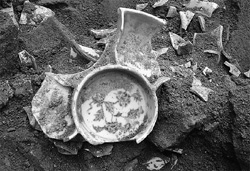
They have excavated 14 small pits, all dating back to the Ming Dynasty, arranged in a round or irregular circle and were dug specially to bury the ceramic fragments.
However, the researchers also found piles of broken pieces that seemed to have been thrown together at random.
They surmised that sometimes, after the craftsman smashed the defect works, they just dumped them onto the ground at will.
Most of the fragments could be recovered into their original appearance.
To the craftsmen in the Ming Dynasty, these pieces were not as good as the ones that have survived. But to contemporary researchers and historians, these add to the design and creations in the list of Ming Chinese porcelain.
(China Daily February 22, 2005)