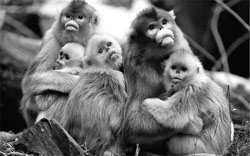
Like the giant panda, the Sichuan snub-nosed monkey (Rhinopithecus roxellana) is considered one of the country's national treasures.
Distributed throughout Sichuan, Gansu, Shaanxi and Hubei provinces, the rare species which is also known as the Sichuan golden monkey or the golden snub-nosed monkey lives in mountainous areas at a height ranging from 1,400 to 3,400 meters above sea level. Scientists believe there are only 15,000 to 20,000 Sichuan golden monkeys, famous for their long, golden fur, left in the wild.
Of those, it has been estimated that 39 groups, with 3,800-4,000 members, inhabit the Qinling Mountains in southern Shaanxi Province, in northwest China.
It is in these mountains, with their rich biodiversity, including more than 560 vertebrate species, that Professor Li Baoguo of Northwest University in Xi'an, the provincial capital of Shaanxi, has established the country's first golden monkey field research base.
From this base, the primatologist and his students have almost completed their difficult but essential individual identification of the golden monkeys under study.
As a result of 14 years of arduous work, Li and his students have been able to chronicle the monkeys' living habits and obtain deeper insights into their social behavior, population dynamics, mating practices and their relationship with the environment.
Interesting finds
The ground-breaking research has also led the researchers to ponder over the effectiveness of existing conservation strategies for the species.
Legends and tales about the monkey led people to believe that the groups of monkeys lived in their hilly kingdoms with their king, the most powerful male, who dominated their lives.
However, Li and his students have made some new interesting findings. The basic social unit of the Qinling golden monkeys is not the family, but rather the one-male unit.
But a single adult male isn't the leader or king of a unit. The researchers observed that the female members of the unit often dominate the male.
In fact, the researchers found that the adult female monkeys have the power to "impeach" the only adult male monkey in their unit and put another adult male on the "throne," and a change in male head of a unit occurs every three or four years, Li explained.
"In April 2003, we observed the replacement of the leader in a one-male unit," Li said. "This replacement process was completed over a period of five days. It is the first report of adult male replacement in a Sichuan snub-nosed monkey unit."
Sometimes the female monkeys mated with the males from the other units, a kind of adultery, he added.
"There is a certain amount of this behavior in their society. But we do not have a clear understanding of it yet."
Although adult male replacement exists among the golden monkeys, Li and his students have not recorded infanticide among the monkeys they have observed.
The golden monkey has been categorized as a species of Asian colobine. International researchers have documented infanticide among a few other species of Asian langurs in their studies.
Regular field trips
Li and his students have also observed the life of the other monkey groups on the eastern ridge of the valley where their base is located. The monkeys in that troop number about 110 individuals.
All their research findings are the result of a strict routine that Li has developed over the years. The base for their field work is Gongnigou Valley in the Zhouzhi National Nature Reserve in Shaanxi, the natural habitat of the Sichuan snub-nosed monkeys.
The trip from Xi'an to Gongnigou is still taxing. After a six-hour shake-up on a bus and a motor tricycle and a one-hour hike up a winding mountain path, Li's four students arrived at Yuhuangmiao Village hidden in the Qinling Mountains during their field trip this May. They carried with them a full tank of liquefied natural gas and food for the next 10 days.
It was raining the next day. They stayed in a villager's house and could only wait.
"It's very dangerous to search for the monkeys on the slopes on a rainy day," Lu Jiuquan, who is working on his doctorate with Li, told China Daily.
The rain stopped on the third day. Lu and six villagers, whom the school hired, spent more than 12 hours combing the forests on the west ridge of the mountains encircling the hamlet, until they found their target troop of about 100 monkeys. In the next few days, the farmers worked to somehow keep the monkeys in Gongnigou Valley.
The farmers' work made it easier for the students to watch the monkeys from their observation posts at Gongnigou. When the west ridge troop of monkeys arrived, they were somehow divided into eight one-male units. They sat on branches and fed on leaves.
The students observed them with binoculars.
Li Yinghua, a graduate student in her third year, introduced different individuals of some units to Yu Xiaoyu, a first-year graduate student: "The big adult male is Changmao, who has particularly long fur. The female adult near him is Heiwei, meaning black tail..."
To the students, such work in the wild is quite common. They observed the monkeys in the mountains every day during the field trip. Some of them have been going on these field trips almost once a month for the past several years.
But to Professor Li, dean of Biology Department of the School of Life Sciences of the university, the present research conditions can only be considered luxurious, especially when he recalls the first days when he initiated the research over 14 years ago.
First days
It was on October 4, 1989. Li still remembers when he first hiked from the National Highway 108 to Yuhuangmiao Village.
It took him eight hours to trek the 25-kilometre mountain path.
In this area, the dominant animals living in the wild are golden monkeys and takins. The takins live at a higher elevation, well above and far away from the natural habitat dominated by the monkeys.
On the west ridge and east ridge of the mountains surrounding the village, he found troops of Sichuan golden monkeys, one on each ridge. He was fascinated by the beautiful and clever mammals and decided to make the area his research base. The village would be the base camp. He built up a camp ground at Gongnigou.
"With an altitude of 1,646 meters, Gongnigou was at that time a no-man's land within dense forests," said the 43-year-old scholar. "It was more than two hours of hard climbing from the village, for there was no footpath at all."
There, however, the professor has built up the country's first field research base for the golden monkey.
"Usually it took us several hours to find the monkeys and then we would watch them for one or two hours," he said. "But sometimes we searched for a whole day and saw nothing."
Later they built a hut at the camp site, in which six students and teachers can stay overnight.
"So we could stay on the mountains for one week living on bread and canned food," he said.
As they learned a lot about the natural habitat of the monkeys and the monkey groups during their field trips, they were encouraged to delve deeper.
"To learn the monkey's social structure and behavior, group dynamics and mating system, we must know how to tell them apart," he added. "That's truly the key and base to furthering our research."
However, for years, they had difficulties getting closer to the monkeys, who live in deciduous broad-leaved forests, mixed deciduous broad-leaved and coniferous forests, as well as coniferous forest.
It has been extremely difficult for them to identify individual monkeys when they hide among the leaves and branches of the trees. And they move quickly on top of the trees.
To achieve their research objectives, Li and his students had to get closer to the troop of golden monkeys. "To watch them closely and regularly, we have to create a place where they would like to stay," he said.
Following international norms, they chose a feeding area at Gongnigou.
The feed is only a kind of bait, he said.
They started to set out food such as apples, corn and radishes in early November of 2001, when the golden monkeys had difficulties finding enough food. However, the monkeys were hesitant at first. For 11 days, they didn't touch the food placed on open ground in the valley.
"A sub-adult monkey picked up an apple and took a bite," Li said. "In the next day, both adult and infant monkeys began to come and sample the food. We don't feed them much so as to avoid having too much impact on their ability to survive in the wild.
"In fact, they have hardly cared about our food this spring and summer while natural sources of food are rich. So we have to hire the villagers to drive them into the valley.
"But in the winter, they like the feed and stay in the feeding area."
So the harsh winter has become the best season for the researchers to observe the monkeys. Sometimes they can watch the monkeys from a distance of less than a meter, he said.
They have been able to give names to most of the adult, sub-adult and juvenile monkeys of the west-ridge troop.
"But it's still a challenge to recognize individual infants," Li said. "We're trying to find a new method to solve the problem."
Over the years, he said, almost every member of his team has spent more than six months every year in the valley.
The cumulative research has achieved encouraging results.
Over the years, Li and his students have published more than 20 papers in academic magazines at home and abroad. Their research won financial support from both the country's Natural Science Foundation and several overseas foundations.
More thinking
The research achievements have also pushed the professor to reconsider their original ideas about conservation strategies for the golden monkeys in the area.
He has begun to call for more concrete research before the building of the proposed ecological corridors which might cause fragmentation of the monkey's habitats.
He said that even after more than 14 years of observation, the researchers have failed to find any migratory patterns between the west-ridge troop and the east-ridge troop.
"The two ridges are close and there are no natural nor man-made barriers between them," the professor said. "Without genetic exchanges between the two troops, however, the population of both troops has been quite stable."
That means that some special mating mechanism exists within a troop so the members of the troop can avoid inbreeding, he said.
"But we haven't got any clear idea yet," he said.
It also means that there are certain geographic boundaries existing in the minds of the monkeys.
"Will the ecological corridor be efficient enough?" he said. "We don't have any special scientific proof yet. And it's extremely expensive too. "So why don't we choose a more efficient way or invest in more scientific research?"
According to the scholar, for the sake of the monkeys, banning all commercial logging in forests in the area 1,400 meters above sea level is certainly an efficient conservation strategy. "The golden monkeys have always lived more than 1,400 meters above sea level," he explained. "I think the villagers living in the area can collect their firewood on the lower slopes for they have no other option."
He suggested that the Zhouzhi National Nature Reserve should expand its boundaries because the east-ridge troop is still living outside the nature reserve.
And tourism is certainly a threat to the fragile ecosystem in the Qinling Mountains, he said.
In the past 10 years, he said, the region has witnessed a 10-time increase in the number of tourists. At present, it receives 50,000 tourists a year. Newly built roads and hotels and garbage left by tourists have had a clear negative impact on the local environment.
"Our research base is facing pressure from tourism too," he admitted. "People want to come and see the monkeys. But I still insist our feeding area is only open to researchers."
(China Daily June 16, 2004)