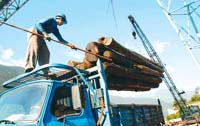
Due to a lack of wood to feed the blazing stove of national economic growth, China is considering radical changes to its forestry policies to lure both private and foreign investment.
The central government is working on new regulations to legalize the separation of use rights from the ownership of land already covered by or destined to be planted with trees, said Li Zujiao, head of the Economic Development and Research Centre under the State Forestry Bureau.
The new rules will pave the way for the transfer of the forest land use rights to marketize the sector and protect the interests of investors, Li said.
The separation of land ownership from the right to use it was instituted roughly 20 years ago as part of a plan to lease urban areas to foreign investors, and later non-State investors, for up to 70 years, as the Constitution stipulates that all land in the country is owned by the nation and cannot be sold.
The transfer of land use rights is believed to be one of the fundamental factors in the nation's rapid economic development, and experts hope the introduction of the concept to the forestry sector will similarly work to eliminate the 270-million-cubic-meter shortage of timber China suffers annually.
Besides legalizing the marketization of the sector, Li said, the government will also move to cut red tape to facilitate related investments as well as logging operations by distinguishing protected trees from wood-production forests.
The government currently imposes strict controls on the logging industry in an effort to check further damage to the environment. Applications to invest in wood production, processing and sales involve long, complicated approval procedures.
Heavy tax levies on the sector are expected to be cut to reduce investors' costs and bring down domestic wood prices, which are higher than foreign supplies, making domestic wood and related products less competitive against imports.
Uniform policies on financing, investment, taxation and the use of resources will be applied to all investors in the sector, regardless of whether the investors are State-owned, private or foreign.
"The sector is opening wider," Li said. Meanwhile, the government encourages foreign and private investment in tree planting and wood processing, and in domestic and foreign trade by the establishment of wholly owned companies or joint ventures, land leases, or the acquisition of stakes in related State-owned enterprises.
Investors will enjoy full freedom in their business development and be guaranteed their earnings as well as legal, social and political status, he added.
Severe shortage
China has been a forest-poor country for decades, and the shortage of wood and inadequate timber resources may continue for another half century, according to analysts.
"Existing forests still fall short of protecting the national ecological environment even if not a single tree is allowed to be cut," said Zhou Shengxian, director of the State Forestry Bureau, "but felling every single tree in the country for the logging industry can only satisfy domestic wood demand for a few decades."
Lei Jiafu, deputy director of the bureau, said China's wood reserves only account for 2.9 per cent of the world's total, far from adequate to meet the demand of a country that contains about 22 per cent of the world's population.
According to international standards, at least 30 per cent of a country's land should include forested acreage to achieve a good, stable and sustainable ecological environment, but the ratio in China is only 16.55 per cent.
An expected GDP growth rate of 7 per cent per year and an annual net population growth of about 11 million in the next five to 10 years will create a strong and steady increase in the demand for wood, said Lei, adding that China faces an even more severe shortage in the decades to come.
China's per capita wood consumption is now just 0.29 cubic meters, far below the worldwide average of 0.58 cubic meters.
An optimum 370 million cubic meters of wood is needed annually, but domestic supply only came to 100 million cubic meters in 2002, said Li Zujiao. China relies heavily on imports and is already the largest importer of wood in the world.
He noted that per capita forested areas and wood reserves in China equaled only 20 and 12 per cent of the world average, respectively, explaining that the country will require at least 18.5 billion cubic meters of wood in the next 50 years, 1.6 times the amount all the forests in China can produce today. And the country must plant more than 90 million hectares of new forests to realize its forest coverage target of 26 per cent of national land areas by 2050.
Official statistics indicate that domestic forests have only supplied a little more than 5 billion cubic meters of wood since the founding of the People's Republic in 1949.
Afforestation efforts
For their part, the public and the government have made immense and continuous afforestation efforts. Altogether, 6.2 billion people participated in tree-planting activities in the last 14 years, with a total of 39.8 billion trees planted.
Man-made afforestation efforts in 2002 alone encompassed 6.67 million hectares. Live planted trees covered 46.7 million hectares by 2002, accounting for 26 per cent of the world's total. As a result, China leads all other countries as home to the largest number of planted forests in the world.
These endeavours have brought China's forest coverage to its current 16.55 per cent, compared with 8.6 per cent in the early 1950s and 12 per cent in the 1980s. Total forested areas were expanded to 15.87 billion hectares, creating 12.5 billion cubic meters in total timber reserves.
The forestry sector's financial output hit 438 billion yuan (US$52.96 million) last year, according to government statistics.
These efforts, however, are still dwarfed by an accelerated demand, so the government decided to take bigger steps with an ambitious plan to create 13.34 hectares of fast-growing timber forests before 2015, aiming to provide 133.37 million cubic meters of wood annually.
The project, kicked off last August, was one of six massive afforestation programs requiring a combined investment of more than 700 billion yuan (US$84.64 billion). The others include the protection of natural forests, sand-break forests near Beijing and Tianjin, shelter forests in North, Northwest and Northeast China and along the Yangtze River, wildlife protection parks and a program to return some arable land to forests and grasslands.
The fast-growing, high-yield timber forests will be located in 886 counties in 18 provinces and autonomous regions in central and eastern China.
However, analysts noted, the massive undertaking will require heavy investments and much patience as the plan will take time to bear fruit, which explains why the government is considering new regulations and polices encouraging foreign and domestic investment and trade.
The project's key players are businesses, not government entities, said Shi Min, a senior official under the State Forestry Bureau in charge of the plan.
Financing the market-oriented project will depend on the market, and the government can only provide limited policy credit, Shi said.
Businesses must be prepared to supply an abundance of capital and technology, while the investment returns will not be high, said a representative of a State-owned company who declined to be named, adding that commercial banks are reluctant to grant loans for such projects.
Besides, he said, most of the existing companies in the sector are small and unlikely to be able to list on stock exchanges as a way of raising money.
In the short run, analysts said, China will still have to depend heavily on imports.
The State Council held a national meeting in September after issuing a set of new policies in June focused on tapping both domestic and foreign supplies.
Premier Wen Jiabao promised at the meeting to grant forestry "strategic importance" status in national development and include the sector in the country's overall social and economic development plans.
Wen vowed to speed up related legislation and further improve government polices to create a favorable environment for the sector's development.
Encouraged by the government's latest moves and attracted by the market demand, domestic and foreign businesses are starting to invest more in the sector.
In Guangdong Province alone, more than 540,000 small- and medium-sized businesses have invested in timber forests, according to the State Forestry Bureau. Together they have planted 1.1 million square meters of timber forests, accounting for 50 per cent of the province's total commercial woodlands.
Meanwhile, large timber companies and financial groups from seven countries - the United States, Malaysia, Australia, Britain, France, Italy and New Zealand - as well as China decided at the end of last month to launch what will become the largest international timber exchange in the world.
In the first phase, construction of the exchange is planned to cover 100,000 square meters of floor space at a cost of US$200 million.
The investor behind the exchange, which will conduct both cash and futures trading in timber, is registered in Hong Kong and includes 12 multinational financial groups.
Some of the foreign financial groups have already expressed interest in investing in the fast-growing timber forests in China, said Zhang Lei, deputy head of the Economic Development and Research Center of the State Forestry Bureau.
The exchange is expected to not only attract foreign and private investment in timber forests, Zhang said, but also bring China's timber trade in line with the international market.
China's afforestation targets
* 2010: National forest coverage of 19 per cent; 22 million hectares of land affected by desertification converted to forests and grasslands; 30 per cent of urban areas covered by trees and grass in 70 per cent of cities.
* 2020: National forest coverage of 23 per cent; 20 million more hectares of land affected by desertification converted to forests and grasslands; 35 per cent of urban areas covered by trees and grass in 70 per cent of cities.
* 2050: National forest coverage of 26 per cent; all land affected by desertification deemed suited to afforestation converted to forests and grasslands; 45 per cent of urban areas covered by trees and grass in 70 per cent of cities.
(China Daily November 27, 2003)