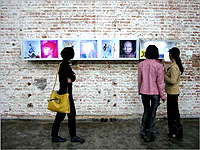
In a cameraman's jacket, artist Xu Yong, 49, received us at the gate, shook hands, then ushered us into his "reception room" -- a wooden platform suspended at the far end of a huge hall lined with sculptures, video installations and obsolete factory machinery.
Following our agile host we climbed a ladder, made our way across the platform, carefully ducking low cross beams, before settling down on two comfortable sofas to talk.
"The history of this place was well known, especially to older Beijingers of my generation," Xu told China Daily.
Xu, a photographer and arts manager, was referring to the former 798 Electronic Components Factory in northeastern Beijing's Dashanzi, where his newly opened 798 Art Space and 798 Photo Gallery are located. The arts projects have transformed vacant factory workshops.
Along with some other factories in the area, the 798 Factory was built in the early 1950s with the support of the former Soviet Union and designed by experts from the former East Germany.
For decades, the factories turned out parts primarily for the military and were famous examples of State-owned enterprises under the old planned economy. But with the emergence of a market economy in China in recent years, the firms underwent a difficult restructuring to merge into the Beijing Seven Stars Group, an enterprise which now manufactures products for civilian use.
To the surprise of many, those vacant areas have once again become the focus of national and even international interest. What is making the news this time around is not business, but the area's rise as a new venue for contemporary Chinese arts.
Some of the old workshop buildings that had been left empty for years have turned into the favored haunts of a group of artists, designers, publishers, performers and those involved in the commercial side of the arts.
With an eye for great spaces and low rents, these people are enthusiastically transforming the old buildings into stylish galleries, art centers, open artists' studios, bars, restaurants, and associated commercial offices.
In addition to Xu's 1,200-square-meter studio -- the largest in the area -- and photo gallery, there are about 20 other organizations situated in the area which covers less than one square kilometer, adjacent to Beijing's Airport Expressway and within half-an-hour's drive from the city center.
Around 30 contemporary artists have set up their studios there, all of which are open to visitors. And 200 more artists and organizations, keen to join the community, are on the waiting list to move in.
"We hope to inject new concepts and forms to these old buildings," said Xu, a co-organizer of the recent campaign "Reconstruction 798," aimed at promoting the rising artistic community among the wider public.
"Of course, we are not going to reconstruct the old factory, but to transform this area into a new cultural landscape, the Dashanzi Arts Territory."
Designing a Lifestyle
New concepts and forms were not what most concerned the earliest artists and arts managers who moved in.
Robert Bernell, an American art publisher and collector who created the well-known English website www.chinese-art.com, opened his office there in Dashanzi in February last year. "What attracted me most then were the low rents and large spaces," said Bernell, who is now running his company "Art Books Time Zone 8" from Dashanzi.
"The rent was cheap -- only 0.8 yuan a day per square meter. Even now it is only 1 yuan (about 12 cents). All I did to the building was change the roof and paint the walls. That cost me about 25,000 yuan (US$3,019)," said Bernell, speaking from his elegantly decorated and spacious offices, whose color scheme is reminiscent of some of the old houses of Europe.
Bernell was probably the first foreigner to open an arts-related business in today's Dashanzi Arts Territory.
In his wake came the Tokyo Gallery of Japan which opened the Beijing Tokyo Art Projects last October. The New York-based Long March Foundation also launched its 25000 Cultural Transmission Center here in February. Both institutions focus on advocating Chinese contemporary art.
In addition to "Art Books Time Zone 8," local fashion magazines such as Le, I Look and Seventeen have also opened offices there recently.
"I enjoy the post-industrial nature here and believe that conforms with the direction of Beijing's urbanization -- to move factories out of town and eventually replace manufacturing industries with service industries," said Bernell.
Huang Rui, a Beijing-born designer who spent time living in Tokyo, is a primemover behind the Dashanzi Arts Territory. He moved in last year and built his home and studio in a section of the factory workshop.
A co-organizer with Xu, who integrated the various projects for the promotion campaign, Huang and the Beijing Tokyo Art Projects, to which he acts as artistic consultant, were the early advocates of the territory to the artists and like-minded organizations.
He himself is the designer of at least seven major art spaces in the area, including the Beijing Tokyo Art Projects, the 798 Art Space, the At Cafe now under construction, and his own home and studio.
"Concerning the reconstruction of the factory area, I am not in favor of the concept that design means to create a totally new space. We need to make it clear what the essence of the current buildings is and try to avoid destroying its original vitality. That's what's in my mind," said Huang.
"It's not just an issue of architectural design, but above all a problem of attitudes to life and culture."
The designers of the original factory workshops were steeped in the precepts of Bauhaus, the early 20th century German school that sought to ground architectural beauty in practical, industrial function.
Swathed in oversized, often slanting banks of windows, the shop floors were bright on the darkest of days. Swooping arcs and the unusual angles once bore paintings of revolutionary slogans, before and during the "cultural revolution (1966-76)."
Even today, huge slogans such as "Long Live Chairman Mao" remain intact, reminding people of a very special period of modern Chinese history.
Believing the original design has its permanent life and the old buildings have their special historic and cultural meanings, Huang and many others based in Dashanzi have largely preserved the structure of the buildings and the surface of the walls, including the slogans. Some redundant factory machines are also retained.
They just replaced the broken windows, moved the heating system underground, and redesigned the living and office space to meet modern and practical needs.
Many of the spaces are designed by the artists themselves and as such reflect their own particular aesthetic tastes and interests.
Many of them are impressive, but some, according to Huang, are "disappointing and violate the nature of the original structures."
Li Songsong, an oil painter and graduate of the Central Academy of Fine Arts in Beijing, is one of the artists who expected to find a quiet, large and cheap environment in which to work.
"It's okay till now," said Li, who, together with three artists friends, rents a large section of workshop.
Li's oil on canvas paintings are often based on people and scenes from old photographs.
Li, however, was clearly concerned that the studio artists atmosphere he values at Dashanzi will ultimately be ruined by an increase of bars and parties and sightseers.
Controversial Future
While many are already advocating the Dashanzi Arts Territory as having a "SoHo-like industrial chic" and a Chinese version of the fashionable "Loft Lifestyle," some are starting to worry this could be another eye-catching "bubble" in China's drastically changing contemporary arts scene.
Xu Yong is one of the die-hard supporters of the project.
"This territory not only provides comprehensive areas to exhibit and foster contemporary arts, but is attractive because the buildings are vivid episodes of the history of New China," said Xu, who is known for his photographs of old Beijing hutongs and as an initiator of the popular Hutong Tours since 1993.
"In this regard, these buildings are just like hutongs and should have a lot of social and economic value. It is very likely to become a new highlight on Beijing's cultural scene."
Xu revealed that there are controversies over whether the area would be able to survive for long, since, according to the city's urban planners, it is earmarked for renovation into an electronic industrial zone similar to Zhongguancun, along the lines of the Beijing Seven Stars Group.
"Of course, we all hope that the area will not be dismantled. It would be much better to preserve and build it into a major cultural area."
Most of the artists and organizations in the territory have signed two to three years' rental contracts with the property management department.
But the authorities in charge of the area seem very cautious and decline to comment on its long-term future.
Zhao Sihai, general manager of Beijing Knightland Art & Design Co. Ltd., said: "I am not sure if this territory will be dismantled in the future.
"We moved in this January and have a three-year contract. It depends on what you make it. If it's really good and worth preserving, it would survive," Zhao said. "I think the experience of living and working here is more important."
But Zhang Zhaohui, a Beijing art critic and curator who studied in New York, was scathing of the Dashanzi Arts Territory which he slammed as nothing more than the label of a promotional campaign with strong colonial and opportunist characteristics.
"They just follow the suit of artistic communities such as SoHo in New York, also transformed industrial districts. Few of the artists come to seriously practice art. Most of them just come for opportunities to exhibit and sell works or just have parties and gatherings," accused Zhang.
"Some people are always trying to catch up on fashionable things and to seek, in China, equivalents of something in the Western world. I would rather believe the phenomenon as a reflection of the spiritual turbulence of some people and a result of commercial promotion," Zhang said.
Adding: "The preservation of the slogans of the 'cultural revolution' in the buildings particularly indicates an unhealthy political inclination and a mindless nostalgia of the past."
Some artists and managers also worry that the overnight popularity of the Dashanzi Arts Territory will lead to the rapid rise of rental fees in the area, which will eventually price them out.
SoHo may not be the best model to follow, from an artist's perspective.
Within a few decades, the district turned into one of the most fashionable and expensive parts of New York, a far cry from the Bohemian enclave for artists of its early days.
What the future holds for Beijing's Dashanzi Arts Territory is anyone's guess.
(China Daily April 23, 2003)