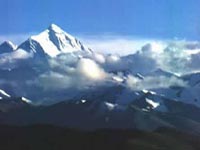
The days of empires and overt colonialism have long past but the Earth's highest peak has retained its anglicized name, complained Gelek, an established Tibetan scholar with China's Tibetology Center in Beijing.
"It is time for the Western world to respect us Tibetans by recognizing the highest peak on Earth by its Tibetan name, Qomolangma," he says.
"This is also a call to the international Tibetology community to use Tibetan names for Tibetan things."
Lin Chao, a professor of geography with Peking University, who died in 1991 in his early 80s, branded the naming of the peak after George Everest, the surveyor-general of India from 1830 to 1843, as "ignorance and arrogance" on the part of the British, whose then empire extended into much of Asia.
For Tibetans, it is unacceptable that the 8,848-metre summit and symptom of a benevolent goddess is known to Westerners by an English name.
Lin Chao, an expert on geographic history and toponymy who spent 61 years studying and teaching geography, explored the controversy in a paper entitled "The Discovery and Name of Qomolangma," published in the fourth issue of the Peking University Journal in 1958.
In the paper, the late professor concluded: "Those who discovered Mount Qomolangma first were Tibetans living in southern Tibet and they so named it. And those who first recorded the peak on a map using scientific methods were Chinese surveyors Shengzhu, Churbizanbo and Lanbenzhanba, who conducted the survey in Tibet between 1715 and 1717."
The trio -- an official in charge of ethnic affairs and two Buddhist lamas -- were dispatched by Emperor Kangxi (reigned 1661-1722) of the Qing Dynasty (1644-1911) to map the territory of Tibet.
"They had all studied mathematics at the imperial astrological bureau," Lin wrote.
They "quite accurately" recorded the geographic data of the Qomolangma area and marked the name of the peak in its Tibetan pronunciation on the map, "which laid down the foundation of knowledge about Qomolangma in the ensuing two centuries."
Kangxi Atlas
The map bearing the name of Qomolangma was incorporated in 1721 into the Atlas of the Whole Imperial Territory, which, known as the Kangxi Atlas, was the first official documentation of the summit.
Jean-Baptiste Regis, a French missionary who helped perfect the maps, then sent the atlas to France where Nouvel Atlas de la Chine -- the New Map of China -- was made, based on the Kangxi Atlas, in 1733 by Jean Baptiste Bourguignon d'Anville, a royal cartographer.
The French version of the atlas included two maps of Tibet, on both of which Qomolangma was marked in French as M. Tchoumour Lancma.
Copies of the Kangxi Atlas were duplicated and distributed more widely in China in 1822 during the reign of Emperor Daoguang (1821-50) and in 1864 during the reign of Emperor Tongzhi (1861-75).
Although the Chinese characters for Qomolangma that appeared in the Qing maps look different from the present-day Chinese characters for the peak, they sound the same and are all faithful to Tibetan syllables.
German geographer Julius Klaprotto published his map of Central Asia in 1836 based on the Chinese maps and documents, on which Qomolangma was accurately marked as Disomo langma in German.
The survey and marking of Qomolangma on the map during the reign of Emperor Kangxi preceded the British colonialists' attempt to map the summit by more than 130 years, according to Lin.
When the British tried to map the mountain from India, "they knew nothing about Qomolangma. While they could not get a permit to conduct surveys among local Tibetans in areas around the peak, they did not bother to study the literature already in existence in Europe and China," Lin wrote.
"They arbitrarily named what they used to address as Peak XV after a person who had nothing to do with Qomolangma."
If the British were ignorant of the name Qomolangma when they named the summit after George Everest in the mid-19th century, thereafter they made no attempt to revert to the Tibetan name which had been known for some time.
Brigadier General C. G. Bruce, at the time serving with the British army in India, was quoted by Lin as saying, in reference to the first British expedition to climb Qomolangma in 1920: "Even if this proposed expedition finds its real name written clearly on the mountain, I hope it will take no notice" as "no name is more beautiful and suitable as Mount Everest."
Clearly miffed by this impertinence, Lin wrote: "That means the British approach to the name of Qomolangma was to insist on calling it Everest despite the fact that it had already had a Tibetan name. This was ridiculous."
Tibetan students studying at the Central University for Nationalities in Beijing echo the late professor's sentiments.
Tibetan Heritage
Daqung, a Tibetology major from Xigaze in Tibet says Tibetans' relationship with Qomolangma is almost inherent.
"We don't come to know her by learning, but she comes to us," he says. "Qomolangma is in every Tibetan's heart and the stories about the goddess are passed down to us as part of Tibetan heritage."
Basang Cering, Daqung's Tibetan classmate, says: "It's not simply an issue of naming.
"The name, as well as the peak, is too important to us Tibetans. There are so many tales and legends about the mountain and it has become part of Tibetan culture."
In Tibetan legends, the Himalaya region was once an ocean and all creatures and plants lived peacefully in the forest ashore. But one day came a monstrous dragon with five heads and the huge waves it stirred up inundated the forest and meadows.
When the creatures were about to be swept away by the torrents, five colorful clouds descended from heaven, turned into five beautiful goddesses and defeated the monster with their magic power.
At the request of the creatures they saved, the five goddesses did not return to their heavenly residence and stayed on to protect lives on Earth.
They ordered the sea to recede before they turned themselves into five peaks, one of which is Qomolangma, which towers the highest, most serene and imposing, with her perennial garb of snow under an azure sky.
Zhandui, a Tibetan researcher on religion at the China Tibetology Research Centre in Beijing, says Tibetans began to worship mountain gods long before Buddhism was introduced to Tibet.
In Bon-Chos, the indigenous religion of Tibet, mountain gods, together with gods of fire and water are believed to bring blessings for prosperity and peace. "Qomolangma is believed to be one of the five goddesses who take care of the region," Zhandui says.
In Tibetan classics, the Qomolangma area was regarded as a place for raising birds in the seventh or eighth century, and was called Chamalang or Lhochamala in Tibetan, words which have a similar pronunciation to Qomolangma.
Milarepa, a reverent Tibetan Buddhist monk and hermit known for his literary talent in the 11th or 12th centuries, is believed to have spent nine years in the Qomolangma area studying Buddhist doctrine and absorbing himself in the culture -- he produced a number of odes to Qomolangma.
Lin and some other Chinese scholars began to call for promoting the use of the summit's Tibetan name world-wide in the 1950s. At a press conference during his visit to Nepal in April 1960, Zhou Enlai, the late Chinese premier, said Chinese people were not happy with the name Everest.
"It was imposed on the mountain," said Zhou.
Some Westerners also feel the name is not correct.
In his book "Chomolungma Sings the Blues" -- Chomolungma is another English alternative spelling for Qomolangma -- published by Constable in 1997, Ed Douglas, a British journalist, observed: "I, for one, regret that most of the world will continue to call it Everest. There are unpleasant colonial undertones to the name Everest."
But the English name persists into the Internet era, with the name Everest dominating all websites relating to the peak. In most cases, Qomolangma or Chomolungma is used only as a reference.
Time for Change
While Qomolangma is indicative of the orient, Basang says the British name "may mislead those who don't know the mountain into thinking that the summit is in Europe or the Americas. To name the holy mountain after a foreigner is nothing but disrespectful to our Tibetan culture."
Xu Tiebing, a professor of international relations at the Beijing Broadcasting Institute, points out that according to norms governing international relations, the name given by indigenous people should be respected.
"It's forgivable for Westerners to call the peak Everest because of their ignorance of its Tibetan name," he says.
"But now so many years have passed and it is time for them to correct their mistake."
Gelek says: "When Qomolangma becomes the only word for people all over the world to refer to the highest peak on Earth, I, as a Tibetan, will feel very contented." And so will the Tibetan goddess of the Earth.
(China Daily November 18, 2002)