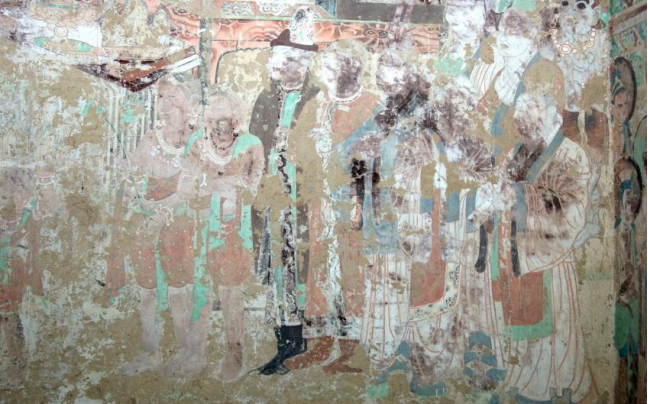
Portrait of Ethnic Groups Along the Silk Road
In the early years of the reign of Emperor Taizong of the Tang Dynasty, many tribute missions arrived from regions surrounding the Tang, so the emperor ordered painter Yan Liben to depict the images of envoys along with texts describing the countries represented by these figures. This illustrated scroll is known as The Envoy with Tribute Bearers. Similarly, the Dunhuang murals, starting from Cave 220, which was built in 642, feature characters attending sermons in the Vimalakīrti Nirde?a Sūtra Illustration. These characters include kings, princes, and envoys from various countries dressed in different attire, showcasing the diverse ethnic groups along the Silk Road.
In this scene from the Vimalakīrti Nirde?a Sūtra Illustration of Cave 220, the original depiction showcases a situation with Vimalakīrti, a revered lay Buddhist, feigning illness at home, with the true intention of taking the opportunity to give preaching while kings, princes, ministers and elders from various countries visit to inquire about his health. In the painting, under Vimalakīrti's canopy, the kings, princes, and envoys attending the sermon exhibit diverse appearances, with varying skin tones and attire reflecting their ethnic characteristics. The person at the front of the line, with dark skin, hails from the South Sea, while those behind him in brocade robes come from the Western Regions, and those wearing feathered crowns are from the Korean Peninsula. The figures depicted in this work represent a diverse array of ethnic groups previously unseen in Dunhuang murals prior to the Tang Dynasty. Experts observe that Dunhuang artists crafted the figures based on the models brought from Chang’an to create an authentic portrayal of the various ethnic groups traveling along the Silk Road during the early Tang period, not only reflecting interactions between the Tang Dynasty and its surrounding cultures but also showcasing the exchanges among the various peoples along the broader Silk Road.
絲路各民族群像
貞觀初年,因周邊地區(qū)前來(lái)向唐朝朝貢,唐太宗命畫(huà)家閻立本繪制了各國(guó)使者的形象,并以文字?jǐn)⑹鏊L人物的國(guó)家,這個(gè)圖文并茂的圖卷就是《職貢圖》。同樣,敦煌壁畫(huà)從初唐貞觀十六年(642)營(yíng)建的莫高窟第220窟開(kāi)始,《維摩詰經(jīng)變》中前來(lái)聽(tīng)法的人物就有身穿不同服飾的各國(guó)國(guó)王、王子和使者的形象,呈現(xiàn)出絲路各民族的群像。
第220窟的《維摩詰經(jīng)變》的這一畫(huà)面,原本是表現(xiàn)維摩詰居士居家稱病,各國(guó)國(guó)王、王子、大臣、長(zhǎng)者前往問(wèn)疾的場(chǎng)景。畫(huà)中維摩詰居士帳下,前來(lái)聽(tīng)法的各國(guó)國(guó)王、王子和使者,面貌各異,膚色和服飾盡顯民族特色。站在隊(duì)伍最前方的皮膚黝黑者來(lái)自南海諸國(guó),其身后穿錦邊袍服者來(lái)自西域、戴鳥(niǎo)羽冠者來(lái)自朝鮮半島。畫(huà)面中的人物,實(shí)為唐代以前敦煌壁畫(huà)所未見(jiàn)的各族人物群像,應(yīng)是敦煌畫(huà)師根據(jù)長(zhǎng)安傳來(lái)的粉本加工而成,是初唐時(shí)期往來(lái)于絲綢之路上的各族人物的真實(shí)寫(xiě)照。既反映出唐朝與周邊政權(quán)之間的交往,也展現(xiàn)出廣義絲綢之路上的各民族往來(lái)。
