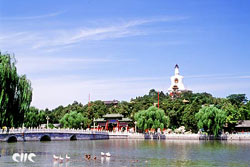
Beihai, situated in the center of Beijing, was the pleasure palace of Liao, Jin, Yuan, Ming and Qing emperors.
In the middle of the 11th century, it was known as the "Jade Islet Palace" where the Liao Dynasty rulers resided while visiting the suburbs of their capital, Yanjing. In the Jin Dynasty, it was converted into an imperial villa, at which time Beihai (North Lake) and Qionghua (Jade) Islet (the present site of the Whiter Dagoba) were incorporated into the grounds. Many of the Taihu Lake stones found on the Song emperor' s garden in the Northern Song Dynasty capital, Bianliang (modern Kaifeng). They had originally been collected in Suzhou under Emperor Huizong of the Song Dynasty.
After Kublai Khan destroyed the Jin capital, he constructed the Yuan Dynasty capital Dadu with changed to the Pool of Great Secretion (Taiyechi) and Qionghua Islet was named Longevity Hill. The Palace of the Moon (Guanghandian), built on the island during by Yuan leaders as a ceremonial hall and office for issuing governmental decrees. The jade urn used to hold wine at imperial feasts held in the hall is displayed in its own pavilion in the Circular Wall (Tuancheng).
During the Ming and Qing dynasties, Beihai continued to be used as an imperial pleasure garden. Several large-scale construction projects were undertaken to improve the park' s facilities. In 1651, under Emperor Shunzhi, the White Dagoba Temple was built on the site of the Palace of the Moon, and the island was renamed White Dagoba Hill. The dagoba was badly damaged in an earthquake in 1679 and rebuilt the following year. Emperor Qianlong (reigned 1736-1796) also added several new structures. Apart from the halls, terraces and pavilions on the island, he built the Temple of Revealing Happiness (Chanfusi), the Little Western Heaven (Xiaoxitian), the Hall for Gazing at the Water (Chengguantang) and the Tranquil Heart Study (Jingxinzhai). Beihai has changed very little since Qianlong' s time. It was formally opened as a public park in 1925.
There are two gates. The front gate is at the eastern entrance to Wenjin Street and the back on West Di' anmen Street. The front, known as the Gate of Received Light (Chengguangmen), leads directly to the triple arched Bridge of Everlasting Peace (Yong' anqiao) built in 1332. Linking the Circular Wall with Qionghua Islet, the southern gateway called Accumulated Emerald (Jicui) and the northern Piled-up Clouds (Duiyun). Beyond the northern gateway, 30 stone steps rise to the Temple of Eternal Peace (Yong' ansi). Inside is the Hall of the Wheel of the Law (Falundian), with pavilions on either side and a terrace to its north laid with curiously shaped stones. Caves lead into a tunnel to the White Dagoba Hill.
The White Daboba is the aesthetic high point of Beihai Park. On the southern slope is the Hall of Beneficent Causation (Shanyindian), where the view takes in the waters of Zhongnanhai (Central and South Lakes), the golden roofs of the Forbidden City and the nearby city streets.
On the northern side, the park is a maze of pavilions and corridors leading around deep rocky crags. At the water' s edge, a semi-circular corridor follows the shoreline from the Tower Beside the Waters (Yiqinglou) to the Pavilion of Sharing Coolness (Fenliangge). To the north are the Hall of Ripples (Yilantang), which can also be reached by tunnel from the hilltop, and the Studio of the Peaceful Path (Daoningzhai).
Crossing the Mountain Climbing Bridge (Zhishanqiao) and passing through the children's playground, one comes to the Young Pioneers' Hydraulic Power Station built in 1956. To the east are the Spring Rain Forest Pool (Chunyulintang) and the Studio of Painted Pleasure Boat (Huafangzhai); further north the path leads through a mulberry grove to the park' s back gate. Directly opposite is a lock through which water flows into the lake. To the east is the Altar to the Goddess of Silkworms built by Emperor Qianlong, which is now the site of the Beihai Kindergarten. To the west the path leads on to the Tranquil Kings (Tianwangdian), the Nine-Dragon Wall (Jiulongbi), the Hall for Gazing at the Water (Chengguantang), the Iron Screen (Tieyingbi) and the Five Dragon Pavilions (Wulongting).
East of the pavilions are docks for pleasure boats and the ferry that runs across the lake to the hall of Azure Reflections (Bizhaolou) on Qionghua Isle. To the west of the pavilions the Little Western Heaven (Xiaoxitian), commonly called Haidao (Island in the Sea) or the "Land of Unlimited Happiness." houses a collection of Buddhist images. To the north is the former site of the Temple of Revealing Happiness (Chanfusi), now a botanical garden. In 1980, a tropical greenhouse for mango, longan, litchee, carambola and coffee trees was erected.
To the west of the botanical garden is the Pavilion of Ten Thousand Buddhas (Wanfolou), with its entrance inscribed with "Wonderful Place of Dignity and Solemnity"(Miaojing Zhuangyan). This pavilion was built by Emperor Qianlong to mark his mother' s 80th birthday. There are 10,000 tiny niches designed to hold gold images of the Buddha, which were stolen in 1900 when the Eight-Power Allied Forces invaded Beijing. The pearls and gems inlaid in the large Buddage which once stood in the Hall of Great Compassion and Truth (Dacizhenrudian) in the Temple of Revealing Happiness were also taken as booty.
Below is a more detailed introduction of the better known structures in Beihai:
⑴ Qionghua (Jade) Islet, also known as Qiong Islet or Mountain, covers an area of some 66,000 square meters. Lamaist advisers proposed that Emperor Shunzhi of the Qing (reigned 1644-1661) build the 35-meter-tall onion-shaped dagoba on the site of the Jin Dynasty Palace of the Moon (Guanghandian). The White Dagoba was damaged in the 1976 Tangshan earthquake but repaired soon after. Large weirdly shaped rocks, carved to resemble caves inhabited by Daoist immortals, cover the island. At the summit stands an ancient hall, reputed to have been the dressing chamber of empress dowagers during the Liao Dynasty. On the slopes are the Hall of Correct Enlightenment (Zhengjuedian), the Hall of Universal Peace (Pu' andian) and the Hall of Beneficent Causation (Shanyindian).
The Hall of Beneficent Causation is built of glazed bricks with 100 glazed ceramic images of the Buddha set into its walls. In the center is a statue of the Goddess of Mercy with 1,000 Arms, also called the Buddha Who Calms the Lake (Zhenhaifo). The Pavilion for Evoking Victory (Yinshengting) which stands before the dagoba contains a stela inscribed with"A Complete Record of White Dagoba Hill."The Pavilion for Inspecting Old Script (Yuegulou) displays 495 samples of famous Chinese calligraphers, which were carved in stone during the time of Emperor Qianlong. The collection is an excellent source for rubbings.
⑵ The Temple of Eternal Peace (Yong' ansi), originally the home of the Lama Nuo Buhan, was built in 1651 and named the Temple of the White Dagoba. Inside the main gate lies the Hall of the Wheel of the Law (Falundian). Up the flight if stone steps is the Hall of Beneficent Causation.
⑶ The Hall of Heaven Kings (Tianwangdian) lies on the west bank of Beihai Lake. A glazed tile memorial archway stands before the hall, and to the north is the Gate of Heavenly Kings. Inside are two stone pillars, the eastern pillar inscribes with the Diamond Sutra (Jingangjing) and the western with the Yaoshi Classic. Behind the Hall of Great Compassion and Truth
(Dacizhenrudian) is the Ten Buddha Pagoda (Shifota). To the west of the pagoda is the Beihai Stadium, built after the founding of the People' s Republic. The Hall of Heavenly Kings is now the Beijing Youth Science and Technology Hall.
⑷ The Tranquil Heart Study (Jingxinzhai) lies to the east of the Hall of Heavenly Kings. The buildings of this famous "park within a park" are the best preserved in Beihai. After 1949, this section was entirely renovated for use by the Central Documentary History Research Institute.
⑸ The five Dragon Pavilions (Wulongting) to the west of the Hall of Heavenly Kings were built in the Ming Dynasty as a fishing spot for the emperors. The five pavilions on the water are linked by an angled corridor that resembles a swimming dragon' s Benevolence (Longzeting). It has a double-eaved roof which resembles a parasol and rectangular terraces extending front and back. To the east lie the Fragrance (Zixiang) and Auspicious Clarity (Chengxiang) pavilions, and to the west the Surging Good Fortune (Yongrui) and Floating Emerald (Fucui) pavilions.
⑹ The Nine-Dragon Wall (Jiulongbi) is to the south of the Beihai Stadium. Built in the Ming Dynasty, it is 6.9 meters high, 25.5 meters long, 1.4 meters thick, and constructed entirely of glazed tiles. On each side nine coiling dragons frolic among waves and clouds.
⑺ The Iron Screen (Tieyingbi) in front of the Hall of Gazing at the Water (Chengguantang) derives its name from its color, which resembles iron ore. T he strange creatures carved on both sides date from the bell casting room at Deshengmen (Gate of Moral Victory), where it began to rust. In 1947 the Beiping Cultural Relics Administration brought it to Beihai for display.
⑻ The Bronze Immortal Bearing the Dew-Colleting Dish (Tongxianchenglupan) stands on the northwest slope of Qionghua Islet.
According to tradition, the Han Dynasty emperor Wu Di was told that by drinking dew caught in a bronze dish he could live to the age of eight hundred. This was so intriguing to the middle-aged emperor, in 104 BC he had a bronze immortal and dish cast and placed in a palace outside the capital Chang' an (now Xi' an). Qianlong shared his predecessor's dreams of longevity and had another statue of the same image cast and placed on Qionghua Islet. Others say Jin rulers brought the statue here from the Song capital of Bianliang (now Kaifeng) when they built their palace.
Entry ticket: 10 yuan;
Opening Hours: 06:00 to 21:00;
Traffic:
Bus No.s 5, 101, 103 or 109 to the front gate of Beihai;
Bus No.s 13, 42, 105, 107, 111 or 118 to the back gate.
(China.org.cn)
|