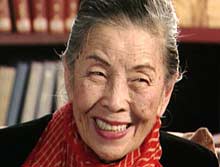
Dai Ailian (Tai Ai-Lien), the pioneer and founder of modern Chinese dancing art, famous dancer, dance teacher, and honorary president of the Chinese Dancers' Association, died in Beijing on February 9, 2006 at the age of 90.
Dai holds a high reputation in the world of dance. On a golden plaque presented to her, a dance organization from Taiwan inscribed the words: "Mother of Chinese Dance." These words aptly describe Dai's status in the development of dance in China.
"Ballet is my work, while folk dance is my greatest pleasure," She once said. Trained in ballet in England, Dai Ailian is one of China's premier dance icons, and extraordinarily impacted art and culture in China by bringing Western dance to the country.
In the reception lobby of the Royal Academy of Dance in Britain, there are four sculptures of female dancing artists, and one of them is the bust of Dai Ailian. In the unveiling ceremony, Dai said that: "the honor belongs to my motherland." These words from the bottom of her heart are a good annotation to her dancing career.
Early Days
Dai Ailian was born in Trinidad and Tobago, an independent republic in the West Indies in 1916. Dai's forefathers had been living on the island for many years, but led a miserable coolie life when they first arrived at the place. But after several generations of hard work, things became much better. By the time Dai Ailian was born, the living conditions of Chinese people were improved. Dai's father planted sugarcane and coffee, and also conducted business in food supplies, cotton cloth, and stationery. The well-off family provided Dai access to a good education.
Dai liked to play with her cousins on the sea beach to pick shells, swim, paddle a boat, fish, climb trees, or even play soccer. Playing outside the room all day long, Dai saw the tropic sun burned her skin to a dark hue. Hence her family intimately nicknamed her as the "cocoa chocolate."
When Dai was five, one of her cousins who was studying dance in Britain visited Trinidad. Her cousin, soon after finding that the little girl was very good at expressing the rhythm of music with her body language, taught Ailian some basic ballet moves.
When Dai was six or seven years old, she began to perform children's dance on the school's stage. At 10, she choreographed and performed a dance by herself called Colored Egg , according to the Easter custom.
Upon her mother's persistence, Dai was accepted as a student of a white teacher's student despite serious racial discrimination at the time.
Growing up on Trinidad, Dai had four dreams. The first was to become a singer. She then wanted to be a navy soldier because there were many ships visiting the island, and she was interested in the life of a sailor and very curious about the world. Another dream was to be a musician because she started to play piano at the age of 7. She even set her sights on becoming a painter.
Although she began taking ballet lessons at the age of 5 and enjoyed dancing for family members after dinner every day, she did not think seriously about dancing until she was 14, when her mother sent her to London. There she received ballet training by such luminaries of ballet and modern dance as Anton Dolin, Dame Marie Rambert, Rudolf Laban, and Mary Wigman.
Study in England
In 1930, she went to London to study dance. Though ballet and modern dance were not well connected at that time, Dai Ailian learned both of them, which greatly helped in her later development.
Misfortunes struck six years into Dai's stay in Britain. Her father gambled away all the money and could no longer support Dai and her sisters in London. Dai's eldest sister had married in London, and her other sister went back to Trinidad. But out of her love for dance, Dai chose to stay. She did all sorts of jobs just to survive on her own and won two scholarships to study at the Jooss-Leeder Dance School at Dartington Hall.
At the Jooss-Leeder Dance School, Dai met her long-time love, an Austrian-British sculptor whom she never married but loved all her life, accompanying him for a year in London.
Never learning to speak Chinese in Trinidad and knowing little about Chinese culture, Dai envied those Chinese students in London and made friends with them to learn Chinese. With a desire to connect with her roots, she borrowed the English versions of Chinese history books from the Great Britain Library.
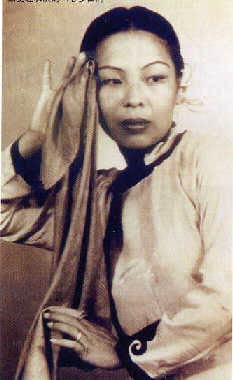
Fascinated by the story of Yang Guifei, the favourite concubine of Emperor Xuanzong in the Tang Dynasty (618-907), she choreographed a solo performance called Yang Guifei in 1936 according to the stories and her own imagination.
A dancing swallow in the flames of war
After Japan launched its aggressive war against China in 1937, Dai took part in benefit performances organized by the China Campaign Committee in London to raise funds for the Hong Kong-based China Defense League, headed by Soong Ching Ling, wife of Sun Yat-sen.
Then came a turning point in the dancer's life. By chance, Dai read Edgar Snow's Red Star Over China , which made her decide to return to China. With the help of Soong, Dai arrived in Hong Kong in 1940 and soon fell in love with the noted painter Ye Qianyu.
After she arrived in the city of Guilin via Macao, she found to her surprise that such a large country had no place for artistic dance performances. Many people thought that she was a dance- hostess in bars when they heard she was a dancer. Some people even thought "dancer" was another name for a prostitute. She realized the reason for the lack of dance in China was the absence of brave pioneers to make it popular, besides the obvious reasons related to society and history. Since she was a red-blooded youth, she decided to face the difficulties and blaze new trails.
Trained in classical Western ballet, Dai showed great interest in Chinese folk dances, especially the ethnic dances. Soon after she returned to China, she traveled many times to see the minorities in Southwest China's Yunnan, Guizhou, Guangxi, and Sichuan provinces to learn the folk dances from the ethnic people.
The direction Chinese dance should take was unclear to Dai at the time. It would have been easy to introduce the Western ballet and modern dance she had learned, and people of the upper classes would have readily accepted it. However, Dai Ailian chose a different path by devoting herself to developing national dance, which was a dream she had held for many years.
When she was learning dance in London, she often saw dance performances at overseas students' social activities by the students from other countries, including Japan, India, and Indonesia, but she never saw anyone from China performing. She felt it was a pity Chinese dance was not being shown, and it made her think what modern Chinese dance should be like. Based on materials she had in English about Chinese history, literature, and painting plus her own understanding of dance, she designed "ideal Chinese national dances," such as the Royal Concubine Yang and Weeping Willow. When she arrived in China, Dai began to make her dream a reality.
Dai Ailian's new trails were based on two parts.
The first was to learn from local Chinese operas, taking from them traditional Chinese dances. For instance, the dance in Melody to Homesick was choreographed to a piece of music of the same name written by Ma Sicong, including postures from Kunqu Opera for the dance. The success of another dance in The Old Carrying the Young was a result of studying Xiaofeiyan, a famous actress of Guiju Opera.
The second part concerned studying from ordinary people and getting source materials from folk dances. For example, after watching people of the Yao ethnic group gather and dance to the accompaniment of drums, she created the dance The Drum of the Yao People. Also, The Spring Outing was created when Dai became familiar with the custom of Tibetan people singing and dancing to their hearts content when plum flowers blossom every year.
Under the poor conditions of that time, Dai Ailian endured untold hardships to study the dances of ethnic groups in West China. She also managed to make friends with the local people and remove their worries while learning the religious dances of some ethnic groups. In this way, she created and performed a group of new national dances based on the dances of the Miao, Yao, Yi, Tibetan, Uygur, and Han ethnicities.
Some of the performances were inspired by real life during the War of Resistance against Japanese Aggression (1937-1945), and burned with patriotism. For instance, Dongjiang River was about a story in which a woman risks her life to transport medicine to the frontline under heavy bombing from enemy planes.
The dances of Dai Ailian created a strong and wide response. In 1946, at the gatherings of frontier music and dancing in Chongqing, Tianjin, and Shanghai, Dai Ailian performed a number of national dances she had created. The public referred to her as a sower of seeds and the "first person to tap the heritage left by the ancestors." Today, a historical evaluation on that grand activity is found in the entry for Dai Ailian in the Chinese Encyclopedia: "Not only did she help the folk dances of various ethnic groups in China get onto the modem stage, but she also launched a popularization campaign of folk dances."
Founder of modern Chinese dancing
In the following years, Dai choreographed, performed, and taught dance in China. She was named principal of the Beijing Dancing School when it was first set up in 1954.
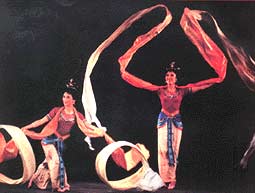
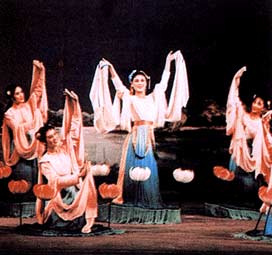
After the founding of New China in 1949, Dai Ailian's artistic path became even wider. In the early 1950s, she was involved in the creation and leading performance of the first ballet in China: Dove of Peace. Two dances with a strong national flavor, Dance of Lotus Flowers and Flying Apsaras , swept the stages both home and abroad as they won the gold prize at the World Youth Festival. By the 1990s, authoritative dance organizations designated these two dances as 20th century classics of Chinese dance.
From 1950, Dai Ailian began to work at various leading posts, such as the director of the Central Song and Dance Ensemble, the first dean of the Beijing Academy of Dance, the director and adviser of the Central Ballet Troupe, and vice-chairman of the Chinese Dancers' Association.
A dancer with international influence, she also participated in many international activities beginning in the 1980s, including working as a judge at international dance competitions, leading Chinese dance delegations to international dance competitions, and attending international academic meetings on dance. In 1982, she was elected the vice-chairman of the International Council for Dance of the UNESCO, and attended the meeting of the council in Paris every year till her death.
Her trademark works include Lotus, Flying Apsaras, Longing for Home, The Mute Carries the Cripple, Tibetan Spring, Anhui Folk Dance, and Sale . All of them are fruits of careful studies of Chinese dances. Although classical and some folk dances were restricted in China during the Cultural Revolution (1966-1976), Dai remained influential in Chinese and international dance circles after China opened up to the world and began its economic reform process in the 1980s.
She introduced a number of noted dancers such as Rudof Nureyev and Margot Fonteyn to teach in China and tried her best to promote Chinese dancers to the world.
In 1982, she was elected vice-chairman of the International Council for Dance of UNESCO, the United Nations' cultural and educational organ.
Dai led a single life after divorcing her second husband in 1967. When a China Daily reporter asked if she felt lonely sometimes in 1982, her answer was: "Life is interesting with its ups and downs. I am always occupied, so I have no time to feel lonely."
In devoting most of her 90 years to her love of dance and her roots, she will be most remembered not only for her soul-stirring performances, but also for paving the way for Chinese ballerinas.
(chinaculture February 21, 2006)