-The Medical Classic of the Yellow Emperor
-Shen Nong's Herbal Classic
-The Classic of Difficulties
-Treatise on Febrile Diseases
-The Pulse Classic
-Newly Revised Materia Medicae
-Compendium of Materia Medica
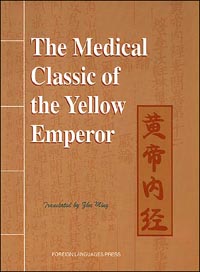
The Medical Classic of the Yellow Emperor
The Medical Classic of the Yellow Emperor is one of the earliest books found in the corpus of traditional Chinese medicine (TCM). It enunciates the systematic structure of the theoretical system of TCM and reflects the theoretical principles and academic thoughts associated with it. This theoretical system has formed the basis for development of TCM since its establishment. Nearly all academic thoughts of many well-known medical masters and medical schools appearing during the history of TCM have grown out of the theoretical system of The Medical Classic of the Yellow Emperor. Consequently, it is one of the basic theoretical curriculums of TCM today.
All medical theories come from practice and, in turn, direct practice. Throughout the millennia, the great contributions by TCM to ensure the well-being of Chinese people depended on the theoretical system of The Medical Classic of the Yellow Emperor. Therefore, it received lavish attention from medical practitioners throughout Chinese history and was venerated as an ancestral work of physicians, not to mention being a compulsory classical work in TCM.
Times of Compilation and Its Author
Many historians and physicians throughout Chinese history studied and verified that the major contents of The Medical Classic of the Yellow Emperor had appeared in the Warring States Period (475 BC -- 221 BC). It had been added during the Qin Dynasty (221 BC -- 206 BC) and Han Dynasty (206 BC -- AD 24).
The Yellow Emperor is the legendary first ancestor of the Chinese nation, and many Chinese people are proud of being regarded as his offspring. Many Chinese living in earlier times ascribed all their culture to him. This book was titled with his name in order to lead it to fame and authority. The academic divergence of thoughts in this book sufficiently indicates that it is neither a work of a single individual, nor medical achievement of a certain period or a local region, but rather the summarization of experiences of many medical practitioners over a long time.
Components of the Book
The currently universal version of The Medical Classic of the Yellow Emperor encompasses two parts: The Plain Questions and The Divine Pivot. Each part has 81 articles. Thus, the book is composed of 162 articles.
Basic Academic Thoughts Found in the Theoretical System of The Medical Classic of the Yellow Emperor
The compilation of The Medical Classic of the Yellow Emperor established the unique theoretical system of TCM, and formed the basis for the development of TCM. According to the development regularity of medicines and the inference from the theoretical contents of The Medical Classic of the Yellow Emperor, this distinct system is based on anatomical knowledge, and directed by ancient philosophical thoughts. It was produced after long observation of life's phenomena, and proved repeatedly through medical practice. It developed gradually to form from perceptual cognition to rational knowledge and from scraps to comprehensiveness. Therefore, the theoretical system described in this work is under the guidance of ancient plain materialist dialectics, combining with the regularity of human life's activities. This system also presents a lot of significant theoretical principles and academic thoughts. They are also ideological ways that we must master when we study The Medical Classic of the Yellow Emperor. This theoretical system has two typical features, i.e., plain materialist dialectics and integral idea that man and nature are mutually corresponding.
Plain materialist dialectics
A. The "essential qi" is the source of the generation and formation of everything. The ancient Chinese philosophers regarded that the source of the cosmos was the essential qi. Everything in the world was produced by the essential qi, namely, original qi. The qi is an invisible materialistic element that forms everything. Of course, the "everything" also encompasses the human beings. Man is endowed with the essential qi from nature, and it is called qi, essential qi, vital qi, or original qi. The concept of qi permeated the medical field. This, the idea that everything consists of qi, is inevitably shown in The Medical Classic of the Yellow Emperor. The qi is not only the basic material that forms the body, but also the dynamic power of the body. The life's activities of human beings are the manifestations of movements of the qi. Different combinations of the qi may generate different things. So, according to different places an different functioning of the qi, different names of qi are determined, such as true qi, ancestral qi, nutritive qi, defensive qi, liver qi, spleen qi, heart qi, etc.
B. The materialism is highlighted. Prevailed the theories of yin-yang and the five elements in plain materialist dialectics, which were used to explain the changes of nature in the Spring and Autumn Period (770 BC -- 476 BC) and Warring States Period (475 BC -- 221 BC). It let more people become suspicious of the religious superstitions towards gods and ghosts. Life science was led to the realm of materialism.
C. The proposition that the life is antagonistic and united is prominent. Not only the body's structures but also life's activities are antagonistic and united, and too are man and nature. Everything has its two antagonistic and united sides, i.e., yin and yang. The antagonistic and united movements of the yin and yang push everything to develop forward incessantly, originating birth and death of everything.
D. Life is undergoing constant flux all the time. The Medical Classic of the Yellow Emperor regards the entity of nature, living things and diseases as not being motionless and still, but incessantly moving, developing and changing under the mutual actions of the yin and yang. Consequently, we should analyze and treat a disease with the idea of movement. This is the theoretical reference to syndrome identification and treatment determination in TCM.
The integral idea that man and nature are mutually corresponding
Man and nature are mutually corresponding. This is a unique feature of TCM that differs from almost all other world medicines. TCM regards the physiological processes and pathological changes of human beings are closely related to nature. Many things involved are put into correspondences organically, such as the waxing and waning of the yin an yang of nature; the five elements that constitute the world, i.e., wood, fire, soil, metal and water; the running of the sun and moon and stars. The climatic changes of spring, summer, autumn and winter; the spring generation, summer growth, autumn harvest, and winter storage; the human functional system in which the five zang-organs are the chief body, and such things, are linked up as well. The occultness and the intrinsic links of both the universe and human beings are incredibly demonstrated.
Chapter Sorting
The Medical Classic of the Yellow Emperor was compiled over 2,000 years ago. The language used in this book is archaic and laconic, and its expressions are gracious, far-reaching, and abstruse. The time when it was written is very distant. The book was copied again and again by hand. In ancient times people wrote on bamboo slips which were then tied together. Over the years the binding would sometimes fall apart and the slips would smudge or break. Therefore, pieces of the original text might become mixed up, incomprehensible or incomplete. This history gives us some difficulty in trying to study The Medical Classic of the Yellow Emperor.
In this book, all the contents are arranged in eight chapters, except for "acupuncture" and "five movements and six climatic qi". The eight chapters are respectively the yin-yang and the five elements, zang-organs and manifestations, channels and network-channels, pathogens and pathomechanisms, diseases and symptoms, diagnostic methods, therapeutic principles and methods, and health preservation.
(Source: The Medical Classic of the Yellow Emperor, Foreign Languages Press, 2001)
Shen Nong's Herbal Classic
Shen Nong's Herbal Classic (Shen Nong Ben Cao Jing), which was first compiled some time during the end of the Western Han Dynasty, lists various medicinal herbs at given grade and rarity ratings. The book recorded 365 types of medicine, some of which is still used in contemporary clinics, and also set up a beginning of the establishment of Eastern medicine.
The Classic of Difficulties
The full title of The Classics of Difficulties (Nan Jing) is The Yellow Emperor's Classic of Eighty-one Difficulties. The old writing was created by Bian Que (Qin Yue-Ren), a legendary doctor in history. Completed circa the end of Western Han Dynasty to Eastern Han Dynasty period, the book summed up eight-one questions on TCM theory and provided explanation to TCM concepts.
Treatise on Febrile Diseases
Treatise on Febrile Diseases (Shanghan Zabing Lun) was written by Zhang Zhongjing, the sage of Chinese medicine in the Eastern Han Dynasty. Assimilating from previous medicinal literature, and collecting many prescriptions elsewhere, Zhang finally wrote the medical masterpiece. Unfortunately, however, shortly after its publication, the book was lost during wartime. Giving a detailed account on how to diagnose and treat various diseases caused by internal organs, this book is meaningful in that it helped the development of clinical medicine many centuries later. The other work of Zhang is a compendium of his clinical experiences, called Synopsis from the Golden Cabinet (Jingui Yaolue) which is regarded as a highly influential doctrine.
The Pulse Classic
The Pulse Classic, also known as Mai Jing, was written in the West Jin Dynasty by Wang Shuhe, in which he described the pulse positions, methods, and established 24 different kinds of pulse. This work allowed future generations to grasp the essence of pulse in an instance, as well as understand the different pulse phenomena with every illness. It is the first book in the Chinese medical literature entirely devoted to pulse diagnosis. As such, it is the undeniable and necessary foundation text for anyone seriously interested in understanding the rationale for and method of reading the pulse in Chinese medicine.
Newly Revised Materia Medicae
The book was edited by the government of the Tang Dynasty, therefore is also known as Materia Medicae Tang Edition (Tang Ben Cao). It is the oldest extant pharmacopoeia book (an official book listing a catalog of medicine and their use) in the world. This book included 850 types of medical herbs and their pictures, which further improved the scale of eastern medicine.
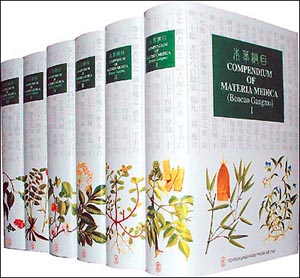
Compendium of Materia Medica
Li Shizhen's 410-year-old classic,
Bencao Gangmu: Compendium of Materia Medica, with its lore chronicling centuries of Chinese medical achievement, is a treasure trove of information on traditional Chinese medicine and on Chinese folk views of the world, which underlie many of the prescribed treatment regimens.
With the publication of the Compendium of Materia Medica, not only did it improve the classification of how traditional medicine was compiled and formatted, but it was also a great medium in improving the credibility and scientific values of biology classification of both plants and animals.
The compendium corrected many mistakes and false understandings of the nature of herbs and illness. Li also included many new herbs, added his own discovery in certain drugs, their effectiveness and function, as well as more detailed description according to experiments. It also has notes and records on general medical data and medical history.
Compendium of Materia Medica is also more than a pharmaceutical text, for it contains information so vast that it covered topics in biology, chemistry, geography, geology, history, and even mining and astronomy, which would seem to have little to do with herbal medicine. It has been translated into more than 20 languages and spread all over the world. Even now it is still in print and used as a reference book.
(Source: Compendium of Materia Medica, Foreign Languages Press, 2001)