| Home / Education / Education-Photo | Tools: Save | Print | E-mail | Most Read |
| New Skills to Make Job Hunting Easier |
| Adjust font size: |
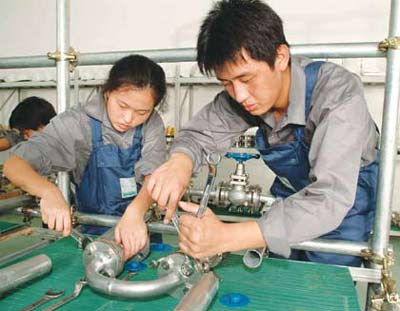
In an effort to improve vocational education the Chinese Ministry of Education announced recently that it would spend 2 billion yuan (US$255 million) to update teaching facilities and establish a quality curriculum at 100 vocational colleges nationwide.
The effort is part of the country's promise to invest 14 billion yuan (US$1.79 billion) in the vocational education system in the 11th Five-Year Plan (2006-10). This year 3 billion yuan (US$383 million) has been spent on pilot junior vocational education schools and vocational education centers at the county level bringing relief to teachers and students who've long suffered from a lack of financial support. As a result of poor input most vocational schools and colleges are burdened by a lack of suitable teachers, outdated facilities and curricula and few internship opportunities. Some schools, under financial strain, were forced to raise their tuition fees. This in turn kept out more impoverished students. Currently about 7 million students are studying in 1,300 vocational colleges and about 20 million are studying in 14,500 junior vocational schools. Under the structure graduates from junior middle schools may choose to attend junior vocational schools or senior middle school. After graduation from senior middle school students who want further education also have two choices: university or vocational colleges. Considerations involved in making the choice include the family's financial ability and students' academic performances. Normally poorer families send their children, who aren't particularly good in studies, to vocational schools. Junior vocational school students may advance to vocational colleges after passing examinations and students at vocational colleges can enter universities after they've successfully completed a different set of exams. Junior vocational schools and vocational colleges often offer the same courses but the depth of learning varies. Obviously the students who graduate from vocational colleges have better career prospects. According to Sun Cheng, associate researcher with the China National Institute of Educational Research, the underlying reason for the skill shortage is an imbalance in the educational system which invests less in vocational education. The Vocational Education Law requires that 20 percent of the annual education budget goes to vocational education but the ratio is much lower in reality. Statistics released by the ministries of education and finance and the National Statistics Bureau show the ratio of investment in vocational education has declined from 13.4 percent of the entire budget in 1994 to 7.1 percent in 2004. That ratio might be even lower in different provinces and municipalities. For instance in South China's Guangdong Province, which has a huge demand for skilled workers, junior vocational schools receive only 3 percent of the total education budget whereas secondary schools receive 32 percent, according to China Economic Report. "Ideally the per-capita investment for vocational education students should be three times that for secondary school but the practice in According to a 2001 national human resources report manufacturing workers in In a sea of high-tech products a label stating "Made in The reasons behind the differences might be many but one is simple. Front-line workers in these countries are often better trained than their Chinese counterparts and their products are considered to be of a higher quality. "The lack of skilled workers has affected the quality of the products made in our country," said Liu Zhanshang, director of the Ministry of Education's vocational education department. So the current investment in the vocational education system aims to meet In economic hubs like the According to Yu Zuguang, deputy dean of the Vocational Education Research Center under the Ministry of Education, The current rate of Chinese senior middle school graduates in post-secondary vocational schools is around 38 percent. By contrast it was about 50 percent in The imbalance has also led to a different market response to vocational students and ordinary academic students. Ministry of Education statistics show that an average of 95 percent of vocational college graduates found find in recent years while for university graduates it's only 73 percent. Despite According to Cheng Fangping, an expert in vocational education at the China National Institute for Educational Research, it's better if those pilot vocational colleges don't fit the same stereotype. "Education authorities should consider the local situations in satisfying the regional and national economic development requirement," Cheng said. He also pointed out that vocational education currently overemphasizes textbook knowledge. "A new type of teaching methodology should be established in vocational schools, one that asks skilled technical workers to conduct the instruction instead of teachers with little actual experience," Cheng said. "Also the new teaching methodology will move students from classrooms to factories or internship locations." According to Cheng, instead of being viewed as only a part of the educational system, vocational education actually needs collaboration from the business sector as well. " Another problem is that society isn't promising a bright future to vocational schools and students. This leads to decline in enrolment and student quality. According to some educators in a society that emphasizes academic study and university attendance vocational education still suffers from a sort of discrimination. "Unlike in some countries such as South Korea, which provide more financial support to vocational than academic education China's vocational schools enjoy far less investment than that which goes to secondary education or universities. Therefore, they're not good enough to attract students and good students are not willing to attend these schools," said Wang Linfeng, professor at the Also, unlike in developed countries where skilled workers can earn as much as a university professor, such workers in Similarly, in developed countries, vocational education graduates have their own corporate ladder which ensures them lifelong education and promotion. But in Gao Pingping, a junior middle school student in East China's ( |
| Tools: Save | Print | E-mail | Most Read |
 |
| Related Stories |
