Luxuriant Primitive Vegetation
Moisture and warmth are the basis of life. The existence of the passage of vapor makes southeastern Tibet the world’s highest oasis. Its virgin forests constitute the third largest forested area in China, after those of Northeast China and Yunnan Province.
The Colorado Canyon in Arizona, USA, is known for its dry climate and sparse vegetation, and for the variety of strata from the Proterozoic era to Cenozoic era that may be observed on its bare sides. By contrast, the Yarlung Tsangpo Great Canyon takes pride in the green vegetation that grows everywhere. Both canyons are of great scientific significance, but the scenery of the Yarlung Tsangpo Great Canyon is the more pleasing and attractive.
It is easy to find primitive plants in the canyon. In the boundless forests amid dense exuberant foliage, there are great trees everywhere that have died of old age and fallen. Some fallen trees have almost rotted away, covered with moss and the same color as the ground, leaving just the giant trees protruding slightly above the ground. Some others, because of the additional decomposed humus they provide, have become breeding grounds for young trees and grasses. Below the waterfalls at the bottom of the canyon torrents have torn away the branches and fibrous roots from the fallen trees and stripped them of their bark. They lie there on the riverbed, all higgledy-piggledy, unchanged in shape, but dark blue in color after years of exposure to sunlight.
Plenty of sunshine and the warm and humid climate make the Yarlung Tsangpo Great Canyon exceptionally rich in ecological variety; according to expert statistics, there are about 3,700 botanical species here. In striking contrast, despite occupying roughly the same latitudes as China, the USA has only about 2,000.
Scientists believe that the critical thing is not the number of botanic species in the Yarlung Tsangpo Great Canyon, but rather in the primordial nature of the plants. In the international “green revolution,” people consider gene transplantation the most significant issue. Scientific results show that after transplanting the wild wheat gene to cultivated wheat, the latter demonstrating outstanding lodging resistance and cold resistance, producing large increases in yield. The plants in the Yarlung Tsangpo Great Canyon are not only wild, but also primordial. The importance of the gene of plants is beyond description. For this reason, many have praised the Yarlung Tsangpo Great Canyon as the gene bank of world plants.
The mountainous gorge and the effect of the vapor passage result in the canyon having China’s most complete range of mountain vertical natural zones. Mount Namjag Barwa is a case in point. Within a vertical distance of about 7,000 meters, every kind of ecosystem and vegetation, from equatorial to arctic, may be found here. Starting from the bottom, the ecosystem sequence goes: tropical low-hill evergreen and semi-evergreen monsoon rainforest; subtropical broadleaf forest; warm temperate-zone mountain evergreen coniferous forest, cold temperate zone sub-alpine evergreen coniferous forest; sub-frigid zone alpine shrubs; sub-frigid zone alpine ice sheets; and frigid zone upper alpine ice sheets. With so many kinds of eco-system in the area, the canyon is eulogized as a natural museum of world mountainous vegetation. In the judgment of some scientists, “The Yarlung Tsangpo Great Canyon is of world-level importance, both for its bio-diversity and in terms of sustainable use of its bio-diverse resources.”
I paid great attention to the many species of plant in southeastern Tibet, making records and taking pictures of them en route. Here are notes on some of them.
Qianma Nettle. A plant of the genus Urtica, noted for the stinging property of its leaf-hairs. A botanist told me that there are about twenty types of nettle, of which Urtica dioica is the most poisonous. These nettles grow profusely in the valleys and forests of the Yarlung Tsangpo Great Canyon and neighboring areas. The first one I saw growing was below a stone wall in Gushiang Village. A teammate pointed to plant with big fat green leaves covered with stings and told me: “This is a nettle. Don’t touch it or you’ll get a nasty sting and itch.” He went on to tell me about a previous expedition where an unwary team member had suffered for days after touching one. Along the Parlung Tsangpo River, going from Pelung Village to Zachu there were nettles all along the way, growing up to about 20 centimeters high by the side of the 40-centimeter-wide path. Further away they grew taller than a man’s height and when there was a wind, the nettles would be bent towards the center of the path, blocking the way. Twice in southeastern Tibet I got stung and my skin became red and swollen, painful and itchy, but nothing more serious than that. Oddly enough, the local cattle like to eat this plant. Some people say its fibers may be useful as a raw material for textiles, and the young leaves of nettles are good for lactating women. Thus, it is clear although they are a nuisance, nettles are still of great value.
Alder. This is a tree (genus Alnus) of the birch family. Some people here call it “the vanguard tree.” And this is why: the heavy rainfall and steep mountain slopes that predominate in and around the Yarlung Tsangpo Great Canyon give rise to frequent landslides, which destroy sections of forest. Years later, in the landslide areas, patches of young green trees start to grow from the poor soil on these steep slopes. These are none other than alder trees. There is such a place near Tongmey, the scene of landslide; the whole area from top to bottom, the only trees growing are alders. It looks like someone had planted them there by design. Botanists say the reason that alder trees became the vanguards is that their roots are full of nodule bacteria, which have the ability to fix nitrogen and improve the soil. Once the soil of the alder forest has been improved, other tree species get their chance and so take root. Once the later- arriving species are well established and have become forest, the “lofty” alder trees “retire” and move to other impoverished soils.
Qiaosong (Pinus griffithii). This is a species of coniferous tree. All of its needle-shaped leaves grow downward. Every five pine-needles form a plume. As there is tinge of blue in the green foliage, some specialists call it the blue pine. This kind of plant grows high and straight, with needle-shaped leaves hanging down gracefully.
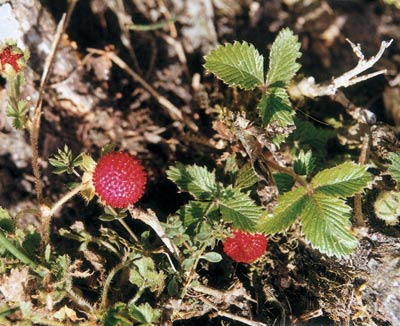
Masang. This is a low-growing bush, its branches covered with numerous red fruits, which at first glance, could be mistaken for red chilies. They occur singly or in small groups across the slopes of the Yarlung Tsangpo Great Canyon.
Nepal ivy. A rampant evergreen climber growing on dying trees up to a height of 8 meters, with clusters of yellowish-red fruits about the size of soya beans appearing among its luxuriant broad leaves. Some scientists say that, once introduced, it could be used as a decorative plant.
Yimobai. This gray colored plant is very special; if you touch one of its leaves with a finger, a white impression appears, hence the Chinese name, which means “turns white when touched.”
Wild pepper. Young wild pepper has reddish branches which are very fragile and break easily when twisted. It gives out a strong aroma of pepper.
Shida Gonglao (Mahonia fortunei). On the outer rim of the leaf are thorns, which hurt when touched. Its fruits are in plume containing seven pea-like fruits. They turn purple when mature, a little bitter and astringent. Its stems have a skin about one millimeter thick, which is springy, like that of the oak. The yellow wood inside has a wide range of uses in Chinese herbal medicine. Chinese physicians call it shida gonglao, meaning “ten merits,” because it is effective in invigorating blood circulation and treating diarrhea. It is also cultivated in gardens in South China, for example in Yangzhou, Jiangsu Province.
Moss. Moss is not a strange thing. It grows everywhere in cities and countryside in summer. But the moss in the Yarlung Tsangpo Great Canyon is different, it looks like green beard, more than a dozen centimeters long. It is fine and soft, hanging from the lower branches of big trees. A botanist on our team said, given the right temperature and humidity, the moss may grow as long as tassels.
Wild tung tree. It is flame-red, and so very conspicuous against the green sea of forests. Its fallen leaves are also fiery red.
Pseudo-lily. Its leaves are big, fat and bright green, so it looks very fresh and tender. The pseudo-lilies I saw were all growing in shady and wet places under big trees in forests. Some of them were a meter tall. Their roots look like the white bulbs of garlic.
Ormosia fir. This has a tall trunk with green branches and leaves. It produces ormosia, also called “love peas.” It is a precious and rare species.
Qingcijian (blue thorn plant). This is a shrub, with a number of long woody stems growing up from close to the ground. From the stems hang many purple or green fruits, which look like grapes or small hanging lanterns, the stems becoming beautiful curves under the weight of fruits. I bit one fruit open and found that it contained a large stone and that the juice had a bitter, astringent taste.
Xunzimu. This is a kind of creeping plant that spreads across cliff crevices and along the ground. Its stems spread like out-stretching arms, creating many beautiful shapes. It is suitable for use as a decorative plant, or for use in container landscapes.
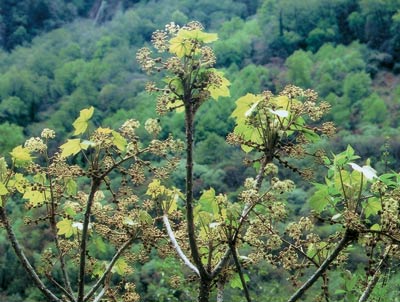
Congmu (Aralia chinensis L.). Belonging to the same family as ginseng, the congmu is widely distributed in the Yarlung Tsangpo Great Canyon, usually growing under evergreen leafy trees. It can grow up to six or seven meters high. Its stems and branches are covered with prickles. Its flowers are similar to those of the ginseng, possibly because they both belong to the family of slender acanthopanax (Acanthopanax gracilistylus).
Zhangliebainashen. Easy to find because of its big thick leaves.
There are also Chinese tulip trees, alpine oaks and others with special features already mentioned in the chapter “The Great Bend at Zachu and the Magnificent Rainbow Waterfalls”.
Also, the thick layer of humus in the primal forests is conducive to the growth of various kinds of fungi, among them the zhangzijun (River deer fungus), one of the three most pr
ecious and rare fungi in the world.
Songmu(Aralia chinensis)
Thistle