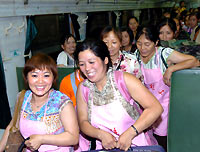
A group of 600 young rural women arrived in Beijing last night on a special train from southwest China's Sichuan Province.
They have come to the capital to find jobs as domestic workers, which have become indispensable for busy urbanites.
Their profession is perhaps one of the oldest, even though its popularity in mainland cities began to grow only 20 years ago.
In 1983 the Beijing Women's Federation set up the March 8 Domestic Service Centre - the first baomu placement agency in the city, if not in the country. Since then, domestic service agencies have sprung up in connection with neighborhood committees, some with the approval of the women's federation, others purely as profit-making businesses.
Today, some estimate about 220,000 young rural women work in Beijing in a domestic setting.
Feng Xiaoshuang, one of the few sociologists in China to have conducted research on domestic workers, observes that in the past having a maid bestowed status and privilege on the employer. Nowadays, for most, it is a matter of daily necessity.
A babysitter working in Beijing usually earns 400-1,000 yuan (US$48-120) a month, with most receiving 500-600 yuan (US$60-72). Part-time cleaners may charge 6 to 8 yuan an hour. But those who work for cleaning agencies may be paid just 3 or 4 yuan (36 US cents to 48 US cents) an hour, with their company providing food and accommodation.
Like rural migrant workers employed at factories and construction sites, most baomu fall into the most disadvantaged socio-economic groups in the city, and face discrimination and marginalization.
Legal matters
Domestic workers are inadequately protected by labor laws.
Li Tianguo, a senior research fellow at the Institute of Labor and Social Security, said: "Labor laws cannot cover domestic work. Labor laws pertain to the public arena; domestic service is provided in the private space of family and home. Matters covering employment terms, work conditions, rights and responsibilities can only be dealt with in the form of a contract."
As a result, "there is no uniform, standard formula for a contract. Individual domestic service agencies decide on the form of their contracts," Li says.
Over the years, the baomu industry has gone some way towards regulating the market. For instance, according to the Domestic Service Contract stipulated by the Beijing Domestic Service Association, domestic workers should be given no fewer than two days off each month, employers should allow no fewer than eight hours sleep a night and workers should receive extra payment if they are expected to work on public holidays.
But many argue it is up to the government to come up with legislation regarding working conditions, length of work, and the rights and responsibilities of both employers and employees.
For instance, who should pay to insure domestic workers?
"We can urge the employers to adhere to standards of working conditions and wages, and suggest that they buy insurance covering their employees' health and safety, but we have no legal power to force them to do so," says Zhang Xianmin, the general manager of the March 8 Domestic Service Centre.
The gulf between the terms and conditions set out in the contract and the actual workload and conditions can sometimes be huge.
Nannies are usually expected to sleep with the baby they look after. They usually have to get up a couple of times during the night to feed and care for the baby, or simply to soothe them when they cry.
Sleep or no sleep, they are still expected to work efficiently during the day.
Wang, a rural migrant from Shaanxi Province, has worked for a family that lives in a neighborhood of the Asian Games Village for two months, and she earns 500 yuan a month. She wishes her wages were higher, as her job - looking after a bedridden woman in her 90s - is very demanding.
But her biggest complaint is not the lack of money - it is the lack of freedom.
"I am practically house-bound 24 hours a day, seven days a week. Sometimes, I feel I am so depressed that I just have to get out.
"I ask my employers if I can go out and get some fresh air for an hour when everyone is napping. But my employers say that I need their permission to go out even though there is not much to do during that time. I feel they are being too strict with me."
Other forms of rights infringement include sexual harassment, which has not drawn due public attention.
Han Huimin, a social worker who dedicates her time to helping migrant workers by running the Women Migrants' Club, said: "Sexual harassment only hits the media when it is violent, extreme or sensational, but not an inconsiderable number of domestic workers, especially young women, experience sexual harassment of some kind from their male employers.
"Because it is not 'serious,' involving body groping or pinching here and there, domestic workers themselves do not want to tell for fear of losing their jobs."
"Cases such as these are also hard to prove, as it comes down to the employer's word against his maid," Han added.
Advocacy groups such as the Migrant Women's Club have played a crucial role in giving domestic workers a voice, providing legal aid, and giving financial and psychological support.
Established in 1996 by Xie Lihua, deputy editor-in-chief of the China Women's News, the Migrant Women's Club, an NGO, consists of a small handful of staff and volunteers and receives financial support from UNESCO and Oxfam Hong Kong.
Professional training
While these groups call for adequate legal protection of their rights, employers, on the other hand, complain about the chronic shortage of qualified skilled domestic workers.
About 85 percent of domestic workers in Beijing are employed to look after young children or the elderly. Only a third receive proper training prior to employment.
Most domestic workers have completed middle school education or below, are not used to the urban lifestyle and lack professional training opportunities upon their arrival in the city. These are the main factors behind the frequent complaints by their employers.
As supply cannot meet demand, the baomu industry, especially agencies which operate mainly as profit-making enterprises, are usually unwilling to spend money on training. Similarly, prospective domestic workers either cannot afford to or are reluctant to spend time and money on professional development, particularly since they may be able to get a job relatively easily without much experience or many skills.
But there is an initiative meeting this challenge head-on - Fuping Domestic Service School, Established three years ago by well-known economist Mao Yushi and Tang Min, Fuping involves the State, local and provincial governments, the market and individual shareholders like Mao and Tang themselves.
Its winning strategy lies in securing funding and organizational help from the local government through its State poverty reduction offices. Recognizing that rural women are invaluable in the fight to reduce poverty in agricultural provinces such as Anhui and Gansu, Fuping manages to persuade the local governments to fund women when they first come to Beijing.
These women receive a month's training at Fuping, which subsequently helps place them in a job.
"Fuping can't possibly help a large number of rural women alone. The real value of Fuping's experience is its reproducible model," says Stella Xing, the principal of school.
A month's training helps introduce rural domestic workers to urban family life, but it does not change prevailing stereotypes of migrant workers.
Many disputes between employers and baomu arise not necessarily due to their lack of training and housework skills, but because of employers' lack of willingness to empathize with their employees.
The rural-urban divide is so fundamental it can sometimes override individual differences between employers and their employees, argues Feng Xiaoshuang.
"The relationship between employers and employees must be understood in the context of this fundamental difference," Feng said.
Zhang Xianmin believes urban residents must change their attitudes towards domestic workers and domestic work as a profession.
"They must be willing to understand what life is like for their employees back home, patiently show them the ways of life in the city, and most importantly, they must realize that they are not being charitable in hiring a rural maid; they are dependent on the work of these women in order to live a comfortable life," Zhang said.
(China Daily July 21, 2005)