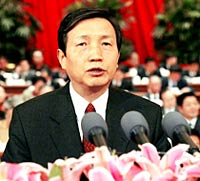
China stressed coordinated and sustainable economic and social development in setting main regulatory targets, and major tasks for economic and social development in 2004, the country's top legislature was told Saturday.
Ma Kai, minister in charge of the State Development and Reform Commission, made the remarks in his report to the legislature on the implementation of the 2003 Plan for National Economic and Social Development and on the 2004 Draft Plan for National Economic and Social Development.
In the year 2004, he said, "We must continue to put the people first and articulate and bring to fruition a conception of all-round, balanced and sustainable development."
"In line with the need to balance urban and rural development, balance development among regions, balance economic and social development, balance development of man and nature, and balance domestic development and opening wider to the outside world, we must shift the focus of our economic work onto restructuring the economy, changing the mode of economic growth, and improving its quality and efficiency."
He said China must nurture, guide and make good use of everyone's initiative in accelerating development so as to bring about sustained, rapid, balanced and sound development of the national economy and all-round social progress.
"Our main macro-control targets for 2004 are as follows: Economic growth rate around 7 percent. Nine million new jobs for urban residents and registered urban unemployment rate confined to 4.7 percent. Rise in the consumer price index of about 3 percent. Increase in total import and export volume of 8 percent.
Targets for China's economic and social development in 2004:
-- Economic growth rate: around 7 percent;
-- New jobs for 9 million urban residents;
-- Urban registered unemployment rate: 4.7 percent;
-- CPI growth rate: around 3 percent;
-- Foreign trade growth rate: 8 percent;
-- Growth of farmers' per-capita net income: 5 percent;
-- Grain output: 455 billion kilograms;
-- Issue of long-term treasury bonds: 110 billion yuan;
-- Total budgetary revenue: 2.357 trillion yuan;
-- Total budgetary expenditure: 2.6768 trillion yuan;
-- Central budget deficit: 319.8 billion yuan;
-- Natural population growth rate: within 7 per thousand; and
-- College enrollment: 4 million undergraduates, 330,000 postgraduate students
China to raise farmers' income, improve food security
China plans to raise farmers' income and improve grain production capacity this year through a number of initiatives to improve its food security, Ma Kai said.
China will continue carrying out strategic restructuring of agriculture and the rural economy and implementing a plan to arrange where crops are grown, so as to use cropland to the best geographical advantage, said the minister.
"We will strengthen the emergency animal epidemic prevention system, improve the system of quality standards and the system for inspecting and testing farm products, and implement the Action Plan for Pollution-Free Food."
The minister said China will promote the adjustment and transformation of township and village enterprises, selectively develop small towns, and strengthen intra-county economies.
Vocational training will be offered to rural laborers, and better information will be provided to guide the movement of surplus rural labor in an orderly way, he said.
"The problem of withholding or delaying payment of the wages of migrant rural workers in cities must be solved, and a mechanism to ensure the timely payment of such wages will be established and improved."
He said that pay for farmers will be included in the budgets for government-financed rural construction projects to ensure they are properly paid.
China will deepen the reform of rural taxes and administrative charges, reduce the rates for agricultural taxes and eliminate taxes on all special agricultural products except tobacco to effectively ease the burden on farmers, he said.
The government will continue to give people work in place of relief subsidies as part of the effort to improve the mechanism for alleviating rural poverty through development, said the minister.
He added that emergency disaster relief work must be done well, promising proper arrangements will be made for the work and daily lives of needy rural households.
He went on to say the acreage sown to grain must be expanded, and the country will make efforts to increase the yield per unit area and ensure that grain output totals 455 billion kilograms this year.
China will practice the most stringent possible system for protecting farmland, and will reform the way land is expropriated and the mechanism of compensating for its expropriation, he said.
"The transformation of farmland to non-agricultural purposes will be planned and managed strictly".
China will launch a project to industrialize production of high-quality grains, and establish a group of state production centers concentrated in major grain producing areas to produce high-quality and special grain crops, said the minister.
He said investment will be increased to develop improved crop strains, promote wider application of advanced agricultural techniques, prevent and control plant diseases and pests, improve irrigated areas, develop dry farming and water-saving irrigation, turn hillsides into terraced fields and build silt trappers.
"Improvement of low- and medium-yield farmland will be accelerated," he said.
Moreover, Ma said, major grain consumption areas will also be obligated to protect their primary farmland to maintain necessary grain production capacity and ensure adequate local grain reserves.
China to beef up human resources development in 2004
China will beef up human resources development this year through implementing the strategy of relying on talented personnel to strengthen the country, Ma said.
"The top priority for our work in education will continue to be rural education. We will lose no time in improving the mechanism for ensuring adequate funding for rural education to make it more regular and institutionalized."
He acknowledged that China will intensify its efforts to make nine-year compulsory education basically universal and to basically eliminate illiteracy among young and middle-aged people in the western region, he said.
"We will continue the project to renovate dangerous primary and secondary school buildings in rural areas and the national program to make compulsory education universally available in poverty-stricken areas."
Ma went on to say that China will work harder to develop high-quality universities and key disciplines and improve the quality of higher education, increase the number of key senior secondary schools and vigorously develop vocational education and continuing education.
Plans call for enrolling of 4 million undergraduate students and 330,000 graduate students in regular institutions of higher learning in 2004, the minister said.
China to create more jobs, expand consumer spending
China will in 2004 implement a proactive employment policy, and continue to expand consumer spending and improve people's lives, Ma Kai said.
"We will further implement existing measures such as fiscal and credit support and tax and fee cuts and exemptions and do everything possible to create more jobs."
The minister said China will give full play to the role of labor-intensive industries, small and medium-sized enterprises and non-public sectors of the economy in expanding employment.
China will vigorously develop the tertiary industry and expand avenues for employment in traditional service industries such as business, food and beverage service and transportation.
He promised to create more jobs in the areas of public health, urban environmental protection, medical care, as well as community and domestic services, and expand employment in tourism, education, training, culture, sports and information services.
China will promote diverse types of employment and encourage people to be flexible in taking a job or become self-employed. he added.
He noted that China will improve the employment service system, strengthen the reemployment assistance system and provide better job training, job introduction and employment guidance services to laid-off workers and the unemployed, and work harder at job placement for college graduates and ex-servicemen.
"We will improve the consumer environment, expand consumer spending and gradually increase the proportion of consumption in our GDP," he said.
He said China will improve the social assistance system, provide subsistence allowances to the urban poor and help needy urban families solve their practical problems, and increase the supply of low- and moderate-price commercial housing, stimulate the secondary housing market and expand consumer spending on housing.
China will steadily increase consumer spending on private cars and communications, and will encourage people to spend more on travel, sports, fitness and culture.
The minister said China will accelerate the development of the credit system and develop consumer credit, combine efforts to expand consumption with those to strengthen regulation of income distribution, and raise the minimum wage appropriately to increase the incomes of urban residents, especially low- and middle-income people.
China needs to strengthen supervision over income distribution in monopoly industries and intensify collection and management of individual income tax to regulate excessively high incomes, said the minister.
He said the central government will focus on increasing funding to solve the problems facing agriculture, rural areas and farmers and to support employment work, social security, education, science, culture and health. We must ensure that government employees' salaries and government retirees' pensions are paid on time and in full, and that state organs receive the funding necessary for their normal operations.
Ma noted that China will continue to have zero growth in our general expenditures as total national revenue in the budget for 2004 stands at 2.357 trillion yuan, and total expenditures are 2.6768 trillion yuan.
That keeps the central government budget deficit within 319.8 billion yuan, said the minister.
China to use treasury bonds in balancing development
China will adjust the orientation of investment using treasury bonds to make full use of their role in promoting restructuring and balancing development, Ma said.
"Premier Wen Jiabao pointed out in his Government Work Report yesterday that we would issue 110 billion yuan worth of long-term construction treasury bonds this year. We must manage and use them well in line with the resolutions of this session."
This year, he said, the focus of these funds will be shifted from the previous emphasis on expanding domestic demand and stimulating economic growth to promoting restructuring and balancing economic and social development.
They will be mainly used for the following:
-- To increase support for developing agriculture and rural areas by building more small and medium-sized infrastructure projects such as water-efficient irrigation facilities, potable water supplies, roads, methane production facilities, hydroelectric plants and pasture enclosure projects, so as to promote balanced urban and rural development, he said.
-- To place greater emphasis on developing social undertakings by investing more in infrastructure projects for public health and medical care, elementary education, primary-level governments, people's courts and public security, procuratorial and judicial organs, so as to promote balanced economic and social development;
-- To support development of the western region and adjustment and transformation of northeast China and other old industrial bases, so as to promote balanced regional development and;
-- To continue to improve ecological conservation and environmental protection, so as to promote balanced development between man and nature; and to build more key infrastructure projects, so as to create the conditions necessary for long-term, stable economic and social development.
Main development targets attained
At the beginning of his report, Ma said that China successfully attained main targets for economic and social development in 2003 with rapid economic growth.
The economy grew rapidly with its efficiency improved significantly, and China's GDP hit 11.6694 trillion yuan in 2003, a 9.1 percent increase over the previous year, said the minister.
Per capita gross domestic product rose to 9,030 yuan, exceeding the important benchmark of US$1,000 for the first time when calculated at the present exchange rate, he said.
The growth of domestic demand was accelerated as investment in fixed assets for the whole country was 5.5118 trillion yuan, a year-on-year rise of 26.7 percent, and that retail sales of consumer goods totaled 4.5842 trillion yuan, up 9.1 percent, he acknowledged. Consumer prices rose by 1.2 percent.
Economic efficiency improved in step with economic growth, and government revenue for the entire country was 2.17 trillion yuan, a rise of 14.7 percent more than the previous year, said Ma.
Economic efficiency in the industrial sector reached a record high. Total profits of state-owned and large non-state owned industrial enterprises were 815.2 billion yuan, an increase of 42.7 percent, 22 percentage points greater than the previous year.
State-owned enterprises and enterprises with the controlling stake held by the state generated 378.4 billion yuan in profits, an increase of 45.2 percent. Of the industrial products made last year, 98.1 percent were sold.
The minister said a number of projects of great importance for long-term economic and social development were completed and put into operation.
In 2003, he said, water was successfully stored in the Three Gorges Reservoir, and permanent ship locks on the Three Gorges Project were opened to navigation, and the project's first set of generators began producing power.
Construction was started on the eastern and central routes of the South-to-North Water Diversion Project. An additional 46,000 kilometers of highways and 1,164 kilometers of newly completed railway lines were opened to traffic. The power industry developed more quickly.
The country produced 1.9 trillion KWH of electricity in 2003, 15.5 percent more than in 2002, and the number of telephone subscribers reached 532 million, a year-on-year increase of 112 million, the minister said.
The minister acknowledged that new strides were made in developing the western region, and implementation of the strategy for reinvigorating northeast China and other old industrial bases began.
"Ecological conservation and environmental protection work in the western region was further intensified. Some 3.37 million hectares of farmland were returned to forests; 3.77 million hectares of barren hills and wasteland were afforested; and 6.66 million hectares of seriously degraded grassland were improved."
Greater efforts were put into infrastructure development, noted Ma. An additional 317 kilometers of track was laid on the Qinghai-Tibet railway line. The eastern section of the West-to-East Natural Gas Piping Project was completed, allowing natural gas to be delivered to east China.
An additional power transmission capacity of over 8 million KW was installed as part of the West-to-East Electricity Transmission Project, said the minister. Another 4,200 kilometers of highways connecting county seats were built or upgraded.
Progress in social undertakings
China recorded all-round development in science, technology, education and all other social undertakings as well as continued progress in ecological conservation and environmental protection, Ma said.
Basic and hi-tech research was intensified and continued progress was made in the state innovation system, said the minister, who singled out the successful launching of the Shenzhou-V spacecraft and its safe return to the earth last October as another milestone in China's hi-tech development.
Fresh progress was made in compulsory education. Regular institutions of higher learning across the country enrolled 3.822 million students, 617,000 more than the previous year, the minister said.
He said efforts to develop public health facilities were intensified, and about 6 billion yuan from the sale of treasury bonds was allocated to develop an anti-SARS infrastructure, disease prevention and control networks at the provincial, prefectural and county levels, and a public health emergency response system.
"Ecological conservation and environmental protection were intensified, and economical and multipurpose utilization of natural resources was promoted. Some 2.05 million hectares of forests were developed to improve ecological conditions or serve as shelterbelts."
Banning or temporarily suspending animal grazing allowed for 8.6 million hectares of grassland to be effectively protected and rationally utilized, he said.
"Pollution control and treatment were accelerated in key river valleys and regions, including the drainage basins of the Huaihe, Haihe and Liaohe rivers, Taihu, Chaohu and Dianchi lakes, and the Three Gorges Reservoir."
He went on to say that various reforms pressed ahead in an orderly manner, and China continued opening wider to the outside world. "Institutional restructuring of the State Council was completed smoothly, and steady progress was made in institutional restructuring of provincial-level governments."
Foreign trade grew rapidly, noted the minister. Imports and exports totaled US$851.2 billion, a year-on-year increase of 37.1 percent, and a total of US$53.5 billion in foreign direct investment was actually utilized.
A total of 8.59 million more urban residents found jobs, and 4.4 million laid-off workers were re-employed in 2003, and both figures exceeded the targets set for the year. The registered unemployment rate was 4.3 percent in cities and towns at the end of 2003.
The urban population had a per capita disposable income of 8,472 yuan, an increase of 9 percent in real terms, and the rural population had a per capita net income of 2,622 yuan, an increase of 4.3 percent in real terms.
Living allowances for laid-off workers and old-age pensions for retirees were basically paid on time and in full. Some 22.35 million urban residents received subsistence allowances, 1.7 million more than in 2002.
The government allocated special funds to help people in disaster-afflicted areas resume production and improve their living conditions, said the minister.
Difficulties, problems facing China
China is clearly aware that there are still many difficulties and problems in economic and social development which cannot be overlooked, Ma said.
"Some longstanding, deep-rooted problems have yet to be solved, and there are still structural barriers holding back economic and social development," he said.
Moreover, he added, there are new circumstances and problems affecting the operation of the economy.
Farmers have difficulty increasing their incomes and grain production has dropped considerably, as the increase in per capita net income for the rural population in 2003 was 0.5 percentage points lower than in 2002, he said.
The problem of indiscriminate expropriation of arable land is serious, and grain output for 2003 decreased by 26.4 billion kilograms year-on-year, said the minister.
The problem of unemployment remains serious as there were about14 million laid-off workers and unemployed people in cities and towns, and approximately 10 million new urban residents are expected to enter the labor force this year, he said.
In addition, large numbers of surplus rural laborers still need to shift to non-agricultural industries and urban areas.
He noted that there is a wide income gap among some members of society, and in both urban and rural areas many low-income people lead a fairly difficult life.
The minister said the country's economic structure is still irrational, and too much of its economic growth is based on extensive production, and the problems of haphazard investment and low-level, redundant expansion are worsening in some industries and localities, resulting in excess energy consumption, serious waste of resources and environmental pollution.
He added that economic and social development remains imbalanced in China as the public health service system is far from sound and the situation that rural education remains weak as a whole requires fundamental changes.
The order of the market economy, he noted, remains somewhat chaotic.
"We urgently need to improve the social credit system. Major industrial accidents occur frequently. We need to take a long-term perspective rooted in the present and solve these problems through reform and development," Ma said.
(Xinhua News Agency March 6, 2004)
|