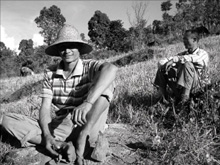
Laokai has been experiencing a kind of depression for the past two years.
In the daytime, more dogs roam the streets than pedestrians. Many shops are closed. In the few restaurants, barber shops, massage houses and groceries that are open, visitors are few and far between.
At night, the Myanmar town only several kilometres south of China seems to come to life. But this is mainly because the neon lights of the casinos are turned on and gamblers and prostitutes appear in the streets.
To many residents in Kokang, or the autonomous First Special Region of the northern Shan State of Myanmar, the slump of the regional seat is only a minor difficulty they are facing after giving up their traditional way of living -- cultivating opium.
To Chinese police in Lincang, it means both achievement and challenge.
It is their cross-border anti-drug co-operation with the authorities of Kokang that has ended the abnormal prosperity of the small town as one of the largest narcotics planting and distribution centres in the Golden Triangle. It spans the border areas of Myanmar, Laos, and Thailand, an area known for producing much of the world's narcotics supply.
But how to help the area inhabited by the Kokangs -- ethnically Han people -- move along a real sustainable road of development remains a challenge.
Opium-free region
At his huge, teak-decorated house on the outskirts of Laokai, Bai Suocheng, deputy commander of the United Kokang State Army, head of the anti-drug committee and the justice of the special region, spoke to China Daily. He said Kokang, with a population of about 140,000 and an area of more than 2,100 square kilometres, has a history of planting opium poppies of more than 160 years.
By 2002, 80 per cent of the local population were making a living growing poppies.
Bai said increasing pressure from home and abroad had led the local authorities to wean the area completely off the cultivation of opium.
In 1989, the Kokang territory was transformed into Myanmar's First Special Region, after the local authorities pledged allegiance to Myanmar's central government.
Before the traditional poppy-planting season -- July, August and September -- of 2002, 476 local officials and policemen were sent to villages scattered around the region's four administrative districts to publicize the decision, inspect and supervise the cultivation ban.
But more than 100 families still planted poppies, said Bai.
"I sent about 130 poppy farmers from these families to jail for education," he said. "They were freed three months later. But the season was already over."
In 2003, only 25 families were found to still be planting poppies. In 2004, not one family was caught.
In every opium season over the past three years, Bai said, they would invite Chinese police from Lincang for one or two inspection tours, which could last between three days and a week.
"Without their help and support, poppy cultivation can't be eliminated in Kokang," he said.
Alternative livelihoods
Back in Lincang, Wang Fangrong, deputy director of the Lincang Public Security Bureau, said that as Lincang shares a 290-kilometre border with Myanmar's First Special Region (Kokang) and Second Special Region (controlled by the ethnic Was), it is the real frontier of the country's war against drug trafficking.
In the 1990s, more than 1,300 hectares of poppies were planted in Kokang. Forty tons of opium were produced every year.
The booming crop and tons of high-quality heroin refined from it each year posed a major threat to China's anti-drug work. At its peak, Wang said, more than 80,000 Chinese nationals stayed in Kokang for business. "It was often narcotics-related."
In 1996, the government of Lincang decided to help its Myanmar neighbour to develop alternative livelihoods such as food processing so they could gradually give up the cultivation of opium.
At first, the Chinese helped farmers living on the plains around Laokai to plant more than 2,600 hectares of sugar cane. Then it built up a sugar refinery in Zhenkang, the county bordering Laokai, to process it. The local authorities began to move some families from cool, opium-rich hills to the plains.
Farmers were also encouraged to grow rubber, tea, teak, mangoes and lychees.
Between March and October 2003, the Lincang government spent 130,000 yuan (US$15,663) on providing Kokang with free seeds, fertilizers and training in agricultural technology. "We trained 500 ex-opium farmers and planted corn, paddies and dry rice on experimental plots in Kokang," Wang said. "They helped to promote the local agriculture."
In spring 2004, Myanmar farmers bought 10 tons of seeds from China, and Lincang made gifts of one ton of improved varieties of corn and 100 tons of chemical fertilizer.
Since 2002, Wang said, Chinese police have been invited to visit every year to learn the latest development of local work in eliminating poppy growing. "Kokang might still be a distribution centre of narcotics," he said. "But it isn't a production centre any more. There are only about 30,000 Chinese still staying in Kokang."
Difficulties of Kokang
The authorities are lauding the opium ban a success -- but there are still difficulties.
"The biggest problem is that we can't find any crop which can truly replace opium yet," said Bai Suocheng.
He said one kilogramme of opium poppies was worth about 3,000 yuan (US$361). It could bring an annual income of 2,000 yuan (US$241) per person to farmers who live in Kokang's high mountains. They can use the money to buy enough food for a whole year.
The other crops are so far giving farmers an annual income of about 500 yuan (US$60) per person. "This is not enough to cover their basic food needs," Bai said.
Poppies are faster growing and much easier to grow in such mountainous areas than many other plants.
In 2003, corn crops were hit by various plant diseases and insect pests, and there was a severe shortage of grain.
"Many families are short of half of the grain needed for the whole year," he said. "This is the biggest difficulty we have faced after banning the cultivation of poppies."
To 43-year-old Yang Taojin, a farmer living in Bamwai Village of Dongshan District, which is 15 kilometres south of Laokai, the situation is even worse.
Just finishing a day's work building a seven-kilometre road to connect the mountain village to the main road with dozens of fellow villagers, he said the poor harvest meant he could only maintain his eight-child family for five months.
"Before 2002, I planted opium poppies and had no difficulty in feeding the family," he said. "Now I have to go to Laokai and even China to find something to do, for example, farming and logging for others."
Lack of farming technology and water, he said, was a barricade to the local development of agriculture.
"We often have to walk 8 or 9 hours to get drinking water."
He is in fact hoping to resurrect his poppy growing. "At least this would give me enough money to buy rice," he said.
He said some families living in other villages moved to the No 2 special region to continue planting poppies.
"I have too many children and am too poor to move," he said.
International support
Opium farmers continuing their cultivation in places outside Kokang is just one of the problems of the past two years, said police officer Wang Fangrong.
He said nearly 500 families of about 3,000 Kokangs have moved to the second special region and other areas in the past two years.
After the ban, more than 2,000 poured into border towns in China to find work. Some of them now traffic drugs. Wang said the number of traffickers from Myanmar had obviously increased between January and July, compared with the same period of last year.
"Most of them are just farmers from Kokang," Wang says. "They're threatening our anti-drug war.
"All of these problems are also potential threats for Kokang's successful elimination of opium poppies."
Helping Kokang find a real sustainable road to development is probably the answer to solving these problems, he said.
"But it's impossible to make it with the efforts of only Lincang, Yunnan and even the country," said Wang. "It needs participation and support of the international community to clear away the source."
He said local authorities of the second special region have announced their intention to ban poppy cultivation in 2005.
"A successful Kokang will certainly be a fine example to give them confidence," he said.
(China Daily December 24, 2004)
|