| Tools: Save | Print | E-mail | Most Read |
| NGOs Should Play Bigger Role in China |
| Adjust font size: |
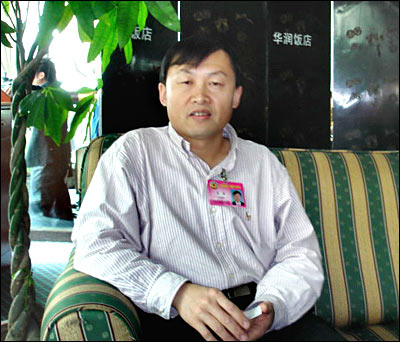
Wang Ming, associate dean of the School of Public Policy & Management and director of the NGO Research Center at Tsinghua University, made an appeal to the government on Wednesday to speed up legislation regulating the operation of non-governmental organizations (NGOs), enabling them to play a bigger role in the public service sectors and China's charity undertakings.
"NGOs play a very important role in the public service sector where government does not function effectively. They are an important part of poverty alleviation and environment protection." Wang is attending the ongoing Fourth Plenary Session of the 10th National Committee of the Chinese People's Political Consultative Conference (CPPCC), China's top advisory body, in Beijing. In an interview with china.org.cn on Wednesday, Wang said that research into NGOs in China began in the late 1990s. However, it's still difficult to determine just how many there are or how big they are because of inadequate legislation regulating their activities and registration. NGOs in China can be divided into three categories: First, overseas NGOs as well as those from Hong Kong and Macao. They started operating in China some time in the 1980s. Wang reckons there are about 10,000 of these in China, out of which 50 percent are engaged in poverty relief, environment protection, community development, public health, providing assistance to special interest groups, and disaster relief. Oxfam and HPI (Heifer Project International) are just two examples. The others are typically overseas chambers of commerce and industry guilds that came into China after it joined the World Trade Organization in 2001. They provide services to multi-national enterprises. The second category is foundations. Since the 1980s, China has carried out many non-profit projects including the Hope Project and some other large-scale poverty relief projects that relate directly to women, children and education. Such projects are typically sponsored by large foundations. As of the beginning of this year, there were approximately 1,070 foundations in operation in China. Charity federations also fall into this category. Although they are comparatively few in number, the funds they are able to generate are huge, raising about 3 billion yuan annually. The third category can be subdivided into several smaller categories. One is social groups that are registered with civil affairs departments above county level in accordance with the Regulations on Management of Social Groups issued by the Ministry of Civil Affairs (MCA). There are currently 153,000 registered social groups in China. The second sub-category consists of privately run non-enterprise units. They must be registered with civil affairs departments above county-level according to the Interim Regulation on the Management of Privately Run Non-Enterprise Units issued by the MCA in 1998. They are involved in a wide range of activities including medical, education, social welfare, culture and agricultural technology. "According to the regulation, those organizations should be non-profit. However, many of them don't operate as such in practice; many private schools and hospitals, for example. But in theory, they do still come under the definition of an NGO. What we need to do next is to regulate their activities within the NGO system." According to MCA statistics, there were 140,000 of such organizations as of the beginning of the year. "In addition, there are about 100,000 to 200,000 NGOs registered with the Industry and Commerce network nationwide. The reason is that the threshold for qualification as a social group and privately run non-enterprise unit or foundation is higher. Many organizations simply cannot qualify. This type of organization is mainly run out of the urban areas." The fourth type is the urban community organization. Such organizations are typically set up by a group of people who believe in a common cause or interest. Some are non-profit, some work on mutual assistance principles, and some are quite simply for pure entertainment, for example, folk dancing groups. "They don't usually have an organizational structure, but are still considered NGOs. We are currently doing some research in this area. We estimate there are perhaps 200,000 to 300,000 of such organizations all over the country." The fifth is rural grass-root organizations, which includes rural technology associations and agriculture technology organizations. "We estimate there may be around 170,000 to 180,000 of these." Wang's view is that the biggest problem with the development of NGOs is that China lacks related legislation. "We lack a unified and standardized legal framework. The majority of NGOs do not fall within our current legal system. Only one-tenth of them are acknowledged under current laws. Further, there are other issues that face NGOs such as limited resources, poor management and the lack of an aim or concrete plan of action. Moreover, many lack professional ability. "The value of funds potentially available to NGOs in China is not small, but the distribution of those funds is not ideal. Generally speaking, the overseas NGOs and the foundations all have guaranteed funds because of their influence, reputation and size, which leaves very little for those that are not as savvy or established." Wang and his team are trying to find ways to solve the problem. "We have been promoting the concept of social responsibility and charity among enterprises. We would like the private sector to invest not only in the big foundations, but to also consider the grassroots NGOs, which are actually a very effective and influential force in society. What we lack now is a system of construction and cooperation between enterprise and grassroots NGO. Last year, only 1 percent of China's 500 big enterprises took part in any charity activity. This is a very sad thing." Wang raised another fund-raising challenge for NGOs. How and why should anyone believe in them enough to part with their money? Wang had these suggestions: First of all, the NGOs need to promote themselves more actively. Second, their operations must be open and transparent to public inspection. Third, there must be supervision. The government is obliged to promote civil charity undertakings. This is why the government must develop regulations. There must be standards that have to be met, and a system of punishment if they are not. "But until such time, the NGOs have to institute self-discipline." (China.org.cn By staff reporter Wang Qian, March 10, 2006) |
| Tools: Save | Print | E-mail | Most Read |
 |
| Related Stories |
| Product Directory China Search |
Country Search Hot Buys |
